The Multiple Myeloma Channel is supported with funding from AbbVie (Platinum), Sanofi (Gold), Legend Biotech (Bronze), and through an educational grant from Alexion Pharma GmbH.
VJHemOnc is an independent medical education platform. Supporters, including channel supporters, have no influence over the production of content. The levels of sponsorship listed are reflective of the amount of funding given to support the channel.
iwMyeloma 2026 | Integration of clinical and translational research in myeloma: ongoing work of the MMRF
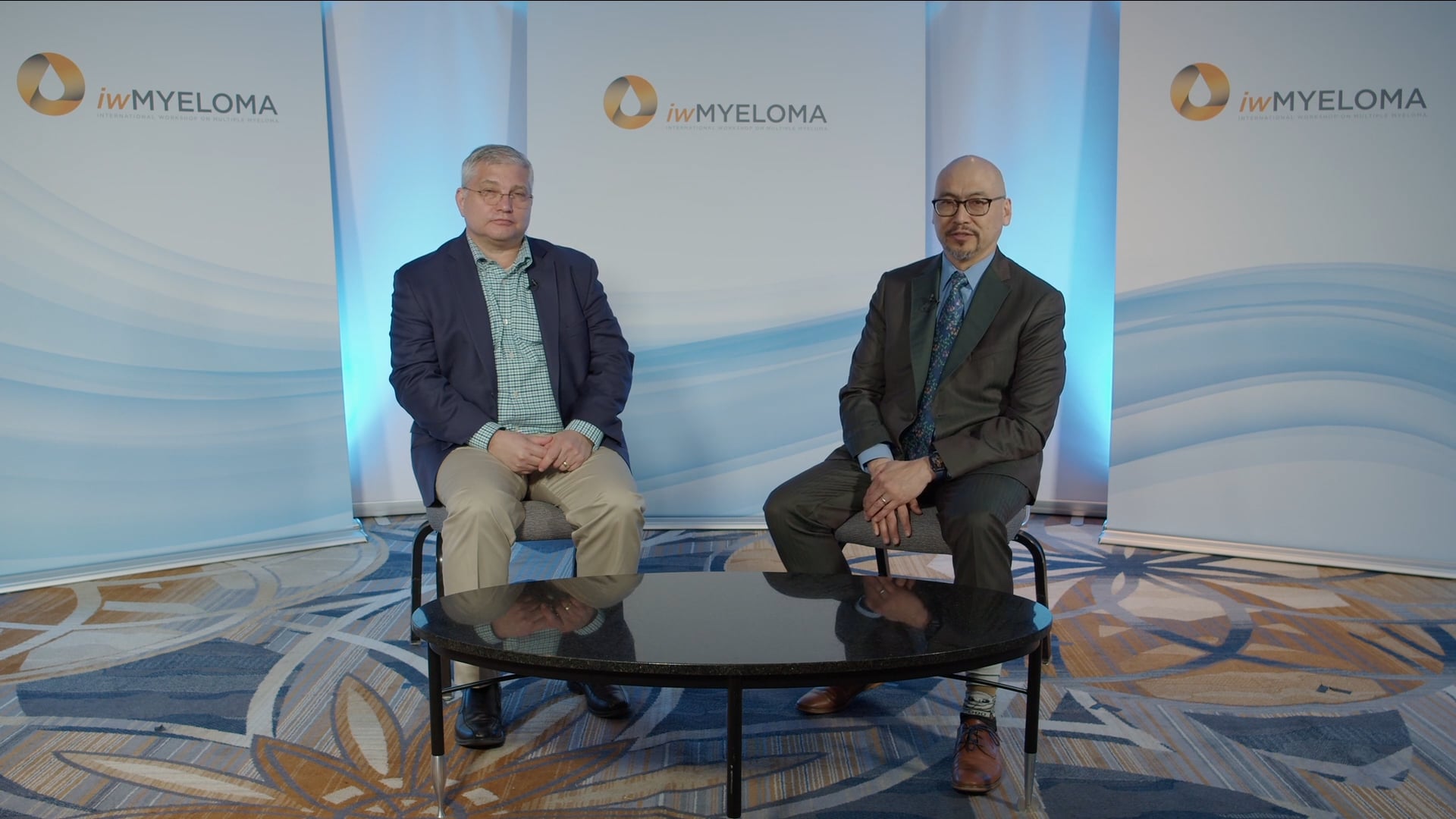
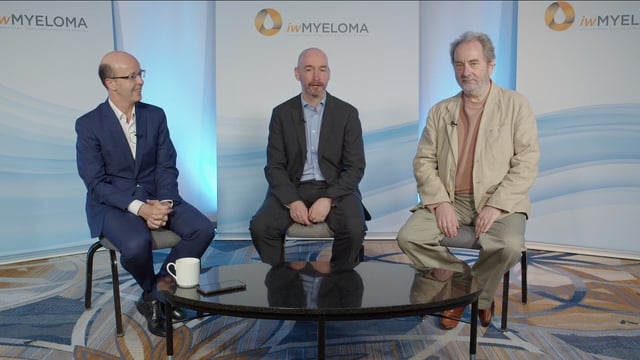
In this discussion, George Mulligan, PhD, Multiple Myeloma Research Foundation (MMRF), Norwalk, CT, is joined by Benjamin Derman, MD, University of Chicago, Chicago, IL, Robert Orlowski, MD, PhD, The University of Texas MD Anderson Cancer Center, Houston, TX, Hearn Jay Cho, MD, PhD, Mount Sinai Hospital, New York, NY, and Chaitanya Acharya, PhD, Multiple Myeloma Research Foundation, Norwalk, CT, to outline the ongoing research efforts of the MMRF. Dr Orlowski begins by discussing an analysis of molecular correlates of daratumumab use in relapsed/refractory (R/R) multiple myeloma, and Dr Acharya highlights findings from the Immune Atlas Project. Following this, Dr Derman and Dr Cho provide insight into the Horizon Two trial (NCT07053436), an adaptive platform trial designed to investigate innovative treatment approaches in patients with high-risk newly diagnosed myeloma. Throughout the discussion, Dr Mulligan emphasizes the foundation’s key goal of integrating clinical and translational research. This discussion was filmed at the 19th International Workshop on Multiple Myeloma (iwMyeloma), held in Miami, FL.
These works are owned by Magdalen Medical Publishing (MMP) and are protected by copyright laws and treaties around the world. All rights are reserved.
Transcript
George Mulligan:
Hi, everyone. Welcome. We’re here at the iwMyeloma meeting in Miami, 2026. And we just completed a session recapping some of the interesting ongoing research that is coordinated by the MMRF. And I’m here with a group of clinician scientists who’ve just gone through some really interesting stuff. So I’m George Mulligan at the MMRF...
George Mulligan:
Hi, everyone. Welcome. We’re here at the iwMyeloma meeting in Miami, 2026. And we just completed a session recapping some of the interesting ongoing research that is coordinated by the MMRF. And I’m here with a group of clinician scientists who’ve just gone through some really interesting stuff. So I’m George Mulligan at the MMRF. I’m the chief scientific officer there. And we’re joined by…
Benjamin Derman:
I’m Ben Derman. I’m the director of the myeloma program at the University of Chicago.
Robert Orlowski:
I’m Bob Orlowski at MD Anderson Cancer Center in Houston, Texas.
Hearn Jay Cho:
My name is Hearn Jay Cho. I’m the chief medical officer for the Multiple Myeloma Research Foundation.
Chaitanya Acharya:
I’m Chaitanya Acharya from the foundation as well.
George Mulligan:
Great. So in this session, we first recapped a couple of different translational stories covering some immune function and activity of daratumumab in multiple myeloma, and then transitioned to a discussion of how this can be implemented into clinical practice, and particularly in the setting of high-risk. So I’ll turn it over to some of my colleagues to share some of their presentations at this session, starting with Dr Orlowski.
Robert Orlowski:
Well, thank you very much. We were part of an analysis of patient samples comparing folks who got daratumumab, of course, an anti-CD38 antibody, versus patients who did not. And we found a couple of interesting differences, which included changes in NK, or natural killer cells, where it looked like a drop in those cell types, which are part of the immune response, was linked to exposure and potentially also response to Dara. And then there was a type of CD8-positive T-cell that has cytotoxic killing and is not exhausted, whose numbers were augmented as a result of Dara, and that could be an indicator of response. And beyond just telling us more about how Daratumumab works, I think the data will be interesting because if it can be validated, we can look for these changes early on in patients, and maybe for those who don’t have them, we can look either to switch away or to think about combinations with Dara to try to augment their response. So it would be a way to do response-adapted therapy as early as possible.
George Mulligan:
Thanks, Bob. Chuck, can you tell us a little bit about the research you described?
Chaitanya Acharya:
Absolutely. So I have the privilege of sharing some of the work that our Immune Atlas consortium has been working on. The interesting results particularly with respect to plasma cells that we’ve identified within the CD138-negative populations of immune cells. As we were trying to understand the impact of tumor microenvironment and the patient outcomes following standard of care therapies in CoMMpass data, we observed that plasma cells also play an important role, particularly when they’re communicating with immune cells. And we’ve identified a group of plasma cells that might be resistant to standard of care therapies. And we’ve also figured out a way to map how B-cells are creating a lineage going from naive B-cells all the way to plasma cells. So one of the questions we can be asking is that, when you find these resistant plasma clones in this good measure single-cell atlas, is there a way we can identify cell surface markers indicative of immune checkpoint, particularly PD-L1, LAG3 and TIGIT for which we already have therapies, particularly in solid tumor. Can we identify patients who are expressing these markers only to appropriately find these patients who don’t respond to immune agents that are being currently given. And is it possible for us to measure these checkpoints in these patients? These are the things that we have been asking of this data, and these are the things that we are trying to arrive at.
George Mulligan:
Great. Thank you, Chuck. So a good description of how certain translational work can inform clinical strategies, and that’s a key theme of our foundation, is that our consortium works fluidly between the translational space and the clinical space. So we’ve invited Dr Derman here to describe one of the most recent clinical trials that we’re setting up in the foundation.
Benjamin Derman:
Yeah, I was really excited to talk about the Horizon Two trial, which is an adaptive platform trial through the Multiple Myeloma Research Consortium. And really what we’re doing is focusing on this subset of myeloma that’s a really big unmet need right now, which is high-risk myeloma. And one of the things that we talked about was that high-risk myeloma really is this moving target right we have defined it differently as the years go on and more recently we had this consensus genomic staging or the CGS that came out through the International Myeloma Working Group and really what that is particularly helping us with is giving us at least some definitions to go on for for what are considered ultra high-risk myeloma and what our trial is really trying to do is create an enrichment trial to be able to give patients these bold innovative designs to be able to enroll into. So the first thing we had to do is come up with a control arm. And there actually was some really good consensus among all the investigators as far as what that control arm should be. In this case, it’s going to be isatuximab and KRD as part of induction with a stem cell transplant, followed by a consolidation piece and maintenance therapy. And then we’ve also layered in several investigational arms as time goes on, and the idea here is to really be able to adjust these platforms as we learn more about what is going to really be the most promising therapies. So one of the most promising right now is really in the age of BCMA-directed therapies, in particular, bispecific antibodies. And so our first investigation alarm that we’re going to be looking at is linvoseltamab with KRD. So really using the same KRD backbone that many of us are using in clinic right now for high-risk disease and adding in linvoseltamab. This is still going to be with transplant and then a maintenance strategy as well after that, including Linvoseltamab. So we’re really excited to get that going and we expect to be enrolling our first patient in May. So this is a very exciting and I think really is going to be able to put together a lot of the insights that the MMRF and the MMRC has garnered over the years.
George Mulligan:
Okay, thanks for that recap, Ben. Very interesting study, and I would only add that, again, the clinical includes translational. So these studies across all the arms will have uniform bio banking and subsequent correlatives to understand and again, deconvolute biological subtypes and understand where we’re seeing the most promising activity. So again, Dr Cho, maybe you could comment on how this is innovative in the face of prior studies or investigational initiated studies that tend to be single arm and elaborate.
Hearn Jay Cho:
Yeah. Horizon is an adaptive platform program. So there’s a master protocol which describes the patient population, in this case, high-risk newly diagnosed patients and a uniform set of inclusion exclusion criteria which we have intentionally designed to be as broad as possible as inclusive as possible so that we can enroll a truly representative US myeloma patient population. The patients who sign consent for the master protocol and are screened and enrolled in the trial will then be randomized to one of several arms: there’s either the control arm that Dr Derman described or one of several investigational arms that we foresee are going to go into the program. And it gives an opportunity to truly innovate and look for novel treatment strategies that are going to be more effective than the standard of care for these high-risk patients. And as you heard, Dr Orlowski and Dr Acharya describing translational research, which has given us a scientific basis to formulate novel treatment strategies, right? Using the discoveries from the laboratory where we have potential therapeutic interventions, putting them together in a novel platform, as Dr Derman described, and really innovating. And so we can test these in parallel, so it’s much more efficient. We can use smaller sample sizes because it’s randomized against control. And it’s going to be fast, we’re going to have evidence of improved efficacy within a few years of initiating the trial. And so we build in several efficiencies. We have speed. We have an outstanding network of clinical sites where we conduct these trials. So we are doing this to offer patients with high-risk myeloma the best possible options for treatment, either the best available standard of care or the best innovative new trial therapies to treat their disease. So it’s purpose built for that.
George Mulligan:
Thank you for that. And maybe I’ll ask you, Dr Orlowski, to elaborate on what you think maybe are the pros and cons of this or this opportunity at this moment in time in myeloma. At least for me, though, I tend to keep in mind for these adaptive studies, which are now increasingly common in oncology, when successful, these studies over time test not just two, three arms. Over time, they test up to a dozen or more. So this is an evergreen strategy, which will continue to evolve. But at this moment in time as we launch I’m curious how you view this platform.
Robert Orlowski:
Yeah absolutely first of all I would say for any patients that are out there they should have information available to them about their risk status especially if they’re newly diagnosed they should talk their physician. And if their physician is not a myeloma specialist, to consider getting a referral to somebody who is a myeloma specialist, whether it be part of the MMRF network or not, although probably there is a place near you where there is an MMRF network site. I think the reason to go after high-risk disease now is that those are still folks that don’t do well as well as we would like with our current therapies. And we’ve made some improvements over the years, but this is still a high-risk group. It’s important to understand the science because many trials that are available out there do not collect the samples the way that you folks are as part of this effort. And as our technology to interrogate myeloma and the microenvironment improves, it’s important to have those samples because you want to be able to understand what will happen in the future and improve upon those treatments. And I also think the fact that we can now use MRD as an endpoint is going to be important because we’re not going to have to wait 10 years to find out the results of these arms. We may have to only get one year or two years in and get an idea of what’s going on, which is really going to be powerful and will allow this effort to be very nimble, which is what we want.
George Mulligan:
Excellent. Yeah, I think that’s a great point around, again, one of the fundamentals of MMRF is to try to bring urgency to everything that we do. And so in this setting, when you have potentially rapid readouts around innovative designs we’re able to get to answers with our bio Pharma partners and with our patients who work with us and that’s really I think what each of us as researchers want in myeloma is faster answers and to test the many combination strategies that are out there. So we think it’s a very hopeful time for these sort of innovative studies, and we hope to be reporting out on the conclusions from some of these studies in the near future.
This transcript is AI-generated. While we strive for accuracy, please verify this copy with the video.
Read more...