The Multiple Myeloma Channel is supported with funding from AbbVie (Platinum), Sanofi (Gold), Legend Biotech (Bronze), and through an educational grant from Alexion Pharma GmbH.
VJHemOnc is an independent medical education platform. Supporters, including channel supporters, have no influence over the production of content. The levels of sponsorship listed are reflective of the amount of funding given to support the channel.
iwMyeloma 2026 | Expanding our understanding of the role of the tumor microenvironment in multiple myeloma
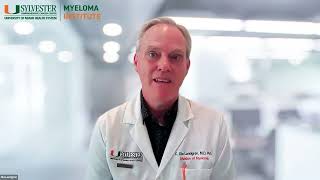
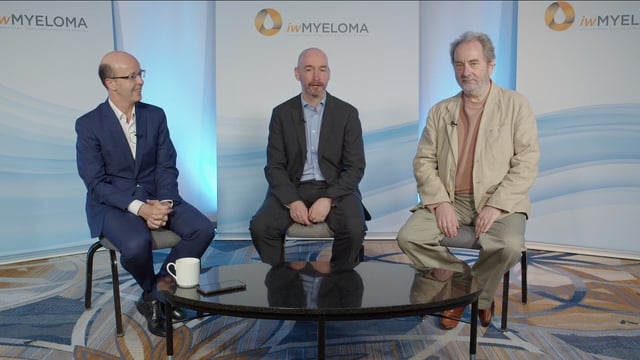
In this discussion, Ola Landgren, MD, PhD, Sylvester Comprehensive Cancer Center & University of Miami, Miami, FL, Gareth Morgan, MD, PhD, FRCP, FRCPath, NYU Langone Health, New York City, NY, and Robert Orlowski, MD, PhD, The University of Texas MD Anderson Cancer Center, Houston, TX, provide insights into the role of the tumor microenvironment (TME) in multiple myeloma (MM). The experts discuss the bidirectional relationship between myeloma cells and the TME, immune system monitoring in patients on maintenance therapy, and the use of machine learning to derive valuable information about the TME from hematoxylin and eosin (H&E)-stained slides. They finish by noting the potential to target and modulate the TME to prevent relapse or for primary prevention to reduce the risk of precursor conditions progressing to overt myeloma. This session was filmed at the 19th International Workshop on Multiple Myeloma (iwMyeloma), held in Miami, FL.
These works are owned by Magdalen Medical Publishing (MMP) and are protected by copyright laws and treaties around the world. All rights are reserved.
Transcript
Ola Landgren:
Hi, I’m Ola Landgren. I lead the myeloma program at the University of Miami. I’m here in Miami, Florida, together with my colleagues Gareth Morgan, who leads the myeloma program at the University of New York, and Dr Bob Orlowski, who is the leader for the myeloma program at MD Anderson. Gareth and I had a great pleasure today to chair a session where we had invited Bob as our keynote speaker at the iwMyeloma 2026 meeting to talk about the role of the tumor microenvironment...
Ola Landgren:
Hi, I’m Ola Landgren. I lead the myeloma program at the University of Miami. I’m here in Miami, Florida, together with my colleagues Gareth Morgan, who leads the myeloma program at the University of New York, and Dr Bob Orlowski, who is the leader for the myeloma program at MD Anderson. Gareth and I had a great pleasure today to chair a session where we had invited Bob as our keynote speaker at the iwMyeloma 2026 meeting to talk about the role of the tumor microenvironment. And the title of the talk was ‘Location, Location, Location for the tumor microenvironment in multiple myeloma’. Bob, you covered a lot of different perspectives all the way from precursor disease into newly diagnosed, after transplantation, in the relapsed setting, and also extramedullary disease. Can you give us some brief summary of what the key points were for your talk?
Robert Orlowski:
For sure, and thank you for inviting me to the meeting to talk about that topic. I thought ‘location, location, location’ was appropriate considering real estate is big in Miami. I think I would probably boil down the presentation to a few key take-home messages. Number one, we’ve always known that the microenvironment is very important and very complex in the myeloma setting. But with a lot of the single-cell technology and multi-omic techniques that we have now, I think we’re appreciating the level of complexity is probably even greater than certainly what I had expected. And that’s a wonderful opportunity from a scientific perspective to understand where things are going in the field. Another take-home message is that, definitely tumor cells influence the microenvironment and change the bone marrow and other sites in which the tumor cells are located to make it more favorable for their survival. The microenvironment can also influence tumor cells. A lot of times that’s in a positive way, meaning that they have an anti-cancer effect, but sometimes that can also be in a way to promote cancer cells. And another take-home message is I think that we’re seeing some data now that incorporating some of these immune measures can actually improve our ability to predict patient outcomes, which is really good evidence that these tumor immune signatures are important. And then finally, we’re beginning to understand some of the pathways involved, and that could get us to a point where we can do more than just identify what’s a bad environment versus a good one, but potentially change a bad one to a good one, which could help to improve patient outcomes. And I think is important as part of hopefully ultimately curing myeloma.
Ola Landgren:
Thank you so much for giving us that summary. You covered a lot of bases during your talk. I think you had almost 100 slides. It was a very, very comprehensive presentation. So Gareth, one of the themes during the presentation was all the work that the Multiple Myeloma Research Foundation had done with the immune atlas work, which is a very, very important step forward, trying to characterize the immune system in relation to different subtypes of disease. Could you just give a brief update on that?
Gareth Morgan:
So, it’s a very complicated and comprehensive analysis, which has used multi-parameter flow and single-cell analysis to describe the complexity of both the T-cells and the non-immune microenvironment. The issue is that I try to understand it and actually it’s very, very difficult because there are multiple different cellular populations within the marrow, they have different impacts. You could look at T-cells, the myeloid compartment, and it all becomes too complex for me, at least. And so one of the key take-home messages I got from Bob’s talk was this idea of simplifying the whole field into a number of distinct ecosystems, and I don’t know how many he described, but what you can think of is the myeloma cell goes to the marrow, it starts conducting the microenvironment, they co-evolve in a codependent way, and it sets up, say, five different types of ecosystems, some less aggressive than others. And what he’s seeking to do is to simplify this whole process into something that’s clinically useful, and if you can do that, then you can predict prognosis in individual patients based upon their genetics of their tumor cells and the microenvironment they sit in because that’s really what we want to do.
Ola Landgren:
I agree with that. Bob, one thing that we did not really talk about during your presentation but I’m thinking of right now is the role of tracking the immune system in patients that are on maintenance therapy. We actually did a study that was also funded by the Multiple Myeloma Research Foundation as part of the Immune Network Grant. Multiple institutions were part of that. Dr David Coffey was the lead author, and it was published just a couple of years ago. In that study, patients could be treated with combination therapy of different kinds, be put on maintenance, and they were MRD negative. And patients that had a sustained MRD negativity was found in this study to actually have a normalization of the immune system, while patients that eventually lost their MRD status and became MRD positive, they had a shifted immune system compared to healthy individuals. The question I always was wondering is, which came first, the hen or the egg? Was it that the cells started coming back and then shifted the immune system? Or was the shift of the immune system letting the tumor to come back? What is your thinking about these types of questions?
Robert Orlowski:
Yeah, and I think I agree it was a very good study. I had a couple of slides on it, although I didn’t get to spend quite as much time on it as I would like. I would say that you have to have a tumor cell there for the microenvironment to change, because it wouldn’t do that on its own. So I think that it probably starts with the tumor cell if you want to do the chicken and egg, which we kind of jokingly discussed there. Because without the tumor cell to influence the microenvironment, the microenvironment by itself cannot generate a tumor. But it probably doesn’t take much in the way of tumor bulk to begin to remodel the neighborhood, if you will, to make it more favorable for the myeloma cell and to accelerate the rate of progression to a faster pace than it would be otherwise. So I do think that looking at the immune microenvironment is important. We’re hoping to do that in the context of the DRAMMATIC study, which is a trial ongoing now through SWOG looking at LEN versus LEN-DARA as a maintenance, and we’re going to have a large cohort of samples from there that will be banked and that we can hopefully analyze. I would like to put in a plug because this was actually a point made by one of the earlier speakers about how important it is to invest in tissue banking because our technology to analyze these systems is only going to grow and we absolutely need to have those samples available to be able to look at. So if folks are doing investigator initiated or industry sponsored, I think it’s incumbent on all of us to try to advocate in favor of doing all of these studies. And I did also want to give you a shout-out since you mentioned some of your data looking just at the H&E slides and the potential that scanning those could give you important information because that would be really a cost-effective and very widely applicable approach if it could be validated.
Ola Landgren:
Thank you. What I mentioned very briefly was we have scanned a couple of thousands of slides just stained with H&E and we have turned the pictures into regression models. We have analyzed those with machine learning algorithms that we have built in-house. And then we have asked, we have first trained the computer model to say, this is a 4;14 translocation, this is an 11;14 translocation, this is a 17p deletion, et cetera, et cetera. And after we have trained the model with very many cases, we then show a new case and say, what is this? And the computer can be over 90% accurate, saying this is what it is. But then the next question we have asked is, how did you know that? And the assumption was that it looked in the tumor cells, and in many cases it does, but then you can color code where the computer in particular looks. And now we have found that it looks in the microenvironment and it has added a dimension to see where, and you can see that the proximity varies from case to case. So there is a spatial component, so it doesn’t seem that the immune system is the same throughout the marrow. It could be different. And I think that can help us and guide where to biopsy and do more sophisticated molecular tests. So Gareth, I want to come back and ask one last question before we wrap up. So, I asked Bob what came first, hen or the egg, and I think for the maintenance, he said that he thinks it’s a tumor cell. I think so too, although I don’t have the proof. I don’t think you have either, Bob, but that’s what we think. But whether the tumor is the first or if it’s the other way around, if there was a way to boost the immune system as a way to sort of hold back the relapse, whether you treat it or you prevent it from going wrong, do you think that’s a likely future direction to boost the immune system?
Gareth Morgan:
I do, actually. And the way I would express it is it’s been very difficult to predict who is going to relapse. It’s kind of stochastic, so random. And that tends to suggest that sort of quiescent cells within the microenvironment and probably in the context of non-hemopoietic nurse cells, which keep these cells sleeping and invisible to treatment, just exist, and then random features lead to their activation. And so if we’re to prevent late relapse, now we’re sort of getting to 100% MRD negativity and the potential for cure, we need to use the microenvironment to deal with these cells that give rise to late relapse, say at 10, 13 years and beyond. And actually the stuff we’ve learned in this meeting about the combination of immunotherapies and the deep responses they give leads me to think that a lot of what we’re doing now is going to change and we have to focus on that change in these new regimens to learn how to truly cure patients.
Ola Landgren:
So preventing relapse is that what you’re thinking?
Gareth Morgan:
Absolutely and so that’s what the immune system does. And if you can do that, then you can prevent MGUS turning to myeloma and smoldering myeloma turning to myeloma. And so if we could get into a world of primary prevention, patients would never get myeloma to start with. And so that really is the future of what we’re all trying to do.
Ola Landgren:
I couldn’t agree more. Bob, do you want to say one last thing?
Robert Orlowski:
Well, I think another example is we can now check MRD down to 10 to the minus fifth. You and your team were key in making that become a regulatory endpoint. We can get down to 10 to the minus six, and people are even talking about 10 to the minus seven. But even at 10 to the minus 6, we know that some of those patients are going to relapse. Some of them are hopefully cured, but I do still think that even in MRD negativity, there’s a role for modulation of the immune system to get rid of some of these persister cells, to use another term that’s popular that Gareth is talking about.
Ola Landgren:
And the fact that we can use the immune system in CAR T-cells, we can use the immune system in a T-cell directed therapies, if we could not do that, but just boost the immune system in the body and that could do the job to prevent the relapse. That’s sort of what we are talking about.
Robert Orlowski:
Absolutely.
Ola Landgren:
Very, very interesting perspective. Thank you both of you. Excellent discussion.
Robert and Gareth:
Thank you.
This transcript is AI-generated. While we strive for accuracy, please verify this copy with the video.
Read more...