The Community Focus Channel is supported with funding from Johnson & Johnson (Gold).
VJHemOnc is an independent medical education platform. Supporters, including channel supporters, have no influence over the production of content. The levels of sponsorship listed are reflective of the amount of funding given to support the channel.
iwAL 2026 | Emerging immunotherapy strategies in AML: CAR-T, NK cells and T-cell engagers
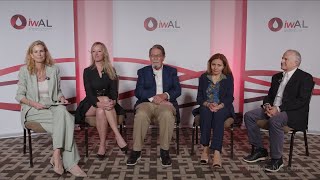
In this roundtable discussion, Pinkal Desai, MD, MPH, Weill Cornell Medicine, New York, NY, David Sallman, MD, Moffitt Cancer Center, Tampa, FL, Marion Subklewe, MD, Ludwig Maximilians University of Munich, Munich, Germany, and Stephen Strickland, MD, SCRI at TriStar Bone Marrow Transplant, Nashville, TN, share insights into emerging immunotherapeutic approaches in acute myeloid leukemia (AML). The panel discusses T-cell engagers targeting FLT3, allogeneic CAR T-cell approaches targeting CD123, and dual-targeted allogeneic NK-cell therapy targeting CD33 and FLT3. They also explore strategies for moving these therapies into earlier lines of treatment, the role of measurable residual disease (MRD), and the challenges of treating high-risk patients, including those with TP53-mutated AML. This panel discussion took place at the 8th International Workshop on Acute Leukemias (iwAL 2026), held in Boston, MA.
These works are owned by Magdalen Medical Publishing (MMP) and are protected by copyright laws and treaties around the world. All rights are reserved.
Transcript
Pinkal Desai
Hello here. we are at iwAL 2026 and we have a fantastic session on immunotherapies for AML. I am Pinkal Desai from Weill Cornell Medicine, and I have the great pleasure of being joined by a panel who who have talked a lot about immunotherapies today and I would like them to introduce themselves and we can have a fantastic discussion.
David Sallman
Sure, I’m David Sallman from Moffitt Cancer Center in Tampa, Florida...
Pinkal Desai
Hello here. we are at iwAL 2026 and we have a fantastic session on immunotherapies for AML. I am Pinkal Desai from Weill Cornell Medicine, and I have the great pleasure of being joined by a panel who who have talked a lot about immunotherapies today and I would like them to introduce themselves and we can have a fantastic discussion.
David Sallman
Sure, I’m David Sallman from Moffitt Cancer Center in Tampa, Florida.
Marion Subklewe
Marion Subklewe from the LMU in Munich, Germany.
Stephen Strickland
I’m Stephen Strickland at Sarah Cannon Research Institute in Nashville, Tennessee.
Pinkal Desai
So maybe start, wait, so there are two forms of immunotherapies. You know, we can basically divide this, right? CAR T-based and non-CAR T-based. So maybe we can start with David talking about, you know, T-cell engagers, you know, what are the data you presented, just a quick spiel of where these agents are.
David Sallman
Yeah, so was excited to present on really two new targets. One was the FLT3 receptor, and one is a brand new target called cathepsin G. Really, focus was mostly on the FLT3 target. This is with a company called Cullinan, which makes an agent CLN-049. And so again, this has taken a long time, but we had our first oral presentation at ASH of 2025. We look forward to presenting some updates in ASH of 2026. But again, we have a very safe agent, low rates of CRS being the main toxicity.
But I think exciting in a heavily relapsed/refractory patient population and patients had received up to eight lines of therapy. We are having CR/CRh in the 20 to 30%. And these are durable responses with full hematologic recovery with patients having responses past four months. And although we’re not sort of the home run in lymphoma, myeloma, we’re finally seeing reproducible activity. So I think the exciting part about where we’re at is we are now in expansion. And so we’re going to have.
cohorts both for TP53-mutant, because we saw a really encouraging signal in this group of patients that does extremely poor, as well as wild-type cohorts. And I think if we can sort of recapitulate the same data, we should be able to go for a single-arm sort of expanded registrational study. And I think if we can get our first therapy approved, then we can really start, I think, a lot of the fun science where’s the optimal point to use these therapies? I think aligned with that.
We’re gonna have a separate frontline protocol that should open by early 2027 of CLN-049 with AZA-VEN. And a lot of this is based on work from from Marion that’s quite exciting, where we can have other therapies that can not only augment the sort of T-cell engager activity, but may be good for depleting the blasts, may help for sort of blast burden, may sort of have other sort of synergistic abilities. And so I think that sort of trial and finally getting a
And immunotherapy in the frontline setting is is is extremely exciting.
Pinkal Desai
Completely agree. And I think that this is where it’s going towards, right? We these kind of especially the non-CAR T-cell engagers, their role seemed to be better suited for sort of the frontline setting, where maybe the exhaustion is not so much there. We don’t have a very heavily pretreated population. Now, compared to that, you know, you know, the the the CAR T approaches have always you know, not panned out as well as we would have hoped for for like in ALL. But theoretically,
you know, if we get the right target and we don’t hit the target that we don’t wanna hit, that and it’s an off-the-shelf product, that’s where CAR T would be very helpful. So we have two very good talks here. So Marion, why don’t you start with with yours and tell us all about it? Yeah.
Marion Subklewe
I was really happy to present the AvenCell trial, which is an allogeneic CAR T-cell product directed against CD123 applied in relapsed/refractory AML patients, and I think it addresses some of the challenges and resistances we’ve seen so far in previous CAR T-cell trials. So, first of all, one issue is always the targeting of myeloid lineage antigens. So we have severe hematotoxicity, expected on-target, off-leukemia toxicity. So
So far, most of the CAR T-cell trials have consolidated CAR T-cell therapy with an allogeneic stem cell transplantation to overcome hematotoxicity. And in this approach of the clinical trial from AvenCell, we have not a conventional CAR T-cell, but we have a generic CAR T-cell recognizing a protein that is not physiologically expressed, and then we have a small adapter or targeting module that is providing the specificity. So you
do the lymphodepletion, give the CAR T cells, and then the targeting module is given as a continuous infusion. It’s very small. It has a half-life of less than two hours. So it also integrates a safety switch. We can sort of turn on and off these CAR T cells. And thereby also preventing severe hematotoxicity. That has also been shown in this clinical trial where 17 patients have been treated.
And CRS, ICANS and also cytopenias were sort of very manageable. CRS, ICANS only grade one and two all reversible and there was no severe cytopenia. So this is a promising approach in that sense. And also second, one of the challenges in CAR T cells is T-cell exhaustion that is also evolving through the continuous sort of exposure to target antigens of the myeloid lineage and with this
intermittent application of the targeting module. You can also give the T cells sort of a resting phase. And I would say first of all these T cells come from a healthy donor. We have an allogeneic product. So that is sort of a benefit. And then we can also stop the infusion and give them some resting phase to increase efficacy. And I think what’s really exciting if you look at the biomarker program, they saw
a very good CAR T-cell expansion. If you compare it to CD19 CAR T cells like liso-cel was even higher. And if you look at previous data in all other CAR T-cell trials, this was less the case. So I think very promising efficacy in the CAR T-cell expansion. And clearly difficult to say from the efficacy side. So 17 patients were treated, heavily pretreated with four prior treatment lines, 10 already were allogeneic stem cell transplant.
prior to this and in the eight patients in the higher dose levels, they saw almost half of them in the CR/CRi, also with MRD-negative responses. So I’m really happy that they’re expanding their cohorts and another twenty patients will be treated.
Pinkal Desai
So a similar approach, another off-the-shelf product but slightly different. So Steve, can you tell us a little bit about SENTI?
Stephen Strickland
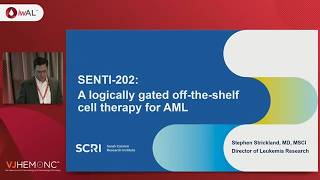
Sure. Yeah, no, I was excited to be able to share the the SENTI-202 data with this group and and to have the discussion that we had. But it is a unique product because an NK-cell therapy as opposed to a T-cell therapy, it is allogeneic. So again, the advantage of being able to collect from a healthy donor, be able to have that product ready and waiting when the patient in need presents. the the target’s a dual-targeted approach, targeting both CD33, which we know is commonly expressed on leukemic blasts.
As well as targeting FLT3 expression, which can be on leukemic stem cells. So trying to to do a a one-two punch, if you will. Now, we also know that some of the CD33-targeted approaches in the past have been met with significant myelosuppression and maybe off-target toxicity, targeting the normal, healthy cells, if you will. And and so this has a logic-gating approach. And so trying to target the bad cells while sparing the good cells with meaning good cells will express endomucin. And so if the
cell expresses endomucin but also CD33, this product doesn’t seem to attack the normal healthy cell. And so being able to deliver the cell therapy product, hopefully have that activity, be able to give multiple doses of this product as well. It’s not a one-cell infusion and you’re done, but being able to safely give repetitive doses again over time, be able to to hopefully have better activity. So we’ve been very encouraged with the results so far.
again in a fairly heavily pretreated population, some of which have been primary refractory to therapy, seeing CRs and CRhs and good deep responses. And all of the CRs that we experienced, the true CRs, were all MRD-negative. And so some of these patients have gone on to stem cell transplant, and we’re seeing nice durability of these remissions that these patients have had too. So very excited overall about the product, about the dual-target approach.
the the off-the-shelf capability and and rapidity with which we can make this available to patients.
Pinkal Desai
So so fantastic I mean approaches to immunotherapy. So I’m gonna maybe ask a question to you two and then you separately, you know, how do we move these to actually help patients in the clinic, right? So if you’re thinking CAR T-cell therapies, you have one approach where you have an adapter molecule that can maybe you know, stop your toxicity or you you know, you can control someone and another way of saying that
with the SENTI data that it just doesn’t hit the you know the normal hematopoietic tissue. So if we are to give these repeated doses, do we know when is when do you other than toxicity, but for actual disease, do we know when to switch off or switch on? We don’t agree upon MRD. When is disease left? So if something’s coming up, do we then turn it on and then let it go? Like what is what how would we go about it in the future?
Marion Subklewe
So I think one important thing is, I mean, these are phase one trials. So if safety and feasibility is shown, it’s justified to move into much earlier treatment lines. And I think it will increase efficacy tremendously. I mean, at least in Europe, the only approved drug in relapsed/refractory is gilteritinib, but nothing else. So I don’t I think it’s a challenge that we only use this after four prior treatment lines, right? So it’s not answering completely your question, but I just want to make the point. I think it would be really important to treat
first relapse and much earlier and I think it will help us increase efficacy. And the question how many cycles, when we are able to stop, currently I think cannot be answered. I think if we have good responses, that is something we’ll we are happy about, and all the other stuff we’ll we’ll have to see, I think cannot be answered.
David Sallman
Yeah, I think the the the challenge is is that you we we say this and so we’re partnered with companies. We know with that we have to get through the relapse part to then do this, and then we don’t see a hundred percent response rate in eighth-line therapy and then they they close the trial. I mean, even to the point we had we you know, there’s CLEC12A, CLL-1 CAR, you know, you know, with a company. we actually had a parallel cohort that would open for MRD-positive at one dose level below. But still, because the first cohort didn’t, we actually I think
we were never we enrolled one patient on that other cohort. So I think we we say all these things, but we finally need to get to the point of actually testing it and not abandoning it because it didn’t work when we said it probably won’t work as well.
Pinkal Desai
one of the bane of I think immunotherapy trials have been and this is particularly true for T-cell engagers is that we see a response in the early on cohorts, you know, similar ranges like thirty percent. and then we expand it and then the results don’t hold true. Now i you know, the i in phase one studies, any AML study you have the drug, then you have the AML heterogeneity and for the engagers you have the third wild card which is
you know, the immune system. something that we cannot quantify. And we are still following like these three plus three designs of smaller without really quantifying who is going into these trials. so how do we do do we do more patients early on? How are we making sure that these are not gonna the responses hold up because we’re not, you know, rigging the the trials with the wrong kind of patients.
David Sallman
I think a difficult question ’cause there are always gonna be small numbers. I I do like, you know, so for example, like where we at with the CLN-049, right? We’re gonna actually have that expansion. We are thinking about at least the TP53-mutant, which it versus not, which is a which is a question that’s impacting many studies across the portfolio. And then again, I think we’re going into it with some thoughts. Less lines, less blast burden. And then we’ll see. I think again, can we then say, Hey, this is our signal and then very clearly go forward with the pivot. So I think things like that that are actually very
basic are probably the answer to to help address your question. But I think that heterogeneity is always there. I do think it’s less in frontline to just to some extent, although we still need to think about molecular subsets. but hopefully doing that. I think at the same time, like MRD is just rapidly, rapidly, rapidly expanding. I mean there’s a lot of different technologies. We’re gonna get down to one in a million maybe for most, you know, subsets. So I think that would make people a bigger believer. Hey, small randomized cohort, you do your combination and you
double or triple the one in a million, then everybody’s gonna say this is the best therapy ever. And then that’s gonna make people believe that you can then see some sort of event-driven endpoint. I think right now is when you’re not seeing as much activity, it’s it’s hard to to believe that. But hopefully with MRD being incorporated, and it still needs to be better incorporated than what we’re doing in many of these studies, then that will be, I think like with with Steve’s trial, I think that could be a very compelling part if they can show, because people are gonna say, hey, these patients went to transplant day sixty. But if he says, hey, well yeah, but you know, down to one in
however many cells they’re stone-cold negative, then we’re all very excited, especially in adverse population.
Pinkal Desai
So perhaps one controversial commercial question is right now they’re all being tested in the relapsed/refractory setting because that’s where we are starting. we know that once they achieve response with immunotherapies, we’re still mostly transplanting them at this point if they’re transplantable. And at that same time at the same way, we have biallelic TP53s where transplants have are not working. So in the in the relapse setting right now for all these trials.
Would you actually exclude the biallelic TP53 patients so that we can move these trials further ahead and not to go with you know, responses that don’t seem durable?
Stephen Strickland
It’s always a provocative question, right? I mean, I I think all of us for the virtue of the trial, we want to exclude the TP53 patients. But obviously we have those patients in front of us and those are the patients who we’re getting more and more of, right? And and that are being referred who are desperately in need of something. So I I wouldn’t restrict these trials to TP53 patients, you know, until we have a really clear, overwhelming signal. But I I think we may need a limit.
the the number of TP53 patients that are entered into these trials so that it doesn’t become just a TP53 study because we’ve seen over decades and decades of attempt that that unfortunately we haven’t made that headway. I think we need to look for a signal in those patients. We shouldn’t make it only a TP53 trial, but we also shouldn’t totally restrict. I think there’s got to be some balance to try and find something there, offering something to these patients in need, but but really balancing it.
Marion Subklewe
But I would sort of turn it around. I think we can identify super high-risk patients like TP53, complex karyotype, although persistent MRD or MRD conversion. And I would say it’s even justified if you show a safety to use these approaches in first line, right? So we don’t even have to wait for relapsed/refractory, but particularly include these patients on a first-line basis.
Stephen Strickland
And and and I would just say we’re, you know, hoping to do that. I think this signal of seeing in relapsed/refractory and then showing a therapy that can, you know, harnessing the power of the immune system if you go, whether it bispecifics or cell therapy, and getting that earlier, combining it with the frontline therapy to try to improve the efficacy, deepen the remission. Hopefully we’re gonna be able to to turn less patients to transplant out of necessity, right? That’s the goal. And but I think we gotta get deeper remissions. We’re gonna be sending many of these high-risk patients to transplant.
But but over time hopefully we can steer less patients there.
Marion Subklewe
And even with transplants, they need a better sort of pre-treatment, right? I mean the relapse rate from TP53 of the transplant and so on. I mean, some centers don’t even do the transplant in this scenario, right? I think it would be really where I would want to see a new therapy, right? In first-line high-risk patients.
Pinkal Desai
Yeah, agreed totally. This these are really great approaches, bispecifics, CAR T, frontline, second line, prior to transplant, post-transplant for MRD eradication. I think this has been a fantastic session and I thank you all for joining us.
Read more...