iwCAR-T 2026 | Cellular therapy approaches in AML: novel targets, off-the-shelf CARs, & NK-cell therapy
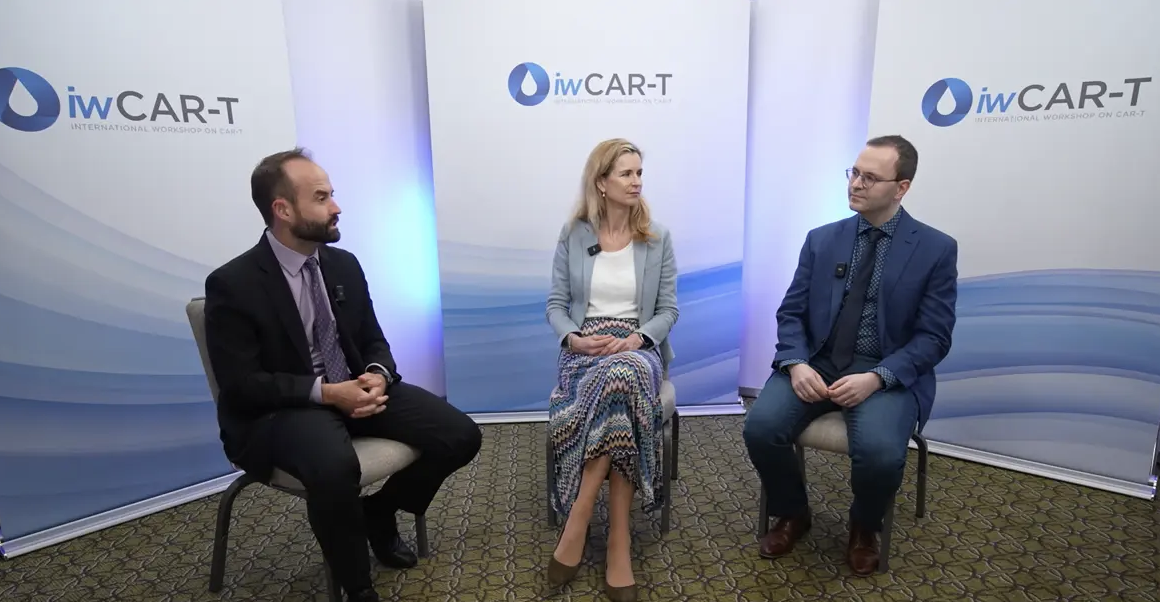
In this discussion, David Sallman, MD, Moffitt Cancer Center, Tampa, FL, Tim Sauer, MD, Heidelberg University Hospital, Heidelberg, Germany, Stephen Strickland, MD, SCRI at TriStar Bone Marrow Transplant, Nashville, TN, Roman Shapiro, MD, Dana Farber Cancer Institute, Boston, MA, and Mohammad Maher Abdul-Hay, MD, NYU Langone Health, New York, NY, provide insight into the status of cellular therapy in myeloid malignancies, specifically in acute myeloid leukemia (AML). Dr Sauer begins by highlighting CD70 as a promising CAR T-cell therapy target, and Dr Strickland emphasizes the challenges of developing cellular therapy for AML due to its heterogeneous biology. The experts discuss the therapeutic approaches that may help to overcome this complexity, such as dual-antigen targeting, NK-cell therapy, and combination strategies. This interview took place at the 8th International Workshop on CAR-T and Bispecifics 2026, in Tampa, FL.
These works are owned by Magdalen Medical Publishing (MMP) and are protected by copyright laws and treaties around the world. All rights are reserved.
Transcript
David Sallman:
Hi, I’m David Sallman from Moffitt Cancer Center in Tampa, Florida. We actually happen to be in Tampa, Florida for iwCAR-T2026. This was the myeloid session really focused on acute myeloid leukemia. So I’ll have each of the speakers introduced and then we’ll kick it off. Dr. Strickland, tell us about you...
David Sallman:
Hi, I’m David Sallman from Moffitt Cancer Center in Tampa, Florida. We actually happen to be in Tampa, Florida for iwCAR-T2026. This was the myeloid session really focused on acute myeloid leukemia. So I’ll have each of the speakers introduced and then we’ll kick it off. Dr. Strickland, tell us about you.
Stephen Strickland:
So Stephen Strickland, I’m the Director of Leukemia Research Program at Sarah Cannon Research Institute based out of Nashville, Tennessee.
Mohammad Maher Abdul-Hay:
Hi, I’m Maher Abdul-Hay. I am from NYU. I actually run two programs there. I run the leukemia program as well as the Transplantation and Cellular Therapy Program. My focus have always been on early phase clinical trials in leukemias and also on GvHD prevention.
Roman Shapiro:
Roman Shapiro, I’m a stem cell transplant physician, clinician, investigator, and assistant professor at Harvard Medical School and Dana-Farber Cancer Institute, where my focus academically has been to prevent and treat relapse of myeloid disease after allogeneic stem cell transplant.
Tim Sauer:
My name is Tim Sauer. I’m coming from the University Hospital of Heidelberg. I’m heading there the myeloid disease program, and my interest is also cellular immunotherapy for the treatment of myeloid neoplasias.
David Sallman:
Perfect. So I think we had a really great session. I think there’s definitely been challenges with traditional targets, especially that may be expressed on normal stem cells. So maybe, Tim, to start with you, you have potentially a new target. Maybe kind of talk us a little bit about it. Talk about the safety and then maybe how you’re about to launch this first in human trial.
Tim Sauer:
Yeah, sure. So, you know, when we looked at the optimal target antigen, you know, we came across CD70. And I think CD70 has raised interest over the last couple of years, but also some discussion because there are people saying that, you know, they did not see that much of CD70 expression. And so speaking of this, what we have done is actually we looked at different time points, you know, at AML cells. And it seems to be that CD70 is not a target antigen that is expressed at the same level throughout the disease. So there may be differences. But in general, we think that CD70 is an attractive antigen because in our in vitro studies, we really haven’t seen any hematologic toxicity, which we think is one of the main challenges for T-cell therapy of AML. So that’s why we focus on CD70. And, you know, our trial, you know, it’s been a long journey so far, you know, dealing with regulators over in Europe. But, you know, I think we’re on a good way. We have now the manufacturing license for the CAR T-cell product, which we will produce in our own GMP facility. And hopefully in the second half of the year, we will start our trial. I think one important point of our trial, or actually there are two, so I think we’ll be treating patients with relapse post-transplant. And I think in our trial, what’s really interesting is the fact that we’ll be using T-cells from the initial stem cell donor to manufacture the CAR T-cell product to really overcome the potential impairment of the autologous T-cells that may be caused by the AML. And I think the second is really this, you know, unique intra-individual dose escalation because, you know, from a lot of other CARs, especially in the myeloma field, we have seen that, you know, the dose matters. And, you know, in particular in CAR T-cell products that are kind of new, so we don’t know what the safety is. I mean, obviously, we have to start with low doses of CAR T-cell products, but, you know, I think it’s really fair for, you know, to offer patients, you know, the option to get like a CAR T-cell dose that may actually be clinically beneficial. And so I think this is something also unique about our trial, and we hope that the patients will benefit from this.
David Sallman:
Yeah, no, I think it’s great. I mean, I think, unfortunately, you know, some of our phase one trials have taken years to get through small numbers of patients. So hopefully you’re going to get through there quicker so that we can at least start to have the answer from that. I guess thoughts on the group overall on heterogeneity of target expression. Actually, we have a paper coming out with a CLL-1 CAR. It was an auto CAR. And actually, we saw the CLL-1 blast go away, but unfortunately, there were a lot of CLL-1 negative blasts. So how much, you know, what’s your guys’ thoughts around, do we have to target multiple antigens? Maybe that’s maybe a good jump into you, Stephen, too, with what you presented today.
Stephen Strickland:
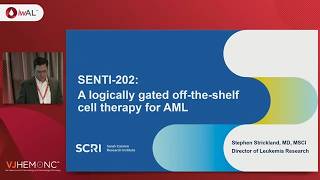
Yeah, I think the question just comes back to the challenges we’ve all faced relative to the heterogeneity of this disease, right? And differential antigen expression. I think, you know, to answer your question about what do we do from a CLL-1, I mean, there’s data emerging that it should be a really good target. But we also may need to see how do we impact that target? How do we increase expression? So we may also have to think about not these cell therapies as isolated therapies, but is there some medication, some treatment that we can do to help upregulate the antigen expression and make the cell therapy more effective? There was some data presented at ASH about using menin inhibition that menin inhibition upregulated CLL-1 or CLEC12A, I think is the other name for it, and by doing so enhance the activity of the CLL-1 CAR-T. So I think, you know, as we are getting more tools in our tool chest, so to speak, I think we need to understand how to optimize these and maybe expand to a broader population of what we’re looking at. And then also the aspect of targeting multiple antigens, you know, the SENTI product is something that is trying to do just that. With targeting CD33, which we know historically has had limitations, we know that it has been associated with hematologic tox, and so it’s kind of a tricky target. But if we can engineer these cells to really target the leukemic cells, and maybe even the leukemic stem cells by FLT3 expression or other mechanisms, and targeting that, but sparing the good cells, for instance, with endomucin. So, you know, I think that we’re just on the precipice of beginning to understand. We know so much more about this disease now that I think we’re finally getting to the point where the science and what we are able to apply our knowledge from what we’re learning is now just hitting its full stride.
Roman Shapiro:
Yeah. If I maybe could add to that as well.. I think that I very much agree with what’s been said and also the fact that given the heterogeneity we see in AML, which has been such a challenge for single antigen targeting, perhaps at least part of the strategy or part of the answer would be not just a target, but get the right cells in the right milieu and right microenvironment and then activate all the other immune effector cells. Again, coming from the transplant side, there could potentially be a lot of immune effectors that are nearby that are just not able to act on the relapsed blasts or the persistent blasts for various microenvironmental reasons. Get the right cells in there to modify the microenvironment to allow these cells to activate and maybe you can address the heterogeneity aspect or the low antigen expression aspect of the leukemia blast.
David Sallman:
Yeah, I think… go ahead, Maher.
Mohammed Maher Abdul-Hay:
Yeah, so I’m blessed I do both leukemia and transplant. It’s just so frustrating when you have someone that you went through a transplant and then they relapse on you. Because where is your graft versus leukemia effect? So there must be something in their immune system, how they found a way to escape the immune system that we’re really unaware of yet. Like in the haplo-identical stem cell transplant, we know there’s loss of heterozygosity, for example. So what happens when we have better donors? I should not say better donors, but like match-related, match-unrelated. I think the problem with AML is that you have so much drivers. Very rarely you have one driver. Like if you have FLT3, you have NPM1, you have DNMT3A, which one is really the driver here? And if you block one, what happened to others? So having one universal target, like hopefully CD70, the CD70 target, it could really make a huge difference. Like one of the studies we presented in ASH and present again today was a FLT3 target. Because FLT3 is about 80% expressed on myeloblasts. So is that FLT3-mutated or not? Is that a target that would be universal? Like you could use something to target, like in our study, a BiTE to target this FLT3. Will you achieve response? And then how these T-cells, I think the very important question for us is how much these T cells are exhausted? Because when you put them on trials, they failed multiple lines. So how much these T-cells are exhausted that we’re not seeing a response? Should we use it earlier on? So I think a lot still we need to understand. But having a unique target or multi-target, I think the future look for me is going to be a combination of stuff. We have to do multiple stuff together, including maybe CAR with a menin inhibitor. I don’t know. Maybe that should answer for certain stuff. But I think it’s more so going to be targeting on the basis of combinations.
Stephen Strickland:
I totally agree. And I think that we have to also kind of revisit the idea of stop a transplant, right, and say our therapy is done or is there a way to enhance the graft versus leukemic effect post-transplant with some of these other agents, whether that be by post-transplant menin inhibition, if that’s going to upregulate certain targets, but does that then activate the donor lymphocytes to then go against? I mean, I think we’re at that point where if we have safer mechanisms, no one wants to give any one to a post-transplant patient to affect the graft, but if we can enhance that activity, then maybe we’re on, you know, hopefully in the era where we can start to do that as well.
David Sallman:
So Roman, you know, NKs, you know, have cured patients for many years, but small subsets, it’s been really, really difficult. I felt to, you know, for NK cell trials to run at a lot of places, there’s issues around, you know, pharma, you know, money, financial. So I guess, yeah, what are your thoughts? Because you’re, you know, you guys have been pioneering a lot of NK cell work. So how do you think it should move forward? And I was actually interested, it looked like you may have like kind of separate high risk group like MDS/MPN, but if you were going to run your kind of pivotal study right now with NK, like what’s the population?
Roman Shapiro:
That’s a great question. And yes, the NK cell field has faced challenges because of, as you pointed out, some of them, yeah, various reasons. These are not challenges that we cannot overcome. These are challenges that we are systematically overcoming with our studies. And that’s why in my talk, I’m a big fan of correlatives to learn where limitations are so we can make the next iteration and improve on those limitations. I feel that’s what we’ve been doing in the NK cell space systematically. The population that I would target, you know, if I had my ideal, I could do this right now trial, right? So this would be the AML patients who are entering transplant with low burden disease, leveraging the fact that the effect of the target ratio, at least in the lab, matters for NK cells. So those who have sort of low burden disease entering the transplant, you give an NK cell that is potent, that can persist, and that is not significantly inhibited by the immune suppression that has to come with an allogeneic transplant. These would be the group and the NK product that I would want. So giving it early.
Mohammed Maher Abdul-Hay:
Are you worried of GvHD here? When you do that, are you worried of GvHD, increasing GvHD?
Roman Shapiro:
So far, no. I mean, yes, we still have to complete our study and complete our studies and make sure. But we have not seen graft-versus-host disease with NK cells either in the post-transplant relapse setting or so far in the early post-transplant setting.
Tim Sauer:
Can I also ask you a question? Because I think for CAR-NKs, one thing people are always saying, since they’re not expanding as well as usually CAR T-cells, what are your thoughts on having multiple repeated CAR-NK cell infusion? Because that’s something that I’m usually thinking of, you know, maybe if there’s not such a great expansion, why don’t we just then continue to infuse?
Roman Shapiro:
Yeah, so again, this is a great point and one of the challenges in the NK cell field that we try to overcome. And I’ll just, before I answer, I’ll say that I noticed in the, you know, in the SENTI talk where you guys cryopreserve the NK cells, you know, at least from the memory NK cell side, we have found challenges with cryopreservation with NK cells because we lose a lot of efficacy if we cryopreserve. So at the moment, we are still requiring fresh infusions. And this poses logistical challenges with having to have the donor come back and give multiple infusions, not to mention, you know, lymphodepletion and so on. So we are trying to overcome all of that so that we don’t need repeated lymphodepletion. So we can have NK cells that auto secrete growth factors for themselves, right? They allow their expansion, but not allowing them to overexpand and then cause other problems. So these are all things that we are currently working on optimizing and improving within the CAR construct. It’s not quite yet ready yet, but it is something that is coming. And multiple infusions are great. It’s just logistically have to overcome those hurdles.
Mohammad Maher Abdul-Hay:
So David, I have a question for you. You know, when the CLL1 CAR T-cell, we were so excited that we thought it’s going to be like really breakthrough. Because, you know, the target looks so appealing. But the data came, it was disappointing. Why do you think that? Is it because the patient were heavily pre-treated? Is it you had a lot of P53? What could you have done different? Or is it this construct is not good?
David Sallman:
You know, I think it’s, yeah, it’s a tough question. I think we’ve all alluded to the same challenge that there is a ton of complexity. I think FDA currently is making us put a lot of these very relapsed refractory patients. So yeah, they were pretty much all, you know, multiple, multiple lines, even more lines than what most patients get with AML, essentially all with high burden. And I think this is also a challenge with pharma, right? Pharma wants us to be like myeloma, lymphoma wants the 95% response rate, you know, through the, you know, through the first couple of patients. And so we really never got to the point of being able to either one, move it up or, or move it, you know, for more, you know, low level disease. Again, my concern, at least on with, with our data was the fact that we were really seeing negative blast populations, you know, emerging. And I think there’s other complexities, you know, what we, the other thing that we noticed our expansion was quite a bit worse than at least like what we’re used to from some of the other like CD19 constructs, same company, you know, from that perspective. So we did intensify lymphodepletion. We jumped the cyclophosphamide up to 750. And that actually did seem to help. So I think the challenge is we can’t copycat what all of our partners are doing in these other fields. And I think we really have to think outside the box. Unfortunately, at times may slow development, but I think if we think we can copy them and then get the same results, that seems to at least not be possible.
Mohammad Maher Abdul-Hay:
Of course, I agree. AML is a different beast and everyone should look at it this way. It’s not ALL, it’s not DLBCL. No, it’s a different beast.
David Sallman:
Yeah, so I think with conclusion, I think exciting session, we’re hearing new targets. I think there is not one right answer, right? We have CAR-NK, T-cell engager, NK-cell, and brand new targets with very novel design and CD70. So I think who is going to be right? Hopefully we’re all going to be right and finally lead to some new novel cellular therapies and immune therapies for patients with AML. But thank you for listening today.
This transcript is AI-generated. While we strive for accuracy, please verify this copy with the video.
Read more...