The Acute Myeloid Leukemia Channel is supported through an educational grant from Jazz Pharmaceuticals.
VJHemOnc is an independent medical education platform. Supporters, including channel supporters, have no influence over the production of content. The levels of sponsorship listed are reflective of the amount of funding given to support the channel.
iwAL 2026 | Novel targets, combinations, and treatments in AML: insights from iwAL 2026
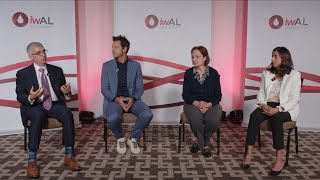
In this roundtable discussion, Gail Roboz, MD, Weill Cornell Medicine, New York City, NY, is joined by Sanam Loghavi, MD, The University of Texas MD Anderson Cancer Center, Houston, TX, Marina Konopleva, MD, PhD, Albert Einstein College of Medicine, New York City, NY, and Thomas Cluzeau, MD, PhD, Central University Hospital of Nice, Nice, France, to share insights into novel targets, combinations, and therapeutic approaches in acute myeloid leukemia (AML). First, Dr Loghavi discusses the evolving genetic classification of AML and the significance of TP53-mutated disease, followed by Prof. Cluzeau, who highlights triplet therapies with an azacitidine-venetoclax (aza-ven) backbone currently being explored. Prof. Konopleva then outlines several topics discussed at the iwAL 2026 meeting, including her work on reactivating apoptosis in AML with direct BAX activation as a novel therapeutic strategy. Finally, Dr Roboz rounds out the discussion by commenting on the promise of an all-oral regimen for patients with AML. This discussion took place virtually as part of coverage of the 8th International Workshop on Acute Leukemias (iwAL 2026), held in Boston, MA.
These works are owned by Magdalen Medical Publishing (MMP) and are protected by copyright laws and treaties around the world. All rights are reserved.
Transcript
Gail Roboz:
Hi, everyone. My name is Dr Gail Roboz. I’m a professor of medicine and director of the leukemia program at Weill Cornell Medicine and the New York Presbyterian Hospital in New York City. It is my great pleasure to be here with amazing colleagues from the iwAL 2026 outstanding leukemia meeting. We’re actually going to recap some important presentations from that meeting, and I’m going to let my colleagues from around the world, so we have representation from Houston, New York, and France, I’m going to let them introduce themselves with their titles, but launch into brief recap of some of the sessions and a little bit of commentary and discussion...
Gail Roboz:
Hi, everyone. My name is Dr Gail Roboz. I’m a professor of medicine and director of the leukemia program at Weill Cornell Medicine and the New York Presbyterian Hospital in New York City. It is my great pleasure to be here with amazing colleagues from the iwAL 2026 outstanding leukemia meeting. We’re actually going to recap some important presentations from that meeting, and I’m going to let my colleagues from around the world, so we have representation from Houston, New York, and France, I’m going to let them introduce themselves with their titles, but launch into brief recap of some of the sessions and a little bit of commentary and discussion. So, Sanam, I’m going to toss to you.
Sanam Loghavi:
Thank you so much, Gail. It’s a pleasure to be here with you all. I am Sanam Loghavi. I’m a professor of hematopathology and molecular pathology at MD Anderson Cancer Center in Houston, Texas.
Gail Roboz:
And I think, you know, let’s get started with your presentation first that kind of go over what you presented at the meeting and why you think it’s so relevant to have a HemePath person talking to us about classifications at this moment in time for AML.
Sanam Loghavi:
Sure. I think, you know, one of the things that is really exciting about what’s going on in the AML world right now is that we have the emergence of targeted therapies. Some are established, some are becoming more established, and then hopefully we’re trying to make more and more targeted therapies. And I think for that reason, the molecular or genetic based classification of disease is very important. And that’s what, you know, we’ve been trying to do as a field is focus more on the genetic basis of disease and the drivers of acute myeloid leukemia, as opposed to just an arbitrary blast threshold that was used years ago. So what’s going to happen with the recommendations of the classification advancement meeting that will inform the WHO sixth edition is that the genetic categories of AML have been expanded. So there’s going to be more genetically defined AML. And for those, there’s, you know, there’s a 5% blast threshold. So you really don’t need the 20% anymore. And then there’s also, you know, there was some debate at the meeting about the overlap between MDS and AML and the category of MDS/AML, that really still is, you know, it remains to be determined. So there’s going to be a little bit of going back and forth on that, but hopefully we’ll come to an agreement based on data. So there’s going to be a companion paper that is going to be published with the CAM recommendations, and there’s structured data calls in that paper that calls for the community to generate data that will inform these so-called contentious areas of the classification.
Gail Roboz:
Well, listen, I think all of us on this call have been around long enough to remember that when it was 30% for AML, then the debate was over 29. So when it’s 20%, then the debate is over 19% blast. There will be a line in the sand wherever there is a blast threshold. And I think that that’s a challenge because I think that from a clinical perspective, this nebulous category of AML/MDS or MDS/AML is a real challenge for discussions with patients who really struggle feeling like, well, thank God I don’t have leukemia. I have 19% blasts. So these, I think, are clinical challenges. Talk for half a second, though, about TP53, because I know that docs will struggle to, on the one hand, you don’t want to just see TP53 and say, oh, all is lost, because not all TP53 is the same. It matters if it’s mono versus biallelic. It matters if you have a complex karyotype. So just a couple of clinical points about how do you actually get at that biallelic, since it doesn’t come on the report that way? It requires a little bit of extra thinking.
Sanam Loghavi:
Right. So, you know, the classification of TP53-mutated myeloid neoplasms is a little bit, you know, if you look at it first, it’s going to look a little bit more complicated. But we’ve tried really hard to put flow charts and, you know, algorithms that get you to one arm or the other. But in essence, if you have two mutations with VAF of 10% or more in each, that’s considered biallelic. If you have a mutation and a deletion by FISH or karyotype, that is considered biallelic. If you have a mutation with more than 50% VAF, that is considered biallelic. So VAF being variant allele frequency, the reason being that you’re implying that the wild-type allele is lost based on that high VAF. I think the area that’s going to be challenging is if you have one mutation with a variant allele frequency of less than 50%. If you look at some of the historic data that has been generated, not everybody has consistently looked at copy-neutral loss of heterozygosity. And when you have copy-neutral loss of heterozygosity, you’re not going to see that by FISH or karyotype. The only way to discern that is by a method specifically validated to look for that, being NGS or array. So if you have a VAF of less than 50%, it can still very well be biallelic. So the point here is to not automatically assume that anything with a VAF of less than 50% is monoallelic. So oftentimes, as you know, a true biallelic TP53 will be associated with a complex karyotype. So that route also gets you to a biallelic. I think the fraction that’s going to be left indeterminate is going to be small. But again, I think it’s going to take us a while to annotate that data and record it systematically as a field so that we can really discern down the line, you know, what the impact of monoallelic TP53 is in acute myeloid leukemia.
Gail Roboz:
Thank you for the explanation. Totally important, I think, for the audience to internalize that, number one, there’s going to be a flow chart to follow, which I think is going to be super helpful. Number two, not all TP53 is the same. And number three, of course, the biallelics we haven’t solved at all in terms of therapy. I’m going to move over to Thomas. So you’re going to tell us where you’re from, your institution, and tell us a little bit about the novel combination therapies and sort of new treatment options for AML that you discussed at the meeting.
Thomas Cluzeau:
Hello. So my name is Thomas Cluzeau from Nice University Hospital in France. So I am very happy to be with you today. And so during the last iwAL meeting, I discussed about the combination in a non-eligible patient with high-risk myeloid leukemia. So as you know, the backbone is azacitidine and venetoclax. But depending on the molecular subtype, there is some possible evolution with some triplets. And I discuss all the specific subgroups. So the first one was the NPM1/KMT2A rearrangement. We can propose a triplet with menin inhibitors. So today we have several triplets with ziftomenib, bleximenib, revumenib, enzomenib. And we have already the results from the phase one study. And based on these results, there is some phase three clinical trial ongoing comparing Azacitidine-Venetoclax plus menin inhibitor versus Azacitidine-Venetoclax plus placebo. What we expect based on the phase one study, we know that there is an overall response rate around 80 to 90 percent with a high level of negative MRD. So it could be a changing practice for the future but of course we have to wait the result of the phase three clinical trial. The second subgroup was the FLT3-mutated patients, so two phase one study combining Azacitidine-Venetoclax plus gilteritinib or quizartinib. And based on this very promising results, we are waiting the results of the VICEROY study evaluating Azacitidine-Venetoclax and gilteritinib. And there is a phase 3 clinical trial ongoing, mainly in Spain. The name is the Venpaki, evaluating Azacitidine, Venetoclax, and Quizartinib. So it could be also changing practice, but we have to wait, of course, the results of the clinical trial to be sure. The last subgroup is the IDH1-mutated patients. So we have also the result from the phase one combining Azacitidine Venetoclax plus ivosidenib and based on this clinical trial there is the EVOLVE-1 clinical trial ongoing evaluating Azacitidine ivosidenib plus Venetoclax versus Azacitidine ivosidenib alone. So after we could discuss the other subgroups, so this is the agnostic subgroup and maybe we could we could discuss the other subgroups. So this is the agnostic subgroup. And maybe we could discuss some drug, tupetinib or the PVEK. And for the PVEK, there is also a phase three clinical trial started recently evaluating the triplet. So we conclude that there is a lot of new treatments. We moved from the Azacitidine backbone to the triplets, and we hope we could maybe improve the outcome of some subgroup of patients. Thank you so much.
Gail Roboz:
That was actually a fantastically succinct summary. So I appreciate that. And I think fundamentally what we’re seeing is a couple of important things. So first of all, Venetoclax did change everything. It changes everything if you combine it with a hypomethylating agent or with intensive chemotherapy, but it doesn’t solve everything. And although outcomes are much better with the advent of Venetoclax, both in younger patients and in older patients, and we have triplet combinations coming up in the unfit setting also with the intensive chemotherapy to try to figure out what can we do to fundamentally deepen the responses with Venetoclax and also prolong them. But that’s kind of a nice segue to Marina’s talk. And I’ll have Marina Konopleva introduce herself in a moment, has been a leader in the field of trying to solve for issues of resistance and try to solve for issues of what can we do to take what, you know, the transformative drugs and AML and make them even better. Marina.
Marina Konopleva:
Hi, Gail. Thank you for the introduction. I’m happy to be here. I’m Marina Konopleva. I’m a professor of oncology at Montefiore Einstein, the College of Medicine in New York, and director of leukemia here. So yeah, so I think at the meeting, we talked a lot about what’s coming next, and there was a session on new therapies, and I think it, in my mind, focused on two subsets. One is kind of KMT2A and menin inhibitor resistance, and second one is TP53-mutated that we talked about before. So, as far as like menin resistance, there was the presentation from Dr. Justin Watts who talked about different menin inhibitors and how the mutations may impact response to one or another menin inhibitor. He also presented data that the signaling mutated AML are less sensitive to menin inhibitors in some clinical trial subsets. And therefore, we can think about combinations down the line with maybe FLT3 inhibitors and RAS inhibitors. But that’s also, at this point, of course, remains to be seen in preclinical data and further in the clinical trials. Ghayas Issa also updated us on the combination studies of menin inhibitors and Venetoclax that are ongoing at MD Anderson. And he also brought up the novel aspect of menin inhibition, which is activation of immune system. And so the combination potentially with DLI, for example, post-transplant is something that becomes an area of novel studies in the clinical practice. And this was also touched upon by Dr. Emma Searle from Manchester, UK, who presented some unpublished data on combination of Revumenib and DLI, again, in the post-transplant MRD-positive setting. She also presented several other novel agents that are deemed to overcome resistance to menin inhibitors, and these include novel CAT6-7 inhibitors, Icarus degraders, and the novel agent that degrades MLLT1 and MLLT3, which is called DBT-3757, which is at this point in the preclinical space. And then, as I mentioned, there was an effort to discuss novel therapies for TP53-mutated AML that we touched upon in the beginning with Sanam. So, Andrew Wei from Australia presented the preclinical data and also the concept of the clinical trial that he initiated, where he aims to target BCLXL. So, BCLXL is a cousin of BCL2, and there are some data from Andrew’s lab, also from our lab, and several other labs that TP53-mutated AML are, in fact, more dependent on survival on BCLXL rather than BCL2, which perhaps explains lack of efficacy of HMA-Ven in that setting. So he showed preclinical data where he used the two BCLXL inhibitors in a triplet combination in the mouse models in sequential fashion, and he got extension of survival reduction of tumor burden. And based on that, he designed a clinical trial with one of the BCLXL inhibitors in combination with Azacitidine, which he calls the ADAPT trial, which is currently ongoing in Australia. Another presentation from Gabe Mannis focused on the multikinase inhibitor, tupatinib, which has multiple targets, including FLT3, RSK, and some others. And some data from the clinical trial indicate that this agent can increase efficacy of HMA-Ven also in the TP53-mutated subset. So there’s this interesting perspective, kind of TP53-independent sensitization to Ven-Aza, and I believe that there are several clinical trials that are being designed right now that are focusing on that combination. And I presented some unpublished and published data on the novel agent that we’re developing here at Einstein that is activating BAXS. So BAXS is downstream effector of cell death that is absolutely required for BCL2 or BCLXL inhibitors efficacy. And so the thinking is that if we can directly activate BAXS and induce a cell death, that can also work in the setting where other agents have failed. So I have shown some preclinical data at this point where we also see efficacy in TP53-mutated models, but this is work in progress and we have quite far away from the clinical trial, but certainly we’ll continue to develop these agents.
Gail Roboz:
Well, thank you for the fantastic whirlwind tour. And I think throughout the meeting, just palpable excitement about the direction where AML is going, both with targeted agents and, as was brought up by both you and by Thomas, the non-targeted agents, not mutationally targeted, but targeting more broadly different resistance mechanisms or different angles to try to get in so that you don’t have to only have one mutation, IDH-FLT3-menin, and so lots in progress. I think that what we’re seeing is the combination of better agents, better MRD detection, and better transplant is obviously changing, hopefully, all of the patient subgroups outcomes in AML. What I focused on, and I’ll wrap with this, is a little bit different. I focused on data combining oral decitabine-cedazuridine with Venetoclax, which has recently emerged as an effective strategy of an all-oral therapy that is tracking for efficacy and outcomes with AZA-Ven, but offers the opportunity for patients in an ongoing treatment plan to have all oral. And this has been truly fantastic because currently the plan for an awful lot of AML patients is still ongoing cycles of treatment. That is the HMA-Ven paradigm. It goes on and on and on. And while there are certain efforts in select subgroups, for example, in NPM1-mutated patients to consider stopping therapy in the setting of MRD negativity, the vast majority of patients on HMA-Ven alone are getting ongoing cycles, and most of them relapse if you stop them. So there was truly, truly an imperative to try to make this more feasible, especially for frail older patients where the whole point is to spend as much quality time in remission as possible out of the hospital. So the oral has been truly fantastic for that. But of course, we hope that from an efficacy perspective, there may also be advantages going down the road of oral decitabine and cedazuridine from an efficacy perspective. And we don’t know that yet, but certainly are anxiously watching the space of combination with menin inhibitors, combination with other agents to see what the advantage of all oral could possibly be other than convenience. I’ll say that for right now, for the patients on ongoing therapies, the convenience factor is absolutely fantastic. I have many patients enjoying it enormously, but we discussed at the meeting that this requires ongoing vigilance for myelosuppression and careful manipulation of dose and schedule to avoid myelosuppressive complications while you’re in remission, which absolutely will happen if you give full dosing. And when I say full, I mean weeks of Venetoclax and fully five days of the oral decitabine. So I think that there’s a lot of tweaking for these regimens to optimize outcomes, to optimize quality of life, to make sure that we as the doctors know exactly what we are giving people so that when we send them home with a pill pack, we know what they’re actually taking. And I think all of this is a, you know, very, very exciting space for AML. The unbelievable accomplishments since 2017 are continuing. I would like to thank all of you for your excellent recaps of the presentations, and I look forward to seeing everybody at upcoming meetings.
Sanam Loghavi:
Thank you so much. Great to be here.
Marina & Thomas:
Thank you.
This transcript is AI-generated. While we strive for accuracy, please verify this copy with the video
Read more...