The Multiple Myeloma Channel is supported with funding from AbbVie (Platinum), Sanofi (Gold), Legend Biotech (Bronze), and through an educational grant from Alexion Pharma GmbH.
VJHemOnc is an independent medical education platform. Supporters, including channel supporters, have no influence over the production of content. The levels of sponsorship listed are reflective of the amount of funding given to support the channel.
EBMT 2026 | Exploratory analyses from DETERMINATION: the impact of Duffy genotype in newly diagnosed myeloma
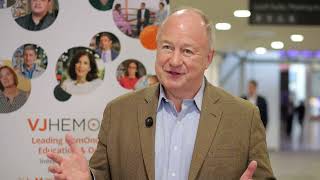
Paul Richardson, MD, Dana-Farber Cancer Institute, Boston, MA, discusses exploratory multivariable analyses of the DETERMINATION trial (NCT01208662), highlighting the impact of Duffy genotype status on progression-free survival (PFS) with lenalidomide-bortezomib-dexamethasone (RVD) alone or RVD plus autologous transplant in newly diagnosed multiple myeloma (MM). Dr Richardson notes that Duffy null patients appear to have better outcomes with RVD alone and may potentially benefit more from less intensive therapies than Duffy non-null patients. This interview took place at the 52nd Annual Meeting of the EBMT in Madrid, Spain.
These works are owned by Magdalen Medical Publishing (MMP) and are protected by copyright laws and treaties around the world. All rights are reserved.
Transcript
We’re here to present an updated analysis because actually about a year ago my colleague Dr. Lauren Merz was here to present our preliminary analysis of this data set and we then were lucky enough to have an oral session at ASH where Lauren presented and at this particular meeting we’re updating our analysis for the EBMT at their request, obviously, and it’s wonderful to have a presentation here...
We’re here to present an updated analysis because actually about a year ago my colleague Dr. Lauren Merz was here to present our preliminary analysis of this data set and we then were lucky enough to have an oral session at ASH where Lauren presented and at this particular meeting we’re updating our analysis for the EBMT at their request, obviously, and it’s wonderful to have a presentation here. Essentially, what we’re doing is to look in a deeper fashion at what the impact of Duffy Null is, as opposed to African-American heritage on treatment outcome.
Just to give your listeners a bit of background, Duffy Null occurs in up to 70% of people of African and Middle Eastern heritage. It’s, I think, underappreciated that this also affects people in the Middle East. And as a result of that, it’s a very interesting phenomenon. It’s basically a Duffy phenotype that reflects on a red cell phenotype that protects the person who has this phenotype from the impact of Plasmodium vivax of the malarial parasite. So from an evolutionary standpoint, it’s been an enormous advantage over the millennia, and hence, it occurs in up to 70% of people of both African and Middle Eastern heritage. The snag is in the modern world, the downside of being Duffy Null is that you’re much more resistant to the impact of inflammation and also to chemokine and cytokine imbalance. So it means, in fact, that the inflammatory signaling that is part of the red cell sink, if you will, when you’re Duffy non-null is gone, and it means you’re much more vulnerable to the adverse effects of inflammation. Now, we think of Duffy Null traditionally as reflecting what we call African leukopenia, but what we’ve realized is much more than that.
So, an observation we made in DETERMINATION was that, remarkably, our African-American patients did not seem to get the same degree of benefit, as it were, differentially from RVD alone versus RVD in early transplant as their Caucasian counterparts. In fact, RVD performed very well in our African-American patients. So we sought to try and understand why. You know, if RVD alone did better and that was counter to what we saw in the rest of the population, was there a reason? And our working hypothesis is that Duffy Null has an impact on outcome based upon its pathobiology or the impact of its pathobiology on myeloma.
And when we look deeper at this, and this is work led by my colleague Lauren Merz, we found that actually the hazard ratio for RVD alone in Duffy Null patients compared to their Duffy non-null counterparts was a striking 0.44 in favor of RVD alone. That’s the most important observation from the analysis we’re presenting here at the meeting. And it’s a decent data set. We’ve identified over 70 patients who are Duffy Null in our data set of over approximately 600 patients. And we’ve been able to take a very hard look to understand why this may be.
What’s also very interesting is that we’ve learned that the Duffy Null patients do seem to do well with transplant overall. It’s just that without transplant, they do even better. And I think that’s an important message. And we’re really trying to better understand why that should be. So further work is ongoing to further interrogate that mechanism. But we think, and our working hypothesis is, that the impact of inflammation and the impact on the inflammasome in particular may have a downstream effect on outcome in the sense that less inflammatory, less intensive therapies may be more beneficial to people who are Duffy Null. Now, that’s a working hypothesis. But if that turns out to be true, that’ll obviously have major implications for the field.
This transcript is AI-generated. While we strive for accuracy, please verify this copy with the video.
Read more...


Disclosures
Consulting: Celgene/BMS, GSK, Karyopharm, Oncopeptides, Regeneron, Sanofi; Research Grants: Oncopeptides, Karyopharm.