The Multiple Myeloma Channel is supported with funding from AbbVie (Platinum), Sanofi (Gold), Legend Biotech (Bronze), and through an educational grant from Alexion Pharma GmbH.
VJHemOnc is an independent medical education platform. Supporters, including channel supporters, have no influence over the production of content. The levels of sponsorship listed are reflective of the amount of funding given to support the channel.
EBMT 2026 | Further investigating the impact of the Duffy genotype in myeloma: DETERMINATION-2
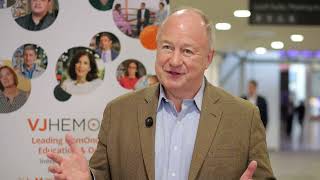
Paul Richardson, MD, Dana-Farber Cancer Institute, Boston, MA, discusses the importance of further investigating the effect of the Duffy genotype on treatment outcomes in patients with multiple myeloma (MM), highlighting the need for a deeper understanding of the interaction between this genotype and treatment response. Dr Richardson notes that the DETERMINATION-2 study will take a closer look at this phenomenon, building upon the findings of the original DETERMINATION trial (NCT01208662), which enrolled a significant proportion of African-American patients and found that Duffy Null status, rather than racial identity, was a key factor influencing treatment outcomes. This interview took place at the 52nd Annual Meeting of the EBMT in Madrid, Spain.
These works are owned by Magdalen Medical Publishing (MMP) and are protected by copyright laws and treaties around the world. All rights are reserved.
Transcript
Well, I think there’s several aspects to this. I mean, the most important thing is that Duffy Null, of course, is a piece of biology that’s relevant to the pathobiology of myeloma. It’s not a racial construct. It’s not a social construct. And I think what’s very important in DETERMINATION is that we had equal access or equality of access to therapy...
Well, I think there’s several aspects to this. I mean, the most important thing is that Duffy Null, of course, is a piece of biology that’s relevant to the pathobiology of myeloma. It’s not a racial construct. It’s not a social construct. And I think what’s very important in DETERMINATION is that we had equal access or equality of access to therapy. So there wasn’t a social impact on our outcomes that we saw. So taking that forward in DETERMINATION2, we’re taking a much deeper dive on this phenomenon. And I think it’s important to share with the audience that in DETERMINATION, we were able to enroll almost 20% African-American patients. That’s the highest number to date in a randomized prospective trial of its kind. We want to build on that in DETERMINATION2, which is launching this year, and take an even deeper dive understanding the interaction between Duffy Null and obviously whole genome sequencing and other aspects of disease biology to help us better understand this phenomenon. Because the reality is the phenomenon withstood further analysis. In fact, it magnified. In other words, if you were Duffy non-null and African-American, you did just the same as your Caucasian counterpart. The critical point was that if you were Duffy null, regardless of your racial identity, clearly, transplant did not confer the same benefit. And in fact, RVD alone performed very well. So this, I think, has implications for our patients going forward, especially in the quadruplet therapy era, as we use quads now, which are so much more effective and have really made it possible for us to think in a very tailored fashion about whether or not we need to use transplants in everyone. And clearly, the data from studies like MIDAS suggests that we can reasonably keep transplant in reserve in an increasingly large subset of patients, recognizing that clearly in other subsets of patients, transplant remains very important and of considerable benefit.
This transcript is AI-generated. While we strive for accuracy, please verify this copy with the video.
Read more...

Disclosures
Consulting: Celgene/BMS, GSK, Karyopharm, Oncopeptides, Regeneron, Sanofi; Research Grants: Oncopeptides, Karyopharm.