The Multiple Myeloma Channel is supported with funding from AbbVie (Platinum), Sanofi (Gold), Legend Biotech (Bronze), and through an educational grant from Alexion Pharma GmbH.
VJHemOnc is an independent medical education platform. Supporters, including channel supporters, have no influence over the production of content. The levels of sponsorship listed are reflective of the amount of funding given to support the channel.
ASCO 2026 | ISABELA study: isatuximab, belantamab mafodotin, pomalidomide, and dexamethasone in R/R myeloma
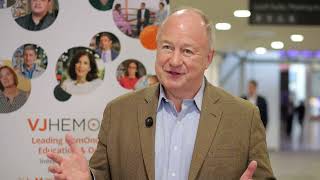
Paul Richardson, MD, Dana-Farber Cancer Institute, Boston, MA, shares insights into the Phase II ISABELA trial (NCT05922501) evaluating the combination of isatuximab, belantamab mafodotin, pomalidomide, and dexamethasone in patients with relapsed/refractory (R/R) multiple myeloma. The combination has shown to be well tolerated with manageable ocular toxicity. This interview took place during the 2026 American Society of Clinical Oncology (ASCO) Meeting in Chicago, IL.
These works are owned by Magdalen Medical Publishing (MMP) and are protected by copyright laws and treaties around the world. All rights are reserved.
Transcript
This is being presented by my colleague, Andy Yee, and it was a privilege to be part of this study. In fact, we at Dana-Farber are actually equal, if not majority enrollers, to that trial in partnership with Andy and colleagues at Mass General. ISABELA, I think, is a fabulous trial. It’s a combination of isatuximab, belantamab, pomalidomide, and dexamethasone. And what we’ve seen is that the combination of all four drugs is well tolerated...
This is being presented by my colleague, Andy Yee, and it was a privilege to be part of this study. In fact, we at Dana-Farber are actually equal, if not majority enrollers, to that trial in partnership with Andy and colleagues at Mass General. ISABELA, I think, is a fabulous trial. It’s a combination of isatuximab, belantamab, pomalidomide, and dexamethasone. And what we’ve seen is that the combination of all four drugs is well tolerated. The ocular toxicity is very manageable. We’ve had no discontinuations of belantamab for ocular toxicity. And most importantly, all of the effects of the belamaf on the eye have been mild to moderate, reversible, and manageable. And this is a very important message to share with our listeners because I think, to some extent, there is a misunderstanding about ocular toxicity from belantamab. It’s simply a corneal effect that’s transient. In our hands, it’s reversible every time. We haven’t seen serious complications such as corneal ulcer, which we just simply haven’t, not only in this study, but in others as well. And we’ve treated over 170 patients with belantamab at Dana-Farber, for example. And the rates of hospitalization and so on are vanishingly low. So ISABELA is a very real-world, practical, effective platform. And in that spirit, combining isotuximab with belantamab, pomalidomide and dexamethasone, our response rate is actually about 90%, which is remarkable. And the progression-free estimates that Andy has are equally impressive in approaching three years. So I think with all of that in mind, we’ve identified a very effective quadruplet, and Andy’s presenting early data on that. In terms of other toxicities, our rates of infection have been very low. In an interesting way, IVIG use has been recommended for hypogammaglobulinemia, but I can say with the use of isatuximab and belantamab, the necessity of using immunoglobulin replacement therapy is perhaps less than we have expected, and that’s encouraging, and we’ll continue to follow the study and report accordingly.
This transcript is AI-generated. While we strive for accuracy, please verify this copy with the video.
Read more...