The Community Focus Channel is supported with funding from Johnson & Johnson (Gold).
The Multiple Myeloma Channel is supported with funding from AbbVie (Platinum), Sanofi (Gold), Legend Biotech (Bronze), and through an educational grant from Alexion Pharma GmbH.
VJHemOnc is an independent medical education platform. Supporters, including channel supporters, have no influence over the production of content. The levels of sponsorship listed are reflective of the amount of funding given to support the channel.
ASCO 2026 | DREAMM-9 final analysis: belamaf plus VRd for transplant-ineligible newly diagnosed multiple myeloma
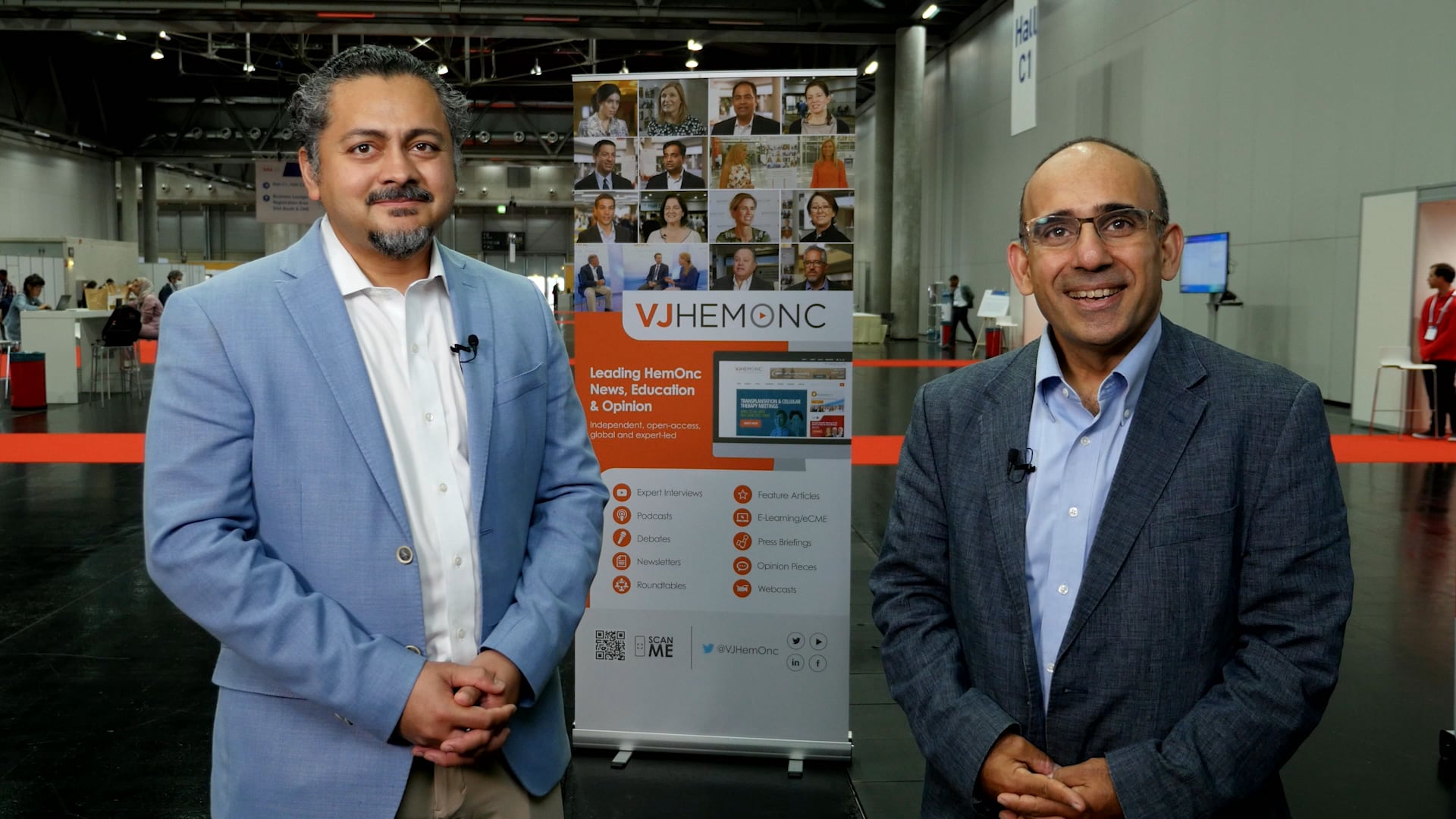
Saad Usmani, MD, MBA, FRCP, FASCO, FACP, Memorial Sloan Kettering Cancer Center, New York, NY, discusses the final analysis of the DREAMM-9 trial (NCT04091126), which examined the combination of belantamab mafodotin (belamaf) with bortezomib, lenalidomide, and dexamethasone (VRd) as induction for patients with transplant-ineligible newly diagnosed multiple myeloma. Dr Usmani highlights that the key lesson learned from the trial is the importance of initial frequent dosing to achieve depth of response, but also notes that this approach is limited by ocular side effects, suggesting that a dosing schedule of every 6-8 weeks during induction and every 12 weeks during maintenance may be optimal. This interview took place during the 2026 American Society of Clinical Oncology (ASCO) Meeting in Chicago, IL.
These works are owned by Magdalen Medical Publishing (MMP) and are protected by copyright laws and treaties around the world. All rights are reserved.
Transcript
The DREAMM-9 clinical trial was a phase one study that looked at the combination of Belantamab mafodotin with VRd as induction for transplant-ineligible newly diagnosed multiple myeloma patients. There were eight different cohorts that were examined to look at doses of Belantamab at 1.9, 1.4, and 1 milligram per kilogram given during the induction phase of every three weeks or every six or even every nine weeks...
The DREAMM-9 clinical trial was a phase one study that looked at the combination of Belantamab mafodotin with VRd as induction for transplant-ineligible newly diagnosed multiple myeloma patients. There were eight different cohorts that were examined to look at doses of Belantamab at 1.9, 1.4, and 1 milligram per kilogram given during the induction phase of every three weeks or every six or even every nine weeks. And then in the maintenance phase, six week, eight week, and 12 week respectively. And so since the dosing schedules and cohorts were different, we decided to group for this the purpose of the final analysis into the more frequent dosing, the extended and the longer extended versions.
The key lessons that we learned was that initial frequent dosing is important to get depth of response but then you start getting into issues with the ocular side effects more frequently, that’s why, you know, the right probable schedule is going to be, you know, six to eight weeks. And then during the maintenance phase, you know, it’s probably going to be around 12 weeks. And those are the dosing schedules that are being followed in the frontline DREAMM-10, as the PrECOG clinical trials. The depth of response was very impressive for this older myeloma patient population with the median age of 74. Response rates, you know, especially if you look at MRD negativity, for the first two cohorts were over 50%, 54 to 56%. They do drop a little bit if you go to q9 or q12 week dosing, so those cohorts you lose efficacy and that’s something that we had highlighted so you know in so that’s kind of like the gist of it that in induction probably you know q6 to 8 week dosing may be better for maintenance q12 week.
This transcript is AI-generated. While we strive for accuracy, please verify this copy with the video.
Read more...