The Multiple Myeloma Channel is supported with funding from AbbVie (Platinum), Sanofi (Gold), Legend Biotech (Bronze), and through an educational grant from Alexion Pharma GmbH.
VJHemOnc is an independent medical education platform. Supporters, including channel supporters, have no influence over the production of content. The levels of sponsorship listed are reflective of the amount of funding given to support the channel.
IMS 2026 | Longitudinal liquid biopsy versus bone marrow assessment for monitoring MRD in frontline myeloma
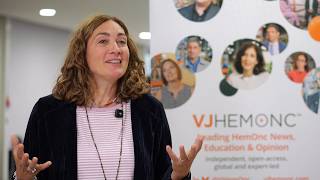
Elena Zamagni, MD, PhD, University of Bologna, Bologna, Italy, discusses the potential of longitudinal liquid biopsy for monitoring residual disease in frontline multiple myeloma, highlighting the benefits of using peripheral blood techniques, such as mass spectrometry and circulating DNA, over bone marrow measurable residual disease (MRD) assessment. Dr Zamagni notes that these approaches can anticipate bone marrow relapse and should be conducted in parallel, allowing for tailored treatment based on MRD status and patient fitness. This interview took place at the 23rd International Myeloma Society (IMS) Annual Meeting in Glasgow, UK.
These works are owned by Magdalen Medical Publishing (MMP) and are protected by copyright laws and treaties around the world. All rights are reserved.
Transcript
Absolutely, our group here in Glasgow, but also other groups, showed the data on the use of peripheral blood techniques to detect minimal residual disease. So I’m referring to mostly mass spectrometry, but also others, circulating DNA. The dynamic is well known now. It is anticipating sometimes bone marrow relapse, sometimes it’s something that should be conducted in parallel...
Absolutely, our group here in Glasgow, but also other groups, showed the data on the use of peripheral blood techniques to detect minimal residual disease. So I’m referring to mostly mass spectrometry, but also others, circulating DNA. The dynamic is well known now. It is anticipating sometimes bone marrow relapse, sometimes it’s something that should be conducted in parallel. So in the future, we have to tailor treatment on MRD, on patient fitness, and we are speaking about fixed duration tailored on MRD. So I think that it is absolutely necessary to move from simply bone marrow techniques, otherwise it will not be feasible in real life. So these studies, ours and others, are trying to figure out the exact timing and the recommendations that can be provided to a broader population, so it’s important to go on with these studies, but I think that the future will be bone marrow once per year and all the rest peripheral blood techniques.
This transcript is AI-generated. While we strive for accuracy, please verify this copy with the video.
Read more...