The Multiple Myeloma Channel is supported with funding from AbbVie (Platinum), Sanofi (Gold), Legend Biotech (Bronze), and through an educational grant from Alexion Pharma GmbH.
VJHemOnc is an independent medical education platform. Supporters, including channel supporters, have no influence over the production of content. The levels of sponsorship listed are reflective of the amount of funding given to support the channel.
COMy 2026 | Insights into the potential for a cure in myeloma: MRD negativity & CAR-T therapies
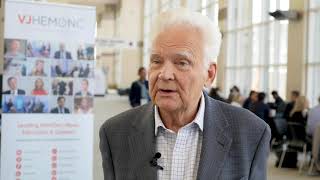
Gösta Gahrton, MD, Karolinska University Hospital, Stockholm, Sweden, shares his views on the prospect of a cure in multiple myeloma (MM), highlighting the role of next-generation sequencing (NGS) in measurable residual disease (MRD) detection and the promise of CAR T-cell therapies in producing curative outcomes. This interview took place at the 12th World Congress on Controversies in Multiple Myeloma (COMy) in Paris, France.
These works are owned by Magdalen Medical Publishing (MMP) and are protected by copyright laws and treaties around the world. All rights are reserved.
Transcript
Well, concerning a cure, in my view, you are not sure of a cure, but you can think about defining it as a patient that has lived for 20 years, we have those patients, and is free of disease, in complete remission, and MRD negative. That’s a cured patient. I think it is interesting that today, you talk about a cure. Four years ago, when I made the first allogeneic transplant, people just talked about having a chronic disease, making the disease chronic...
Well, concerning a cure, in my view, you are not sure of a cure, but you can think about defining it as a patient that has lived for 20 years, we have those patients, and is free of disease, in complete remission, and MRD negative. That’s a cured patient. I think it is interesting that today, you talk about a cure. Four years ago, when I made the first allogeneic transplant, people just talked about having a chronic disease, making the disease chronic. Today we talk about a cure as we did 40 years ago. And I think that’s great. And that change I appreciate very much. Well, I think NGS is the best method. That could be debated, of course, but I think so. But it’s not the proof that you are cured, that you have NGS-MRD negativity. You have to have it for a long time. But maybe after three, four years with NGS-MRD negativity, you may talk about a cure. Well, my advice would be to use the best possible treatment upfront. And in my view, that is a CAR T-cell directed therapy targeting even more than one antigen on myeloma cells and that will give a higher chance for an eventual cure.
This transcript is AI-generated. While we strive for accuracy, please verify this copy with the video.
Read more...