The Lymphoma Channel is supported with funding from AstraZeneca (Diamond), BMS (Gold), Johnson & Johnson (Gold), Takeda (Silver) and Galapagos (Bronze).
VJHemOnc is an independent medical education platform. Supporters, including channel supporters, have no influence over the production of content. The levels of sponsorship listed are reflective of the amount of funding given to support the channel.
EHA 2026 | Results from the Phase III FRONTMIND study: tafasitamab, lenalidomide, and R-CHOP in frontline DLBCL
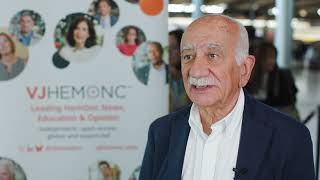
In this interview, Umberto Vitolo, MD, Candiolo Cancer Institute, FPO-IRCCS, Turin, Italy, discusses findings from the Phase III frontMIND study (NCT04824092), which compared a novel combination of tafasitamab, lenalidomide, and R-CHOP to R-CHOP alone in previously untreated high-risk diffuse large B-cell lymphoma (DLBCL). Prof. Vitolo notes that the study met its primary endpoint, with a significant reduction in the risk of progression or death, and that this benefit was observed across all DLBCL subtypes, as well as in high-risk patients with double-hit lymphoma. This interview took place at the 31st Congress of the European Hematology Association (EHA) in Stockholm, Sweden.
These works are owned by Magdalen Medical Publishing (MMP) and are protected by copyright laws and treaties around the world. All rights are reserved.
Transcript
From my study is a phase 3 randomized double-blind placebo study aimed to compare standard treatment which is rituximab CHOP for high-risk diffuse large B-cell lymphoma with a novel treatment with R-CHOP with addition of tafasitamab, an anti-CD19 monoclonal antibody, and lenalidomide. The biological background of the study was to add two agents to standard R-CHOP and lenalidomide is an immunomodulating agent that can increase the NK cells to cooperate with the antibody activity...
From my study is a phase 3 randomized double-blind placebo study aimed to compare standard treatment which is rituximab CHOP for high-risk diffuse large B-cell lymphoma with a novel treatment with R-CHOP with addition of tafasitamab, an anti-CD19 monoclonal antibody, and lenalidomide. The biological background of the study was to add two agents to standard R-CHOP and lenalidomide is an immunomodulating agent that can increase the NK cells to cooperate with the antibody activity. So we randomized all over the world almost 900 patients and only high-risk patients based on international prognostic index high-risk intermediate and high-risk, and also patients with a short time from the diagnosis to start of treatment within 20 days because this recognizes a group of patients with poor prognosis. After three years of follow-up, the study met its primary endpoint about progression-free survival. It was a significant reduction in the risk of progression or deaths for the patients randomized to the experimental arm, with a 25% reduction of risk of progression. And also there was a benefit in terms of event-free survival. A key point that this benefit was observed across all subtypes of diffuse large B-cell lymphoma, in GCB subtypes and also ABC subtypes. And also we observed a benefit for the experimental study for high-risk patients like double-hit lymphoma, even if it’s a small group, but it’s interesting, it’s a good signal to have a new treatment also for these patients.
This transcript is AI-generated. While we strive for accuracy, please verify this copy with the video.
Read more...