The Community Focus Channel is supported with funding from Johnson & Johnson (Gold).
The Lymphoma Channel is supported with funding from AstraZeneca (Diamond), Johnson & Johnson (Gold), Takeda (Silver) and Galapagos (Bronze).
VJHemOnc is an independent medical education platform. Supporters, including channel supporters, have no influence over the production of content. The levels of sponsorship listed are reflective of the amount of funding given to support the channel.
ASCO 2026 | Promising approaches for managing patients with MCL with prior BTKi exposure
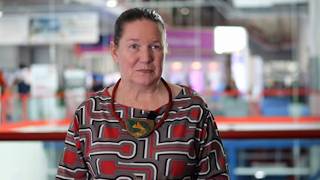
Yasmin Karimi, MD, University of Michigan, Ann Arbor, MI, outlines promising approaches for managing patients with mantle cell lymphoma (MCL) who have previously been exposed to a BTK inhibitor (BTKi), including BCL-2 inhibitors such as venetoclax, bispecific antibodies, and re-challenging with an alternative BTKi. Dr Karimi emphasizes the need for data from randomized head-to-head trials to determine the best treatment option in this setting. This interview took place during the 2026 American Society of Clinical Oncology (ASCO) Meeting in Chicago, IL.
These works are owned by Magdalen Medical Publishing (MMP) and are protected by copyright laws and treaties around the world. All rights are reserved.
Transcript
I think that there are lots of promising options for post-BTK inhibitor treatment in the current era. I think the majority of our patients currently are receiving a BTK inhibitor with frontline therapy after the ECHO and the TRIANGLE data has come out. And so a lot of our patients even in the second-line setting are post-BTK inhibitor. I think we are looking into now whether these patients can be re-challenged with BTK inhibitor, depending on their degree and duration of response...
I think that there are lots of promising options for post-BTK inhibitor treatment in the current era. I think the majority of our patients currently are receiving a BTK inhibitor with frontline therapy after the ECHO and the TRIANGLE data has come out. And so a lot of our patients even in the second-line setting are post-BTK inhibitor. I think we are looking into now whether these patients can be re-challenged with BTK inhibitor, depending on their degree and duration of response. We see promising activity of the non-covalent BTK inhibitors, including pirtobrutinib, as well as BCL-2 inhibitors, both venetoclax, and now with the recent approval of sonrotoclax for this patient population. We also have accessibility to CAR T-cell therapy with two different products, and now our bispecific antibodies, including glofitamab in this patient population, all present very promising data. I think we all need to see the randomized head-to-head data to know which is the next best option for treatment in this patient population, and look forward to seeing the results of the Phase III GLOBRYTE study, which will be comparing glofitamab monotherapy to standard of care, either BR or lenalidomide-based therapy, to really know, one, the impact we’re having with these novel therapies over standard of care, and two, what the durability and outcomes of treatment in this patient population look like outside of the COVID-19 pandemic.
This transcript is AI-generated. While we strive for accuracy, please verify this copy with the video.
Read more...