The Community Focus Channel is supported with funding from Johnson & Johnson (Gold).
The Lymphoma Channel is supported with funding from AstraZeneca (Diamond), Johnson & Johnson (Gold), Takeda (Silver) and Galapagos (Bronze).
VJHemOnc is an independent medical education platform. Supporters, including channel supporters, have no influence over the production of content. The levels of sponsorship listed are reflective of the amount of funding given to support the channel.
EHA 2026 | The value of POD24 when personalizing treatment selection in follicular lymphoma
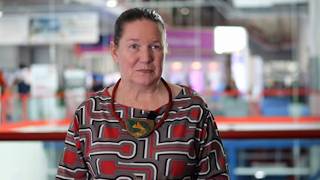
In this video, Tara Graff, DO, Mission Cancer and Blood, Des Moines, IA, discusses treatment selection for patients with follicular lymphoma (FL), highlighting settings in which the POD24 (Progression of Disease within 24 months) clinical endpoint is valuable to clinicians. Dr Graff emphasizes the significance of POD24 in the second-line setting, as patients who have progressed within two years of frontline therapy require effective novel treatment options. This interview took place at the 31st Congress of the European Hematology Association (EHA) in Stockholm, Sweden.
These works are owned by Magdalen Medical Publishing (MMP) and are protected by copyright laws and treaties around the world. All rights are reserved.
Transcript
Currently in the guidelines for frontline follicular, from a standard of care approach, you know, we still heavily rely on chemoimmunotherapy, right? So it’s in our second lines of therapy that we start getting into more of a chemo-free, chemo-light environment. In the frontline, you know, obviously POD doesn’t really come into play because they haven’t progressed yet, right? They’re newly diagnosed patients...
Currently in the guidelines for frontline follicular, from a standard of care approach, you know, we still heavily rely on chemoimmunotherapy, right? So it’s in our second lines of therapy that we start getting into more of a chemo-free, chemo-light environment. In the frontline, you know, obviously POD doesn’t really come into play because they haven’t progressed yet, right? They’re newly diagnosed patients. So in those cases, that’s where clinical trials are really important. For example, I’ve been part of the Epkinly or Epcoritamab R-square trial. So looking at a completely chemo-free option for those frontline or newly diagnosed follicular patients to hopefully capture and better treat patients so that they won’t have progression of disease in 24 months.
Now, where POD24 becomes very important is in that second line, right? So our patients who’ve been treated with chemoimmunotherapy, whether it’s an anti-CD20 with rituximab or obinutuzumab, you know, if they’ve progressed within two years, what we do in the second line becomes important because they’re a more aggressive, you know, patient population. And so it’s very important. And when we look at some of the novel combinations that have been approved, both with epcoritamab R-squared in the second line, that was approved this past November of 2025, as well as the trial, you know, InMIND that is that regimen with Tafa-Len-R-squared, that got approved in June of 2025. Now, both of those regimens, so one with a bispecific, one with an anti-CD19 with Tafasitamab, really highlighted that POD24 group. And those patients that received those novel combinations did better when compared to standard of care therapy. So POD24, when I look at a regimen and what to choose, I go right to that. I want to know how that more aggressive population, how they responded. Because if only the patients that are, you know, low risk and with good disease characteristics are responding, that’s not going to make me feel good. Yes, I’m happy, but it’s those more aggressive patients that we need to really, you know, up the ante and make sure we’re treating appropriately.
This transcript is AI-generated. While we strive for accuracy, please verify this copy with the video.
Read more...