The Community Focus Channel is supported with funding from Johnson & Johnson (Gold).
VJHemOnc is an independent medical education platform. Supporters, including channel supporters, have no influence over the production of content. The levels of sponsorship listed are reflective of the amount of funding given to support the channel.
iwAL 2026 | Expanding donor access for allogeneic transplantation in AML
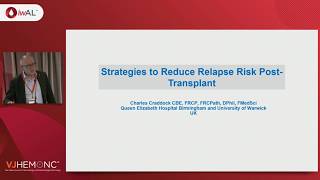
Charles Craddock, CBE, FRCP(UK), FRCPath, DPhil, FMedSci, University of Birmingham, Birmingham, UK, discusses advances in donor selection that could improve equitable access to allogeneic stem cell transplantation for patients acute myeloid leukemia (AML) from ethnic minority backgrounds. He highlights evidence from the Phase II ACCESS trial (NCT04904588) supporting the use of mismatched unrelated donors with post-transplant cyclophosphamide, which could expand donor availability and reduce disparities in access to transplantation. This interview took place at the 8th International Workshop on Acute Leukemias (iwAL 2026), held in Boston, MA.
These works are owned by Magdalen Medical Publishing (MMP) and are protected by copyright laws and treaties around the world. All rights are reserved.
Transcript
Until recently, one of the major challenges in terms of equitably offering a potentially curative transplant to all patients was the fact that it was only possible to identify a well-matched unrelated donor in about 50% of patients from ethnic minorities, in other words, patients who weren’t Caucasian. And that’s largely due to the composition of unrelated donor registries. In contrast, if you are Caucasian, there’s about an 85% to 90% chance of identifying a well-matched unrelated donor...
Until recently, one of the major challenges in terms of equitably offering a potentially curative transplant to all patients was the fact that it was only possible to identify a well-matched unrelated donor in about 50% of patients from ethnic minorities, in other words, patients who weren’t Caucasian. And that’s largely due to the composition of unrelated donor registries. In contrast, if you are Caucasian, there’s about an 85% to 90% chance of identifying a well-matched unrelated donor. So there are a number of ways by which you could try and address that issue. One is to increase the number of donors on these registries, increase the representation of ethnic minorities. But this had proved very slow in terms of tackling this completely unacceptable inequity of access for distinct ethnic groups. What has been transformative has been the demonstration from the US bone marrow transplant clinical trials network in an important study published in JCO last year, the ACCESS trial, that using post-transplant cyclophosphamide, outcomes using a 7 out of 8 or a 6 out of 8 unrelated donor are as good as those achieved using a fully matched unrelated donor. Now, we need longer follow-up on this cohort, and we also need a trial within the UK to confirm it applies also to the UK setting. But this is a really high-quality study, and the implications are profound. Firstly, it offers the chance that almost every patient with what we call allomandatory AML, patients who need a transplant, will have a donor. Secondly, it promises to eradicate the completely unacceptable inequity of access to transplant for non-Caucasian patients. And finally, it has profound implications for the composition of unrelated donor registries, not only in the UK, but across the world. So I think this is one of the most important studies of the last decade. And I think it has profound implications for not only increasing equity of care, but also improving rapid access to a curative transplant for all patients, regardless of ethnicity.
This transcript is AI-generated. While we strive for accuracy, please verify this copy with the video.
Read more...