The Multiple Myeloma Channel is supported with funding from AbbVie (Platinum), Sanofi (Gold), Legend Biotech (Bronze), and through an educational grant from Alexion Pharma GmbH.
VJHemOnc is an independent medical education platform. Supporters, including channel supporters, have no influence over the production of content. The levels of sponsorship listed are reflective of the amount of funding given to support the channel.
IMS 2026 | Melflufen and dexamethasone in triple-class-refractory multiple myeloma
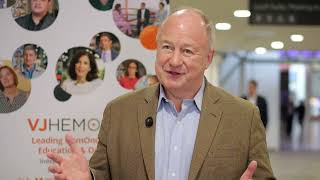
Paul Richardson, MD, Dana-Farber Cancer Institute, Boston, MA, discusses findings from the HORIZON study (NCT02963493) evaluating melflufen and dexamethasone in heavily pretreated, triple-class-refractory multiple myeloma. He highlights differences in response according to prior CD38 monoclonal antibody exposure, including higher responses following isatuximab than daratumumab, and discusses the hypothesis-generating potential of combining or sequencing peptide drug conjugates with CD38-directed therapy. This interview took place at the 23rd International Myeloma Society (IMS) Annual Meeting in Glasgow, UK.
These works are owned by Magdalen Medical Publishing (MMP) and are protected by copyright laws and treaties around the world. All rights are reserved.
Transcript
The HORIZON study was a single-arm Phase 2 trial exploring the activity and safety of melflufen and dexamethasone in heavily pretreated relapsed refractory myeloma patients. They had to be triple-class refractory going into the study, so they all had CD38 monoclonal antibody exposure. A significant proportion had received daratumumab, as one might expect, but actually a number had also received isatuximab...
The HORIZON study was a single-arm Phase 2 trial exploring the activity and safety of melflufen and dexamethasone in heavily pretreated relapsed refractory myeloma patients. They had to be triple-class refractory going into the study, so they all had CD38 monoclonal antibody exposure. A significant proportion had received daratumumab, as one might expect, but actually a number had also received isatuximab. And what we saw are a couple of interesting things. First of all, descriptively, we saw that there was an actual difference in the amount of extramedullary disease associated with the patterns of relapse depending on which antibody the patients had received. In particular, there seemed to be more extramedullary disease associated with daratumumab exposure versus isatuximab, but these numbers did not achieve statistical significance because the sample size was simply too small. So we took a harder look at this and then we saw something that was actually significantly different, which was that the responses to melflufen after antibody exposure appeared to be meaningfully different. In other words, if you’d had prior isatuximab and you received melflufen in salvage, the response rates were remarkable. If you’d received prior daratumumab, there was a significant response rate consistent with the data set overall, but not as marked as there was with isatuximab. And so we wondered, what does this mean? And this is a hypothesis-generating observation, but it suggests that there may be some mechanistic differences in terms of how a peptide drug conjugate might interact with a CD38 monoclonal antibody. Now, why does this matter? Well, it’s very interesting because as some of our listeners may recall, when you combine melflufen with daratumumab, the efficacy was remarkable. This study led by Mary Mathias, the so-called LIGHTHOUSE trial, demonstrated that when you combine melflufen with daratumumab compared to a daratumumab control, the progression-free and overall survival benefit was striking in favor of the combination of melflufen and daratumumab. Now, this trial, unfortunately, had to be closed early and did not complete its full enrollment. And so, essentially, these observations remain descriptive. But this observation that CD38 combined with melflufen is highly synergistic is obviously compelling. And so the fact now that with isatuximab, that difference may be even more marked is, we think, worthy of further study. And so in that regard, this work is hypothesis-generating, but we think compelling because it suggests this construct of peptide drug conjugate in sequence and or in combination with a CD38 monoclonal antibody is worthy of further evaluation.
This transcript is AI-generated. While we strive for accuracy, please verify this copy with the video.
Read more...