The Myelodysplastic Syndromes Channel is supported with funding from Geron (Silver).
VJHemOnc is an independent medical education platform. Supporters, including channel supporters, have no influence over the production of content. The levels of sponsorship listed are reflective of the amount of funding given to support the channel.
iwMDS 2026 | Current best practices and emerging treatment strategies in higher-risk MDS
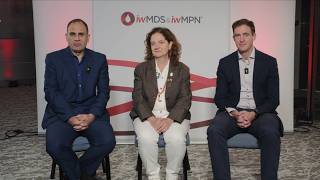
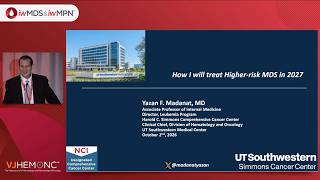
In this roundtable discussion, Yazan Madanat, MD, UT Southwestern Medical Center, Dallas, TX, Maximilian Stahl, MD, Yale Cancer Center, New Haven, CT, and Amer Zeidan, MBBS, MHS, Yale University and Yale Cancer Center, New Haven, CT, discuss current best practices and emerging treatments for higher-risk myelodysplastic syndromes (MDS). Dr Madanat highlights targeted therapies, including ivosidenib and the Phase III PyramIDH trial (NCT06465953), while Dr Stahl discusses lessons from unsuccessful clinical trials and Dr Zeidan explores emerging monoclonal antibodies. The experts also examine the implications of the Phase III VERONA trial (NCT04401748) and the role of transplantation, including findings from the PALOMA trial (NCT04061239). This roundtable discussion took place at the 4th International Workshop on Myelodysplastic Syndromes & Myeloproliferative Neoplasms (iwMDS/iwMPN) 2026, held in Washington, D.C.
These works are owned by Magdalen Medical Publishing (MMP) and are protected by copyright laws and treaties around the world. All rights are reserved.
Transcript
Yazan Madanat
Hi everyone, my name is Yazan Madanat. I’m an associate professor at UT Southwestern in Dallas, Texas. And today we had a wonderful session at the International Working Group for MDS meeting. this is the fourth international meeting, and our session was really targeted at the current best practices for higher-risk MDS. I’m joined today by two of my colleagues and I’ll have them introduce themselves...
Yazan Madanat
Hi everyone, my name is Yazan Madanat. I’m an associate professor at UT Southwestern in Dallas, Texas. And today we had a wonderful session at the International Working Group for MDS meeting. this is the fourth international meeting, and our session was really targeted at the current best practices for higher-risk MDS. I’m joined today by two of my colleagues and I’ll have them introduce themselves.
Maximilian Stahl
Sure, nice to be with you. Yazan, my name is Max Stahl from Yale University.
Amer Zeidan
Yeah, nice to meet you both and Amer Zeidan from Yale University as well.
Yazan Madanat
All right. So I had a brief I was tasked to present on how I will treat MDS in the year twenty twenty-seven. And in higher-risk MDS, you know, we’ve had quite a bit of struggles with clinical trials that have been in development with a slew of negative clinical trials over the past decade or two. and in twenty twenty-seven, you know, some of the advances or the exciting pieces to that is you know, the evolution of targeted therapy, particularly in IDH1-mutated higher-risk disease. so the IDIOME trial led by Marie Sebert has been now published in Leukemia with extremely high response rates with a CR of about 60%, one-year overall survival upwards of 90% in patients with higher-risk disease when they’re treated with ivosidenib monotherapy in the frontline setting.
And as a result of that, we have the randomized phase phase three trial called the PyramIDH study, where two which is a two-to-one randomization where patients were receiving ivosidenib monotherapy versus azacitidine in the frontline setting. And the results of that trial will be registrational and ho could hopefully by end of 2027 maybe result in a change in the current landscape and standard of care. I think the other most exciting thing is that three days ago.
There was a press release using the azacitidine cedazuridine, which is ASTX030, an oral version of azacitidine, where we’re moving towards a more oral therapy for patients with higher-risk disease. And we hope to see the results of that study presented at one of the international or national meetings. Max, do you wanna tell us what what your session was about?
Maximilian Stahl
Sure. Yeah. My session was kind of trying to go back in time and think about the trials that we had over the last ten plus years, trying to improve on the standard of care of MDS and what went wrong or what were the lessons that we learned from those trials. and I acknowledged right in the beginning that it’s very easy to play Monday quarterback and like come up with lessons, but we discussed a couple of them and I just mention a couple here and then maybe a couple of them we leave for open discussion among the three of us. but you know, one thing I think that we all acknowledged during this session was that MDS is a very, very heterogeneous disease, both molecularly as well as from just the pathophysiology of the disease. acknowledging that MDS has both dysplasia, elevated blasts, and different types of mutations, and and putting all those types of patients with a very heterogeneous disease in one clinical trial is maybe not the best way to do these clinical trials. And I showed some examples from the VERONA trial showing that there are some subgroups that might have benefited from venetoclax, such as patients with elevated blasts, while other patients with no blasts or TP53 mutations clearly did not benefit from this intervention. Then I talked a little bit about a suggestion of treating TP53-mutated patients in dedicated clinical trials. because I think they have a very different biology, but also probably require different endpoints. so more event-driven rather than response-driven endpoints. Lastly, I talked about side effects, and that I think we often see in early phase clinical trials that there are side effects, but they may be managed quite well because patients are treated inpatient for a prolonged time at specialized centers. And once a trial is then rolled out into a phase three setting, you see some of the side effects really catching up with you. And then lastly, we we talked a little bit about the updated response criteria, the 2023 response criteria or Zeidan criteria, I guess we can call them.
And you know, and and and some of the limitations of the older response criteria, which was really that you can both underestimate and overestimate the effect of a drug. overestimate I mainly talked about marrow CR and some of the issues. We can maybe discuss that a little bit among us. And then also underestimating response criteria and how we try to formulate less than CR responses. So those were some suggestions, but I think there are a lot more that we can discuss.
Amer Zeidan
Yeah, and my talk looked at some of the monoclonal antibodies that are in development, immune checkpoint inhibitors. And idea is that immune dysregulation, dysfunctional cells, on the quantitative or qualitative level, is a very important component of how MDS develops and progresses. And we have seen evidence of success of immune interventions, such as bone marrow transplantation. So a number of these antibodies have been tested. Some of those earlier generation antibodies, including anti-PD-1, PD-L1, CTLA-4 have not had great success in MDS compared to the very good results we have seen on solid tumors. But some of the novel antibodies, again, some of those kind of newer pathways, such as the TIM-3, the CD47, and the CLEVER-1 and galectin-9 are being explored more. And I showed some of the data. Sabatolimab is the most advanced. It’s an anti-TIM-3 antibody. The phase three missed its primary endpoint in overall survival just by a little bit. Survival was 22 months compared to 18 months with the combination versus HSA with placebo. And the anti-galectin-9 and anti-CLEVER-1 antibodies, one is called LYT-200 and the other one is bexmarilimab.
Both of them are moving from phase one trials to a Project Optimus type of phase two trials where different doses of the drugs are being tested against placebo, both in the frontline as well as in the relapsed/refractory setting. And then the CD47 targeting approach, we had the story of magrolimab, but magrolimab induced anemia and hemolysis and had significant toxicity. So it’s not clear that this pathway is completely invalid. This antibody called AK117 had early data to suggest it does not cause anemia and has good activity in trials that run in China. So what was done is a randomized phase two trial as well looking at two different doses of the antibody against AZA with placebo in the frontline setting. And this trial is fully accrued and hopefully will be presented in the near future. So I think we still have hopefully the chance to see some of those antibodies making a difference in patients with high-risk MDS.
Yazan Madanat
Well, these really exciting advancements. I think, you know, we also had a debate during the session, and I just wanted to hear your input and opinion. we know with the negative VERONA study results using venetoclax higher-risk MDS, there’s been a lot of discussion in the room as to and some people are pro-continuing to use it, and others are gonna be saying HMA therapy is the only way to go for higher-risk MDS. And I just wanted to hear from you, Max and Amer, what your take on that and how you would think about venetoclax higher-risk MDS, if at all.
Maximilian Stahl
Sure. Yeah, it feels almost like two MDS doctors, three different opinions, right, about venetoclax. And I think we saw this during the session. so how I make sense of it or how I use it in my own practice is that it depends on a couple factors. one is are there elevated blasts present or not? I typically don’t use venetoclax if there are no blasts present. I think that was one of the conclusions from the VERONA trial. The second part is the mutational status. I generally don’t use it in TP53-mutated disease. and the third one is what is the therapeutic intent? are we moving this patient to transplant? and often our transplanters require blast reduction. We can discuss, you know, how much blast reduction is sensible before transplant, but that is often a requirement. while I don’t use venetoclax typically for patients who are not transplant candidates and because I’m worried more about cytopenias and kind of long term infection risk, et cetera. I don’t know how Amer feels about it.
Amer Zeidan
I think a very similar approach. So I use it in really a very limited number of patients, relatively younger patients in whom I’m clearly trying to bridge to transplant and they have a blast count, generally more than 10%. And especially the ones who have mutations that could predict sensitivity, IDH, NPM1, although, know, NPM1 could be called AML, based on their new criteria when they are more than 10% blasts, but generally I would avoid it in TP53.
So in my mind, it’s really, if I’m going to use intensive chemo in a patient, AZA-VEN could be an approach where I could do it outpatient. So it’s really more about convenience rather than knowing that it’s better than AZA by itself, especially if there’s a donor that’s lined up relatively quickly. I do think if you are gonna use it, you have to be very careful about causing myelosuppression and giving antifungal prophylaxis and because these things certainly can derail transplant and the most important component of the treatment is going to be transplant. So if you are going to use it, I think you have to monitor and manage the patient very carefully.
Yazan Madanat
No, these are great points from you both. I think I I kind of agree with with that approach for sure, but it’s a very select number of patients that would benefit from it, particularly those heading to transplant where the transplant is kind of quite ready for them. I think, Amer, you hinted at this and and mentioned intensive chemotherapy and we also had a great session pr or topic presented by Dr. Klaus Metzeler talking about the PALOMA trial using intensive chemotherapy, CPX-351 or azacitidine as a bridge to transplant, with an extremely high success rate of upwards of eighty-five percent in their trial of patients were able to get to transplant. And I wanted to know what your take on it. It did have twenty percent of patients who had AML with twenty to twenty-nine percent blasts, but the majority of those patients had MDS and how that might change th your thoughts about current approaches as a when you use VEN-AZA or AZA or intensive chemotherapy as a bridge.
Amer Zeidan
Yeah, maybe I have a couple of general comments and then I’ll be interested to hear what you and Max think. I think aside from the drug that was used, think what was quite innovative for me in this trial is it used an approach that I think we probably should think about more in MDS in which we rather than lumping all patients together, high-risk MDS, whether they are young, you know. Current MDS trials, can put someone who’s 19 and you could put someone who’s 89, right? It’s kind of everybody, as long as they are fit for a trial, whether transplant is a real option or not, they are all put on the same trial. And I think this is causing some problems in the conduct, the interpretation, the results, depending on what is the particular agent and how many patients end up going to transplant versus not. And I’ve been thinking more and more to kind of use an approach that’s more like AML, right? Where we divide patients into fit and unfit, which really means that, you know, can you go to transplant or not, or use it like some age limit. So I think this trial was interesting in the sense that they only put patients who were fit for intensive treatment who were going to go to transplant. So they really were kind of a more homogeneous group. I think this is a very good approach to do trials. I think the downside is that the control arm was 7+3 predominantly and you did ask him about that and which I think was a very important question because a small number of patients got azacitidine monotherapy and somehow we already know that CPX is better than 7+3 in AML arising from MDS. So this made it like okay. Well, you know if most of the patients are getting 7+3 Are you getting side effects without helping the patients with the 7+3? But also what was interesting to me is that the ability to get most of the patients, and you also pointed this out, it’s quite impressive to be able to get 85% of the patients that you started with intending to go to transplant to actually go to transplant. So this tells me that we certainly should try to get patients to transplant whenever possible. And then when we look at the overall survival, still not mature, but the overall survival, the median was more than 36 months. So you are curing many of those patients. So again, this, think, highlights the importance of the transplant. How do we get to transplant? Again, it’s debatable. Is it CPX? Is it 7+3? But I think the concept of being able to bridge patient to transplant and achieve high survival rate is very important. Of course, this unfortunately applies to a relatively limited number of patients with MDS because many of them will not be candidates for transplant to begin with.
Yazan Madanat
Right. Max, any other thoughts or comments on the PALOMA trial?
Maximilian Stahl
Yeahm yeah, no, I agree with everything that Amer said. I think it’s a very interesting trial. I think one thing not to underestimate, and and Klaus mentioned this during his talk, is like what is the transplant algorithm or what is the frontline treatment algorithm in Europe compared to it in the US? And I think one important thing he mentioned is that patients with less than ten percent of blasts basically go to transplant like very quickly, you know, which is not necessarily the practice that we have in the US, at least in many centers, you know. And I think what is one takeaway from this trial, other trials as well. I remember the VidazaAllo trial was important in this, you know, where they gave actually multiple cycles and they lost quite a few patients who they had the intent of going to transplant. So I think the key what they did is they gave a quick induction, they sent them right to transplant, you know. And I think that is important practice. And I think this was to Amer’s point that in the end the survival is driven by the patients who are transplanted, you know, and whatever regimen we give up front, we shouldn’t give this for prolonged time if the patient clearly is geared towards transplant. You know, and and sometimes we should not give it at all. Maybe, you know, if they’re less than ten percent blasts, we maybe should not spend so much time of reducing it to less than five percent when the benefit of that is is arguable at best. And I think at in in most series it probably doesn’t make a difference.
Yazan Madanat
Right. Yeah. And yeah, this five to nine percent I call it the gray zone where you know, some patients you repeat marrows over time and it’s six percent sec seven percent is not changing and you know that disease biology is probably slow and not progressive, where six percent versus four percent isn’t gonna make that whole difference.
Amer Zeidan
Yeah, and some of it is a cultural shift because I think the transplanters in the US generally were generally more tuned into the idea that you have to be less than 5%. But I think seeing a lot of the data over the last several years, I think we are seeing higher appetite to actually transplant patients even if they are slightly above 5 or between 5 and 9 as long as the patient is stable and there is no evidence of progression when you repeat the bone marrow.
So I think some of that hopefully will translate into better outcomes.
Yazan Madanat
Yeah, well that’s fantastic. Thank you both for a great discussion. And with that, we’ll wrap our higher-risk MDS session. Thank you all.
Maximilian Stahl
Thank you, Yazan. Thank you.
Read more...