The Community Focus Channel is supported with funding from Johnson & Johnson (Gold).
VJHemOnc is an independent medical education platform. Supporters, including channel supporters, have no influence over the production of content. The levels of sponsorship listed are reflective of the amount of funding given to support the channel.
EBMT 2026 | Flu/Mel versus Flu/Treo conditioning in adult patients with ALL undergoing first alloSCT
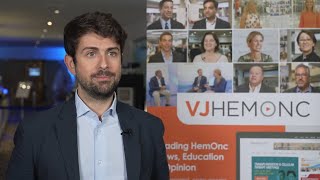
Daniele Avenoso, MD, University of Brescia, Brescia, Italy, shares the findings of a retrospective study comparing fludarabine-melphalan (Flu/Mel) and fludarabine-treosulfan (Flu/Treo) conditioning in adult patients with acute lymphoblastic leukemia (ALL) undergoing first allogeneic stem cell transplantation (alloSCT). Dr Avenoso highlights that Flu/Treo was found to yield comparable overall survival (OS) and non-relapse mortality (NRM) to Flu/Mel, and a multivariable analysis revealed an improved leukemia-free survival and reduced relapse risk. This interview took place at the 52nd Annual Meeting of the EBMT in Madrid, Spain.
These works are owned by Magdalen Medical Publishing (MMP) and are protected by copyright laws and treaties around the world. All rights are reserved.
Transcript
As we know, acute lymphoblastic leukemia is a difficult disease and a non-negligible amount of patients will need an allogeneic hematopoietic stem cell transplant to be cured. But most of the patients may not be fit enough to sustain a fully myeloablative conditioning. Therefore, we need to still optimize the best reduced intensity conditioning regimen because the treatment failure is secondary to disease relapse and from the onset of unacceptable toxicity such as the GVHD and infections...
As we know, acute lymphoblastic leukemia is a difficult disease and a non-negligible amount of patients will need an allogeneic hematopoietic stem cell transplant to be cured. But most of the patients may not be fit enough to sustain a fully myeloablative conditioning. Therefore, we need to still optimize the best reduced intensity conditioning regimen because the treatment failure is secondary to disease relapse and from the onset of unacceptable toxicity such as the GVHD and infections. So with this study, we compare nearly 1097 patients between 2012 and 2024 who underwent allotransplant conditioning with fludarabine melphalan or fludarabine treosulfan. Within the treosulfan group, there were patients slightly older with more comorbidities and despite that they received an intermediate or mild ablative dose of treosulfan. Interesting enough, the overall survival and leukemia-free survival between the two groups are similar, suggesting that treosulfan, even in the context of lymphoblastic leukemia, is safe and effective. And in multivariable analysis, we could confirm that those that receive treosulfan have a better leukemia-free survival and reduced relapse incidence. So we can suggest that Fludarabine/treosulfan can offer a safe and effective conditioning for adult ALL patients.
This transcript is AI-generated. While we strive for accuracy, please verify this copy with the video.
Read more...


Disclosures
MEDAC, Sanofi, Jazz Pharma, Therakos, Alexion.