The Community Focus Channel is supported with funding from Johnson & Johnson (Gold).
The Multiple Myeloma Channel is supported with funding from AbbVie (Platinum), Sanofi (Gold), Legend Biotech (Bronze), and through an educational grant from Alexion Pharma GmbH.
VJHemOnc is an independent medical education platform. Supporters, including channel supporters, have no influence over the production of content. The levels of sponsorship listed are reflective of the amount of funding given to support the channel.
IMS 2026 | Addressing access challenges to bispecifics for patients with multiple myeloma in Asian countries
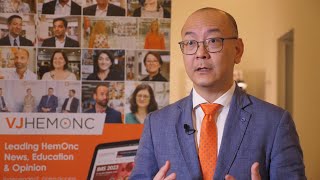
Wee Joo Chng, MB ChB, MRCP, MRCPath, PhD, National University of Singapore, Singapore, Singapore, discusses the main obstacles to increasing access to anti-BCMA bispecific antibodies for patients with multiple myeloma in Asian countries, highlighting that cost is the primary barrier due to prolonged reimbursement discussions with governments and high treatment costs. Dr Chng notes that addressing this issue is challenging, involves multiple stakeholders, and that raising awareness is a key step toward improving access. This interview took place at the 23rd International Myeloma Society (IMS) Annual Meeting in Glasgow, UK.
These works are owned by Magdalen Medical Publishing (MMP) and are protected by copyright laws and treaties around the world. All rights are reserved.
Transcript
I think the biggest issue is cost, really. Many of the Asian countries will have approval by the health authority for the use of BCMA, T-cell engager, or in some places even CAR-T. But that is approval for prescription. But for financial coverage, reimbursement, usually it’s a very prolonged discussion with the government. And if the costs of these treatments are high, then the discussion is even longer...
I think the biggest issue is cost, really. Many of the Asian countries will have approval by the health authority for the use of BCMA, T-cell engager, or in some places even CAR-T. But that is approval for prescription. But for financial coverage, reimbursement, usually it’s a very prolonged discussion with the government. And if the costs of these treatments are high, then the discussion is even longer. It’s a price negotiation with the company. And so what happens often is that for a very long period of time, sometimes as much as a decade after the drug is approved, there’s no reimbursement and patients have to pay for the treatment themselves, which clearly for most is just not possible without the ability to use insurance or national insurance or national reimbursement. So I think that’s really the biggest barrier is how to actually make it affordable. Even if the drug is available and it’s already approved, it’s just not affordable to many of the Asian patients in the Asia-Pacific region. And that’s, I think, our biggest challenge. I don’t have an easy way to solve this problem because it clearly involves many stakeholders, government, drug companies, patient support groups, and so on. And so I think what we are doing, because I’m also chairing an Asian myeloma network, is to actually raise the awareness of these issues, activate patient support groups, raise the awareness amongst the government, because myeloma is a relatively rare condition, and to the government officials, they may not be so aware of the relevance of this rare disease. So it’s to work through multiple channels to try to improve access, but it can be a really challenging situation for the low-income countries, because clearly they have a lot of other priorities to look after in the country.
This transcript is AI-generated. While we strive for accuracy, please verify this copy with the video.
Read more...