The Multiple Myeloma Channel is supported with funding from AbbVie (Platinum), Sanofi (Gold), Legend Biotech (Bronze), and through an educational grant from Alexion Pharma GmbH.
VJHemOnc is an independent medical education platform. Supporters, including channel supporters, have no influence over the production of content. The levels of sponsorship listed are reflective of the amount of funding given to support the channel.
IMS 2026 | Key updates on newly diagnosed multiple myeloma: progress and challenges in high-risk disease
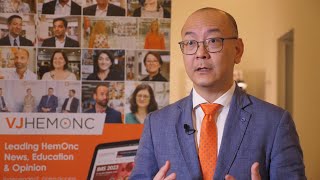
Wee Joo Chng, MB ChB, MRCP, MRCPath, PhD, National University of Singapore, Singapore, Singapore, discusses the key takeaways from a roundtable discussion on newly diagnosed multiple myeloma, highlighting the significant improvement in patient outcomes with current treatments. Prof. Chng notes that high-risk patients still pose a challenge, with debates surrounding the best treatment approaches, including the potential use of transplant, immunotherapies, and double maintenance therapy. This interview took place at the 23rd International Myeloma Society (IMS) Annual Meeting in Glasgow, UK.
These works are owned by Magdalen Medical Publishing (MMP) and are protected by copyright laws and treaties around the world. All rights are reserved.
Transcript
Yeah, so I think what has been shared in yesterday’s session is really how much outcomes of patients with myeloma have been improved with the current way that we are treating newly diagnosed patients. The impact is tremendous because based on the latest findings, you have a progression-free survival of up to 17 or more years. And Philippe shared that the usual life expectancy of someone at 60 is up to the age of about 84...
Yeah, so I think what has been shared in yesterday’s session is really how much outcomes of patients with myeloma have been improved with the current way that we are treating newly diagnosed patients. The impact is tremendous because based on the latest findings, you have a progression-free survival of up to 17 or more years. And Philippe shared that the usual life expectancy of someone at 60 is up to the age of about 84. So that’s 24 years more to live. And you have a diagnosis of myeloma at 60 now. You’re expected to have a remission for 17 of those years. So that’s tremendous progress. But I think we still have a lot more to learn for some high-risk group of patients where currently it’s unclear what is the best treatment for them because even with the current very good treatment, the outcomes are not as good as the standard risk patient. So there was debate about whether these patients will still benefit from transplant, whether they’ll benefit from inclusion of some of the newer immunotherapies like T-cell engagers or CAR-T in an upfront setting, whether they need double maintenance therapy. So there are still gaps that we have to study, but overall, I think for many of the patients with standard risk disease, if we treat them with the current standard based on the latest publication, PERSEUS and CEPHEUS for transplant-eligible patients, the outcome is now going to be very good. There was some time discussing about countries and regions where the drug access may not be as good. So, you know, the standard that I say is mainly applicable to Europe and the US and some of the richer countries in Asia. But for many parts of Africa or maybe even in Asia, in low-income countries, it may not be so possible, right, to do it exactly the same way. So in those patients, I think we have to be more clever with how we do things because even with triplet therapy, the outcomes are very good if we can manage the patient well and prevent them from dying from infection and so on. And also stopping treatment early, like two years of maintenance, giving patients a period of disease-free period may be the kind of strategy we need to go with for the lower-income patients.
This transcript is AI-generated. While we strive for accuracy, please verify this copy with the video.
Read more...