The Community Focus Channel is supported with funding from Johnson & Johnson (Gold).
The Lymphoma Channel is supported with funding from AstraZeneca (Diamond), Johnson & Johnson (Gold), Takeda (Silver) and Galapagos (Bronze).
VJHemOnc is an independent medical education platform. Supporters, including channel supporters, have no influence over the production of content. The levels of sponsorship listed are reflective of the amount of funding given to support the channel.
Tandem Meetings 2026 | Performance status outperforms comorbidities as a predictor of survival after BsAb treatment in LBCL
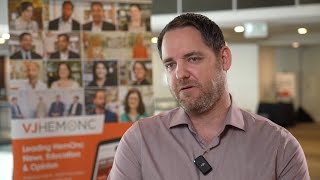
Geoffrey Shouse, DO, PhD, City of Hope Comprehensive Cancer Center, Duarte, CA, discusses the predictive value of performance status in patients with large B-cell lymphoma (LBCL) receiving bispecific antibody (BsAb) treatment, highlighting that performance status outperforms comorbidity scores as a predictor of survival outcomes in this setting. As baseline comorbidities did not appear to be associated with survival, this suggests that comorbidities may not preclude the use of BsAb treatment in patients with LBCL. This interview took place virtually.
These works are owned by Magdalen Medical Publishing (MMP) and are protected by copyright laws and treaties around the world. All rights are reserved.
Transcript
This was another study that we conducted with the CUBIC consortium, the 10 centers across the U.S. looking at bispecific antibody outcomes. The purpose of this study was to evaluate whether comorbidities predict toxicity and survival after bispecific antibody treatment for large B-cell lymphoma. All in all, we had 344 patients included. Half of patients received glofitamab, 45% received epcoritamab, and about 5% received mosunetuzumab...
This was another study that we conducted with the CUBIC consortium, the 10 centers across the U.S. looking at bispecific antibody outcomes. The purpose of this study was to evaluate whether comorbidities predict toxicity and survival after bispecific antibody treatment for large B-cell lymphoma. All in all, we had 344 patients included. Half of patients received glofitamab, 45% received epcoritamab, and about 5% received mosunetuzumab. In prior studies, including CAR T-cell therapy and other subtypes of non-Hodgkin’s lymphoma, we’ve been able to use comorbidities scores to evaluate survival outcomes. So, for example, Severe4, which looks at cumulative illness rating scale comorbidities in respiratory, upper GI, hepatic, and renal systems, is able to predict progression-free and overall survival after CAR-T. We published the findings from that study in 2023. And in addition, one of our collaborators used another score that was done, the TRES score, and there’s evaluated upper-GI and vascular organ systems. And that’s a three-item score.
We evaluated outcomes, specifically survival and toxicity, using each of these scores. And surprisingly, none of the comorbidity scores predicted survival outcomes. So progression-free and overall survival were similar whether patients had comorbidities by Severe4 or by TRES score. On the other hand, ECOG performance status with a cutoff of two or higher actually predicted significantly inferior progression-free and overall survival, with median progression-free survival for patients with good performance status being 4.9 months versus only two months for patients with compromised ECOG. And then for overall survival, the median was 14 months in those with good performance status, and 4.8 in patients with compromised functional status.
Looking at toxicity, the TRES score was actually predictive of higher rates of ICANS. So patients with this TRES score of three, meaning comorbidities in all three organ systems, had rates of ICANS as high as 30%, whereas those with lower TRES scores were in the 10% range. So in a further study, you may be able to identify comorbidities as a predictor of toxicity, but it doesn’t appear that they predict survival outcomes, which is in significant contrast to CAR-T, and it may mean that patients with significant comorbidities are can safely undergo bispecific antibodies.
This transcript is AI-generated. While we strive for accuracy, please verify this copy with the video.
Read more...


Disclosures
Consultancy: Abbvie, ADC Therapeutics, Astra Zeneca, BMS, BeOne Medicines, Kite Pharma, Merck; Prior Speakers Bureaus: ADC Therapeutics, BeOne Medicines, Kite Pharma.