The Lymphoma Channel is supported with funding from AstraZeneca (Diamond), Johnson & Johnson (Gold), Takeda (Silver) and Galapagos (Bronze).
VJHemOnc is an independent medical education platform. Supporters, including channel supporters, have no influence over the production of content. The levels of sponsorship listed are reflective of the amount of funding given to support the channel.
iwCAR-T 2026 | Novel cellular therapy approaches in NHL: NK-cell therapies, allo and in vivo CARs, and more
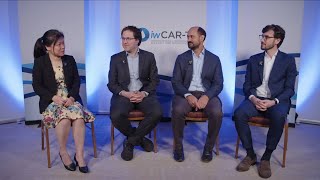
In this discussion, Krish Patel, MD, Sarah Cannon Research Institute, Nashville, TN, is joined by Paolo Strati, MD, The University of Texas MD Anderson Cancer Center, Houston, TX, and Michael Jain, MD, PhD, Moffitt Cancer Center, Tampa, FL, to share insight into novel cellular therapy approaches in non-Hodgkin lymphoma (NHL). First, Dr Strati provides an update on NK cell-based therapies for B-cell lymphoma, after which Dr Jain discusses the use of JAK inhibition to mitigate toxicities associated with CAR T-cell therapy. Finally, the experts comment on the potential of allogeneic (allo) and in vivo CARs, highlighting the benefits they may have over traditional autologous CAR constructs. This interview took place at the 8th International Workshop on CAR-T and Bispecifics 2026, in Tampa, FL.
These works are owned by Magdalen Medical Publishing (MMP) and are protected by copyright laws and treaties around the world. All rights are reserved.
Transcript
Krish Patel:
Hello, I’m Krish Patel from the Sarah Cannon Research Institute in Nashville. We just finished a great session on CAR T-cells, cellular therapy in general, in lymphomas. And I’m joined by my esteemed colleagues who will introduce themselves.
Paolo Strati:
Hello, everybody...
Krish Patel:
Hello, I’m Krish Patel from the Sarah Cannon Research Institute in Nashville. We just finished a great session on CAR T-cells, cellular therapy in general, in lymphomas. And I’m joined by my esteemed colleagues who will introduce themselves.
Paolo Strati:
Hello, everybody. My name is Paolo Strati. I’m a lymphoma investigator at the University of Texas in MD Anderson Cancer Center, Houston, Texas.
Michael Jain:
And I’m Michael Jain. I’m a lymphoma doctor at Moffitt Cancer Center here in Tampa, Florida.
Krish Patel:
So we just finished this session really focused on identifying some of the trends in cellular therapies and lymphomas. So we had a great kind of forum from what might be coming next in terms of technology to, Mike, you talked about modulating toxicity. So maybe, Paolo, I’ll turn it to you first. We talked about natural killer cells as a platform for immune effector cell therapy. Can you tell us a little bit about what we’ve learned so far and where you think the field can take this?
Paolo Strati:
Yeah, it was very exciting to be able to talk about the use of NK cells as a cellular therapy source for patients with B-cell lymphoma. As a reminder, currently we utilize autologous T-cells for patients with relapsed/refractory B-cell indolent and aggressive lymphoma. So NK-cell is really still an experimental source. And we can either utilize cord blood-derived NK-cells or what I presented today was mainly induced pluripotent stem cells that have the advantage over cord blood-derived NK cells to generate billions of cells in a short amount of time and with very homogeneous biology. I focus mainly on two clinical trials because those are the two that have mature enough clinical data for public sharing, FT516 and FT596. And the take-home message is that… So in the first case, we had iPSC-derived NK cells that was engineered to express high affinity CD16 for better antitumoral activity. And it was very safe. We released almost no cytokine release syndrome, definitely no neurotoxicity, and no GvHD, despite this being an allogeneic product. With FT596, we saw similar data. And as a reminder, the main difference between 516 and 596 was the addition of a CAR targetting CD19, but also an interleukin-15 receptor fusion protein so that the NK cells could be more persistent. And there was significant activity also in patients with aggressive B-cell lymphoma. So in both trials, patients were heavily pretreated with a median number of prior systemic lines of treatment of four or above. And despite that, even patients with aggressive B-cell lymphoma were able to achieve durable remissions in about 30% of cases. So definitely, we do have a product, in this case, again, non-T-cell-based, so not coming with all the typical toxicities that we see with T-cells, such as CRS or ICANS, and most importantly, allogeneic, that faces a very important dilemma that we currently have in the field, as these patient with aggressive B-cell lymphoma, on one end, sometimes they can’t wait for the manufacturing of an autologous CAR, but also if they are in the community, they may just struggle to adjust to the logistics the autologous CARs require. And these products seem to be safe and effective, but we need to work more on the persistence. So to the second part of your question, the future currently is trying to further engineer these iPSC-derived NK-cells to make them more persistent. For example, we have created a new product called 522, where we had knocked out CD38 to try to minimize the fratricide that currently NK-cells experience with each other. But also there was an addition of an ADR, a receptor recognizing allodefence to 41BB, and so minimizing alloreactivity and potentially even minimizing the dependency on lymphodepleting chemo. That is probably the next step that we need to do in cellular therapy, try to get away with cellular treatments that don’t require any chemotherapy at all.
Krish Patel:
Yeah, I mean, you really summarized that nicely, Paolo. I think one of the things I’m struck by in the NK cell platform is how safe the therapies were. Very, very little, if no CRS, no ICANS. Kind of juxtaposing that with what you presented, Mike, we know autologous CAR T-cells are a great value, right? Curative treatment in lymphoma, but they can be beleaguered by toxicity. Tell us a little bit about the work that you’ve been doing at Moffitt to try to help modulate that toxicity using medicines that we, you know, already have access to. I thought that was fascinating.
Michael Jain:
Yeah. So we’ve been able to treat standard of care patients with CAR T-cell therapy almost a decade now. And it’s quite different, you know, when you go from mouse models to humans, you know, we’re all physicians and our patients don’t look like healthy mice, right? They can be very sick, inflamed. You know, inflammation is a big part of the cancer syndrome. Patients can lose weight, you know, and get blood clots. And so it turns out that this is actually a pretty important predictor for whether or not when you put an engineered immune cell into a patient, that baseline inflammation tends to flare up after the CAR T-cell therapy. And so some patients have more inflammation than others, and is there a way that we can use known anti-inflammatory agents to try and bring down that inflammation and thus really get good outcomes in all patients? And so one class of drugs that’s been used a lot, particularly in the transplant field, but also all around immunity are the JAK inhibitors. And so the study that we did was to take patients who had a lot of baseline inflammation, treat them with JAK inhibitors before and during CAR T-cell therapy. And what we found is that it indeed reduced the toxicities, but what we were really going for is to try and have patients relapse less because we think the same inflammation that causes the toxicities are also suppressing the T cells, the CAR T-cells, that are doing the anti-tumor aspects. And so then we did some sort of very detailed studies using something called single cell RNA sequencing to look at, OK, how are these anti-inflammatory molecules, the JAK inhibitors, affecting various parts of a patient’s immunity and inflammation? And so I think this is a very interesting and potential future avenue for combining known drugs with our existing therapies, you know, to do better than we have over the last nine years.
Krish Patel:
Yeah, no, I think that was really fascinating, repurposing a drug to both potentially improve efficacy, maybe also modulate safety. Also in our session, we talked a little bit about allogeniec CARs. And then the session after ours, we talked about in vivo CAR T-cells. And so we recognize not every patient can get to an autologous CAR T-cell. Access can be a challenge. Maybe I’d ask you both to share, what do you think about alloCARs and in vivo CARs? They seem, again, very, very exciting platforms. What are some of the take-homes that we can take away from those sessions?
Paolo Strati:
Yeah, maybe I’ll go first. Definitely, both allogeneic CAR or in vivo CAR both address a highly unmet need, both from a biological and clinical perspective. So biologically speaking, one major limitation of any autologous product is that we are collecting immune cells from patients who are previously treated. And as such, those particular T-cells can be hampered by the prior systemic chemos in particular. So utilizing, of course, allogeneic products or in vivo CAR, that’s resolved. One additional advantage of the in vivo CAR, going back to what I was mentioning before, is that don’t require lymphodepleting chemo. That instead is a major priority for allogeneic products as we’re trying to minimize alloreactivity. But I would say we all were extremely positively impacted and surprised by the very good results that we heard at ASH and multiple myeloma, and we hope that we’ll see some similar results on lymphoma.
Krish Patel:
Yeah. What are your thoughts, Mike, on the in vivo platform? Is that something you’re working with? And where do you think it’s going to land?
Michael Jain:
Yeah. So, I mean, it already felt, you know, extremely highly technologically sophisticated to take someone’s T-cells, put them in a dish, you know, genetically engineer them into CAR T-cells and then have them cure people’s cancers. That already seemed amazing. But, you know, as you pointed out, this is not perfect and there are quite a few challenges with that therapy. Now, the next level idea being that you can just genetically engineer it directly in the patient’s body seems even more futuristic. And it does seem that this is possible – you can put the virus directly into the patient or a particle and have your own T-cells become genetically engineered through these gene engineering strategies. Now, this theoretically would overcome several of the problems of current CAR T-cell therapy. It remains to be seen, you know, only small numbers of patients have been treated, but lots of companies are ramping up to do this. We have a trial at Moffitt of in vivo CAR T-cells. And so we’re all very, very excited about the possibilities, but it has to be proven, I think, to see whether it will become part of our future.
Krish Patel:
Yeah, a lot of points you raised, I think, both may help bring down costs, may improve accessibility, but ultimately we have to make sure that they work as effectively and are as safe as the products we have today. So thank you both for taking us through that session.
This transcript is AI-generated. While we strive for accuracy, please verify this copy with the video.
Read more...