iwAL 2026 | The challenges of predicting and diagnosing differentiation syndrome
Stéphane De Botton, MD, PhD, Gustave Roussy Institute, Paris, France, discusses the challenges of predicting and diagnosing differentiation syndrome (DS). He notes that tumor burden may increase DS incidence in acute promyelocytic leukemia (APL), but reliable biological markers remain elusive due to limited availability and high research costs. Dr de Botton explains that while DS is readily recognized in APL, it is harder to identify with IDH and menin inhibitors. This interview took place at the 8th International Workshop on Acute Leukemias (iwAL 2026), held in Boston, MA.
These works are owned by Magdalen Medical Publishing (MMP) and are protected by copyright laws and treaties around the world. All rights are reserved.
Transcript
Usually, the tumor burden may increase the incidence of the syndrome, at least in APL. Otherwise, it’s difficult to determine whether there are some biological markers. For instance, lots of biological markers that are associated with DS are not easily available, and it’s not routinely done so in terms of research it is very difficult and quite expensive so I think it would take time to have a biological true biological marker especially cytokines chemokines and so on so there is no one DS...
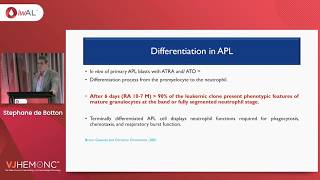
Usually, the tumor burden may increase the incidence of the syndrome, at least in APL. Otherwise, it’s difficult to determine whether there are some biological markers. For instance, lots of biological markers that are associated with DS are not easily available, and it’s not routinely done so in terms of research it is very difficult and quite expensive so I think it would take time to have a biological true biological marker especially cytokines chemokines and so on so there is no one DS. It’s a conundrum of signs and symptoms which are not really very specific. It depends on the context and first on the disease. In APL, it’s quite easy. Nowadays, we recognize the DS easily in APL because we anticipate what’s happening. Rising in leukocytes, signs of DS first described in the early 90s, the context and timing. Timing is very important because it’s at the onset of the differentiating treatment during the first week or by the end of the first week. For other situations with IDH it’s much more complicated because the block of differentiation may occur early or late during the hierarchy and we cannot determine when the DS may occur. Again we select signs and symptoms that could be those seen in APL and obviously we rule out infection which is quite not simple but usually easier than in the last situation which is with many inhibitors in which there are different situations we may encounter true DS as in APL with neutrophilic differentiation it’s easy to recognize with changes in white cell counts types of cells in the peripheral blood. But sometimes it’s monocytic differentiation or progression of the disease. And in that case, it’s not really very easy. And it’s retrospectively that we state it’s a DS or not.
This transcript is AI-generated. While we strive for accuracy, please verify this copy with the video.
Read more...