The Community Focus Channel is supported with funding from Johnson & Johnson (Gold).
VJHemOnc is an independent medical education platform. Supporters, including channel supporters, have no influence over the production of content. The levels of sponsorship listed are reflective of the amount of funding given to support the channel.
ESH AL 2026 | Blinatumomab, inotuzumab & venetoclax in older patients with ALL: practical considerations
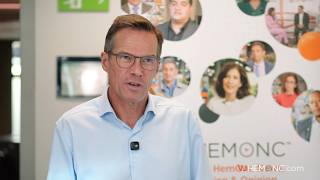
Marlise Luskin, MD, MSCE, Dana-Farber Cancer Institute, Boston, MA, shares insights into the treatment of older adults with acute lymphoblastic leukemia (ALL), emphasizing the importance of improving efficacy while reducing toxicity in this patient population. Dr Luskin highlights the potential of agents such as inotuzumab ozogamicin, blinatumomab, and venetoclax, each with its own advantages and challenges, and notes that ongoing trials are investigating how to best combine these agents to achieve optimal outcomes. This interview took place at the 5th How to Diagnose and Treat: Acute Leukemias meeting of the European School of Hematology (ESH AL) in Mandelieu-La Napoule, France.
These works are owned by Magdalen Medical Publishing (MMP) and are protected by copyright laws and treaties around the world. All rights are reserved.
Transcript
So the principle of regimens being developed for older adults has been to try to improve efficacy, get better disease response, but reduce toxicity. And so if I were to summarize the approaches being taken by groups of investigators around the world is to introduce a novel agent that has the opportunity to add efficacy and then to decrease and in some cases actually completely omit those conventional chemotherapy drugs that I mentioned had all this toxicity...
So the principle of regimens being developed for older adults has been to try to improve efficacy, get better disease response, but reduce toxicity. And so if I were to summarize the approaches being taken by groups of investigators around the world is to introduce a novel agent that has the opportunity to add efficacy and then to decrease and in some cases actually completely omit those conventional chemotherapy drugs that I mentioned had all this toxicity. And there’s been a variety of examples of these regimens developed, as I mentioned, by really creative groups around the world taking different approaches. And I think we’re learning some lessons from these trials together in that when you bring in a novel agent, the chance of getting into an MRD negative remission, getting that initial disease control into a deep remission, we’re much more likely to achieve safely with much less early morbidity mortality and later morbidity mortality. So in terms of the specific drugs that have been investigated, inotuzumab is an anti-CD22 antibody drug conjugate. And that is a drug that has been particularly useful for induction because it has efficacy in the setting of high tumor burdens. So somebody coming in the door, a patient with disease that’s not been treated, this drug can really be effective for getting that disease bulk from significant down to MRD negativity as a single agent or with a dose-reduced chemotherapy. This particular drug, side effects that we particularly worry about are patients who have, for whatever reason, have baseline liver disease, liver cirrhosis, or liver disease. We have to be very careful about this drug, and it may be difficult to give. Also, it can be difficult to give if a patient’s leukemia is affecting their liver at presentation. So that’s the advantages of inotuzumab, but also the challenges. Another drug that we are incorporating into regimens for older adults, and being incorporated into treatment of ALL across the age spectrum, primarily in consolidation, is a drug called blinatumomab. And that’s an anti-CD19, anti-CD3 bispecific antibody immunotherapy. And this drug, the main setting where it can be particularly effective is in the setting of low tumor burden. We call measurable residual disease and actually the biggest benefit may be for patients who actually achieve an MRD negative remission at the level of our detection and we use it as consolidation. Side effects of that drug include cytokine release syndrome or an inflammatory syndrome, less with low tumor burden but can still occur, and neurotoxicity, where a patient can get confused or have other effects on their cognition or their coordination. Again, rare with low tumor burden, but it can occur. And so this can be difficult to give to a patient who might have cognitive issues or dementia in the most frail population. This drug is, as I mentioned, better in low tumor burden, so being sort of developed more consistently in the post-remission phase. But for a patient who, for instance, couldn’t receive inotuzumab, this can still be an option, and there is a response rate in the setting of frontline therapy. And then the third sort of agent that I like to mention is that it’s important to remember that not every patient is a good candidate for inotuzumab or blinatumomab because of the side effect profiles. And then T cell ALL, which makes up about 25% of all cases, can’t use inotuzumab or blinatumomab because they don’t have the targets. And so we need regimens for these patients. And a regimen that my center, my colleagues and I have been working to develop is the combination of venetoclax, a BCL2 inhibitor, and attenuated chemotherapy. So continue with chemotherapy, but reducing the dose, not in venetoclax, which is a BCL2 inhibitor that allows that dose-reduced chemotherapy to be more potent. So we are still learning how to use all of these agents, inotuzumab, blinatumomab, venetoclax, and chemotherapy at attenuated age-adjusted doses, and how we can best combine these together to have our best overall regimen. And that’s where trials are ongoing and being developed by our research groups to try to answer those questions.
This transcript is AI-generated. While we strive for accuracy, please verify this copy with the video.
Read more...



Disclosures
Research Funding to Institution: Novartis, AbbVie
Advisory Boards/Consulting: Jazz, Kite, Pfizer, Novartis, AbbVie, KITE, Syndax, Servier, Autolus, Astra Zeneca