The Lymphoma Channel is supported with funding from AstraZeneca (Diamond), Johnson & Johnson (Gold), Takeda (Silver) and Galapagos (Bronze).
VJHemOnc is an independent medical education platform. Supporters, including channel supporters, have no influence over the production of content. The levels of sponsorship listed are reflective of the amount of funding given to support the channel.
IMS 2026 | Single-cell and proteomic data to predict ibrutinib response in Waldenström macroglobulinemia
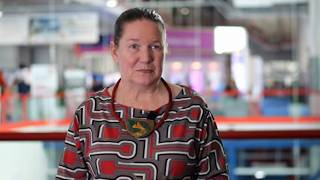
Tina Bagratuni, PhD, National and Kapodistrian University of Athens, Athens, Greece, discusses the integration of single-cell transcriptomic and plasma proteomic data to predict response to ibrutinib in Waldenström’s macroglobulinemia. She highlights how combining specific cell types and plasma proteins improved response prediction compared with transcriptomic data alone, providing insight into how gene expression and protein profiles differ between responders and non-responders. This interview took place at the 23rd International Myeloma Society (IMS) Annual Meeting in Glasgow, UK.
These works are owned by Magdalen Medical Publishing (MMP) and are protected by copyright laws and treaties around the world. All rights are reserved.
Transcript
So the proteogenomics study was a very interesting study because we did use all of the transcriptomic data from our single-cell analysis and we also used the plasma proteome profile of the same patients. So we do see that the plasma proteomics is a very good tool. So we do see many proteins being upregulated in the responder groups or in the non-responder group. We do see significant differences in the cytokine and the chemokine profile after ibrutinib therapy, which shows that ibrutinib is effective in all patients...
So the proteogenomics study was a very interesting study because we did use all of the transcriptomic data from our single-cell analysis and we also used the plasma proteome profile of the same patients. So we do see that the plasma proteomics is a very good tool. So we do see many proteins being upregulated in the responder groups or in the non-responder group. We do see significant differences in the cytokine and the chemokine profile after ibrutinib therapy, which shows that ibrutinib is effective in all patients. But I think the most important part is the integration. So we do see that when we incorporate the single-cell data with the plasma protein data, there is a factor that’s highlighted. This is specific cell types from the single-cell analysis as well as specific proteins from the plasma protein, which significantly improve the prediction score compared to the transcriptomic profile. And again, there is something important which shows that how gene expression leads to protein expression and how this is differentiated among the responders and the non-responders. So these are very interesting data and they will be presented later on today by Dr. Vlahos. So I think that this integration technology will help us much better in predicting patients for a good response.
This transcript is AI-generated. While we strive for accuracy, please verify this copy with the video.
Read more...