The Lymphoma Channel is supported with funding from AstraZeneca (Diamond), Johnson & Johnson (Gold), Takeda (Silver) and Galapagos (Bronze).
VJHemOnc is an independent medical education platform. Supporters, including channel supporters, have no influence over the production of content. The levels of sponsorship listed are reflective of the amount of funding given to support the channel.
CAR-T Meeting 2026 | Comparing clinical trial data and real-world evidence to inform CAR T-cell therapy in DLBCL
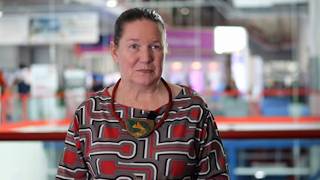
Leyre Bento De Miguel, MD, Son Espases University Hospital, Palma de Mallorca, Spain, discusses the importance of comparing real-world evidence to clinical trial data to confirm the safety and efficacy of approved CAR T-cell constructs in relapsed/refractory (R/R) diffuse large B-cell lymphoma (DLBCL). Dr Bento De Miguel notes that, while there is a lack of head-to-head comparisons of approved CAR-T products, statistical models can be used to make comparisons of datasets more robust and inform clinical decision-making. This interview took place at the EBMT-EHA 8th European CAR T-cell Meeting, held in Palma de Mallorca, Spain.
These works are owned by Magdalen Medical Publishing (MMP) and are protected by copyright laws and treaties around the world. All rights are reserved.
Transcript
Okay, so I think that the first point is that we know that the CAR T-cell therapy has a really curative potential. But I mean, we know this with clinical trials, but I think that the one key question is to confirm that the results that we have in the real-world evidence are comparable with the results that we had with the clinical trials. So that’s why we discussed this point in the session last week in the Congress...
Okay, so I think that the first point is that we know that the CAR T-cell therapy has a really curative potential. But I mean, we know this with clinical trials, but I think that the one key question is to confirm that the results that we have in the real-world evidence are comparable with the results that we had with the clinical trials. So that’s why we discussed this point in the session last week in the Congress. And we confirmed that the results in terms of efficacy and also in the safety profile, that I think that are the two main key points of the therapy, were more or less comparable with the clinical trials. So I think that maybe in the future we will learn more about our real-world evidence that I think that is really important because we don’t have so selective patients. So maybe we will learn in specific characteristics and profiles of the different patients.
So the main problem that we have also in the clinical trials, is that we don’t have head-to-head trials comparing different products. So the same happens with real-world studies. And also these studies are retrospective studies, so this is a limitation that we have. But now when there are some statistical models, such as propensity scores and other statistical strategies that we can use to make the comparison as more comparable, I mean, taking the two groups as comparable groups in terms of really important characteristics, such as, for example, the aggressiveness of the disease, the prior number of lines, or maybe some disease characteristics, LDH. So I think that this analysis with this, I mean, with the use of these strategies are really robust and I think that are very good results to take into account in our daily practice.
This transcript is AI-generated. While we strive for accuracy, please verify this copy with the video.
Read more...