The Lymphoma Channel is supported with funding from AstraZeneca (Diamond), Johnson & Johnson (Gold), Takeda (Silver) and Galapagos (Bronze).
VJHemOnc is an independent medical education platform. Supporters, including channel supporters, have no influence over the production of content. The levels of sponsorship listed are reflective of the amount of funding given to support the channel.
SOHO 2026 | Unresolved questions in T-cell lymphoma: individualized therapy and access to new technologies
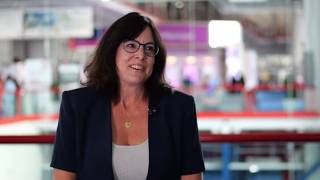
Mary Jo Lechowicz, MD, Winship Cancer Institute, Emory University, Atlanta, GA, discusses unresolved questions in T-cell lymphomas. Dr Lechowicz emphasizes that T-cell lymphomas are heterogeneous, highlighting the need for individualized therapies for every patient. She also highlights the value of new diagnostic and prognostic technologies, such as next-generation sequencing (NGS) and circulating tumor DNA (ctDNA), and the need to widen global access to these tools. This interview took place at the 14th Annual Meeting of the Society of Hematologic Oncology (SOHO 2026) in Houston, TX.
These works are owned by Magdalen Medical Publishing (MMP) and are protected by copyright laws and treaties around the world. All rights are reserved.
Transcript
I think if I had to think of all of T-cell lymphomas, because it’s a much rarer disease that people tend to kind of put them all together, and instead it’s so many different heterogeneous diseases that the question would be, when are we going to have individualized therapy for every T-cell lymphoma patient? I think it would be, I think we have a lot of great tools now, again, with next-generation testing as well as ctDNA and things along those lines...
I think if I had to think of all of T-cell lymphomas, because it’s a much rarer disease that people tend to kind of put them all together, and instead it’s so many different heterogeneous diseases that the question would be, when are we going to have individualized therapy for every T-cell lymphoma patient? I think it would be, I think we have a lot of great tools now, again, with next-generation testing as well as ctDNA and things along those lines. I think it’s also a matter of is it available to everyone? And I think that’s where our newer technology, not only these diagnostic and prognostic markers, but hopefully can be available to people throughout the world. So I think that we do have a lot of wonderful tools. I think that how we use them, whether it be other intelligence-related tools, whether it be different ways that we communicate. We could break down those barriers, you know, in terms of, I mean, COVID made Zoom and things like that much more apparent. Like, do we not think that maybe this technology can help us, you know, to help with that kind of as well, as well as make algorithms maybe much easier to find and think about them in terms of, and I don’t know if you’re going to get to this or not, but when we think about the level of resources in different parts of the world, you know, that there’s sort of gradations based on resources that people have, you know, and how to approach that.
This transcript is AI-generated. While we strive for accuracy, please verify this copy with the video.
Read more...