The Multiple Myeloma Channel is supported with funding from AbbVie (Platinum), Sanofi (Gold), Legend Biotech (Bronze), and through an educational grant from Alexion Pharma GmbH.
VJHemOnc is an independent medical education platform. Supporters, including channel supporters, have no influence over the production of content. The levels of sponsorship listed are reflective of the amount of funding given to support the channel.
IMS 2026 | Improving multiple myeloma outcomes beyond deeper responses
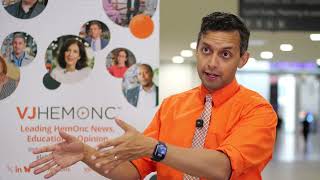
Rahul Banerjee, MD, FACP, Fred Hutchinson Cancer Center, Seattle, WA, discusses how outcomes for patients with multiple myeloma can be improved beyond achieving deeper responses. He highlights the need to improve outcomes for frailer patients and those with functional high-risk or post-CAR-T relapse, while also addressing survivorship, treatment-related complications and quality of life alongside disease control. This interview took place at the 23rd International Myeloma Society (IMS) Annual Meeting in Glasgow, UK.
These works are owned by Magdalen Medical Publishing (MMP) and are protected by copyright laws and treaties around the world. All rights are reserved.
Transcript
I think the talk that I’ll be giving here at the 2026 IMS meeting in sunny Glasgow right now, Scotland, is can we do better for our patients with an I do worse cure in myeloma, very particularly with that focus in mind. I think there are two parts to it. So number one, I think that not every patient will be cured the same way. I think it’s essential to remember that a priori, because many of us talk about CAR-T therapy or bispecific antibodies as being the cure for our patients, and I think that’s largely true...
I think the talk that I’ll be giving here at the 2026 IMS meeting in sunny Glasgow right now, Scotland, is can we do better for our patients with an I do worse cure in myeloma, very particularly with that focus in mind. I think there are two parts to it. So number one, I think that not every patient will be cured the same way. I think it’s essential to remember that a priori, because many of us talk about CAR-T therapy or bispecific antibodies as being the cure for our patients, and I think that’s largely true. You know, the only reason that we’re talking about cures in myeloma is because of these T-cell redirecting therapies, but it’s worth noting that they don’t work as well for everybody. You know, for frail patients, I think there’s some selection bias. The data we’ve seen show that frailer patients often seem to do better than if they get CAR-T therapy or bispecifics than if they don’t. But many of them are not even being offered CAR-T therapy or bispecifics to begin with. So as we figure out the cure for 70% of our most fit patients, we need to make sure that we have an option for our 30% frailer patients as well. I think the other part of the question is functional high risk or post-CAR-T relapse. So patients who are destined to not do as well with these treatments or evidently don’t do as well with these treatments. For the ones who have functional high risk myeloma speaking about this tomorrow, we presented data from the MajesTEC-3 study showing that functional high risk patients defined as early relapse, relapse within 18 months of frontline treatment. If you put them on Tec-Dara, they have a fighting chance. If you don’t put them on Tec-Dara, they do terribly. Three-year PFS for functional high-risk patients who didn’t get Tec-Dara, who got the control arm of daratumumab, lenalidomide and dexamethasone, was 0%. Not a single one of them was still in remission three years out. For the patients who got Tec-DARA, the number was like 77%. Great, but it wasn’t the 83%. It’s still not 100%, so we have work to do there. And I think post-CAR-T relapses, we need to have a better understanding of what to do with those patients and how. The very last thing I would say is, you kind of alluded to this, all of us are talking about how to get our patients to a cure in myeloma. We have to make sure that survivorship comes up hand in hand with cure. Many of our patients, you know, after CAR T therapy, often they’re a little bit surprised. No matter how much I tell them that CAR T therapy is a one-time infusion, but it’s not a one-time deal. You’re still coming in for IVIG, supportive care. You’re still wrestling with grade one infections that are low grade but last for weeks. The ferocity of those post-CAR-T infections, supportive care, monitoring for second primary malignancies, the rare risk of Parkinsonism, nerve palsies, cerebellar toxicities with GPRC5D, CAR-T. These are all rare issues. Infections actually are quite common, but both of them are things that I feel like we don’t talk about as much. And as we get to curing more patients with these treatments, and I talk about doing better, I mean, not just curing the myeloma, but curing the myeloma in a way that you’re not thinking about myeloma treatment every day for as long as you live, right? That’s what we’re looking for, and we have work to do on that front.
This transcript is AI-generated. While we strive for accuracy, please verify this copy with the video.
Read more...