The Multiple Myeloma Channel is supported with funding from BMS (Gold) and Legend Biotech (Bronze).
VJHemOnc is an independent medical education platform. Supporters, including channel supporters, have no influence over the production of content. The levels of sponsorship listed are reflective of the amount of funding given to support the channel.
IMS 2025 | Treatment patterns and outcomes in patients with quad-class-exposed RRMM
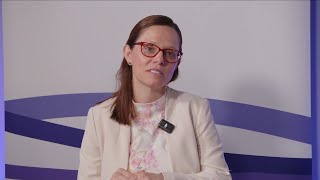
Doris Hansen, MD, Moffitt Cancer Center, Tampa, FL, comments on the treatment patterns and outcomes in patients with quad-class-exposed relapsed/refractory multiple myeloma (RRMM). Dr Hansen notes that quad-class-exposed patients have poor survival outcomes, with inferior overall survival in patients receiving systemic infusional chemotherapy compared with novel agents. This interview took place at the 22nd International Myeloma Society (IMS) Annual Meeting in Toronto, Canada.
These works are owned by Magdalen Medical Publishing (MMP) and are protected by copyright laws and treaties around the world. All rights are reserved.
Transcript
So I did just present on treatment outcomes and survival in patients with quad-class-exposed relapsed/refractory myeloma. Generally, quad-class exposed patients are heavily pretreated with the majority of them being triple and quad-class refractory. What we saw is that in this patient population, the majority of them had high-risk cytogenetics. We also saw prior BCMA exposure with most patients having received a BCMA CAR-T as well as an ADC compared to a bispecific agent in this particular patient cohort...
So I did just present on treatment outcomes and survival in patients with quad-class-exposed relapsed/refractory myeloma. Generally, quad-class exposed patients are heavily pretreated with the majority of them being triple and quad-class refractory. What we saw is that in this patient population, the majority of them had high-risk cytogenetics. We also saw prior BCMA exposure with most patients having received a BCMA CAR-T as well as an ADC compared to a bispecific agent in this particular patient cohort. In terms of survival outcomes, we essentially identified that the median event-free survival for quad-class exposed patients is only about 4.5 months, and the median overall survival is about 13 months. We did see that this was particularly overall survival was inferior for patients receiving systemic infusional chemotherapy compared to some of the novel agents such as BCMA and GPRC5D agents after quad-class exposure. And we did see for those with prior BCMA exposure, generally, they had a, particularly BCMA CAR-T, had a superior event-free survival at about seven months compared to three to four months in the ADC and bispecific cohorts. And in terms of treatment patterns, right, earlier in lines of treatment, we have multiple drug combinations that can be utilized. However, in the later lines of therapy, post-quad-class exposure, you know, yes, we can use GPRC5D as a novel target, but, you know, recycling of some of the same targets and there’s more limitations in the amount of treatments that can be utilized. And there’s a very high attrition rate as well post quad-class exposure at about, you know, at least 30 percent and another 30 percent at index plus one and index plus two due to disease progression or death.
This transcript is AI-generated. While we strive for accuracy, please verify this copy with the video.
Read more...


Disclosures
Research funding: Bristol Myers Squibb/Celgene, Janssen, Adaptive Biotechnologies, Kite Pharma, Karyopharm; Additional funding from Pentecost Myeloma Research Center, Myers Foundation, Schulze and M-CARES awards (pilot grants) via Moffitt Cancer Center; Consultancy: Bristol Myers Squibb, Janssen, Legend Biotech, Karyopharm, Kite Pharma, AstraZeneca, Pfizer.