The Myelodysplastic Syndromes Channel is supported with funding from Geron (Silver).
The Myeloproliferative Neoplasms Channel is supported with funding from Takeda (Gold) and Kartos Therapeutics, Inc. (Bronze).
VJHemOnc is an independent medical education platform. Supporters, including channel supporters, have no influence over the production of content. The levels of sponsorship listed are reflective of the amount of funding given to support the channel.
iwMDS 2026 | Promising advances and remaining challenges in MDS/MPN overlap syndromes
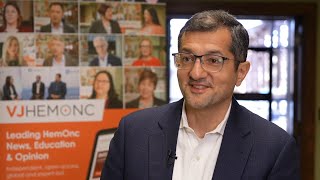
Abdulraheem Yacoub, MD, University of Kansas Medical Center, Kansas City, KS, discusses advances in understanding myelodysplastic syndrome/myeloproliferative neoplasm (MDS/MPN) overlap syndromes, highlighting progress in developing concrete diagnostic criteria and molecular definitions that enable biology-driven therapies and study designs. Dr Yacoub notes that while designing prospective and randomized studies in these patients is challenging, it has not hindered efforts to gather more data. This interview took place at the 4th International Workshop on Myelodysplastic Syndromes & Myeloproliferative Neoplasms (iwMDS/iwMPN) 2026, held in Washington, D.C.
These works are owned by Magdalen Medical Publishing (MMP) and are protected by copyright laws and treaties around the world. All rights are reserved.
Transcript
It’s very exciting that the classification and reclassification of these diseases seems to have plateaued. I think we’ve had a lot more concrete diagnostic criteria that have lasted across multiple diagnostic reclassification models. So I think we probably have a better understanding and definition of these diseases to start with. I think even better, we’re starting to have a better molecular definition of these diseases...
It’s very exciting that the classification and reclassification of these diseases seems to have plateaued. I think we’ve had a lot more concrete diagnostic criteria that have lasted across multiple diagnostic reclassification models. So I think we probably have a better understanding and definition of these diseases to start with. I think even better, we’re starting to have a better molecular definition of these diseases. I think we’re able to define these diseases by factual pathway mutations that define their behavior. And that our therapy is now being driven by biological considerations, not purely morphologic and clinical features. So I think that has been able to allow us to empower us to be able to design better studies that are biology-driven, not just morphology-driven or based on clinical judgment. So that is helpful, and it does feed into the biology and the rationale for that. It is an uphill task to design prospective studies in patients with these diseases. It is even more challenging to design randomized studies in these patients. But again, that has not stopped us, and hopefully we will have even more prospective data.
This transcript is AI-generated. While we strive for accuracy, please verify this copy with the video.
Read more...