The Lymphoma Channel is supported with funding from AstraZeneca (Diamond), Johnson & Johnson (Gold), Takeda (Silver) and Galapagos (Bronze).
VJHemOnc is an independent medical education platform. Supporters, including channel supporters, have no influence over the production of content. The levels of sponsorship listed are reflective of the amount of funding given to support the channel.
EBMT 2026 | Evaluating alloSCT after CAR T-cell therapy failure in patients with R/R LBCL
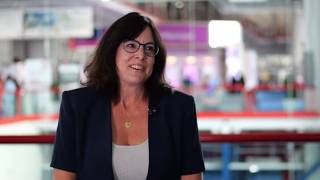
Leyre Bento De Miguel, MD, Son Espases University Hospital, Palma de Mallorca, Spain, shares findings from a multicenter study evaluating allogeneic stem cell transplantation (alloSCT) after CAR T-cell therapy failure in patients with relapsed/refractory (R/R) large B-cell lymphoma (LBCL). She highlights the favorable outcomes of the study and suggests that alloSCT may be a potential option for eligible patients. This interview took place at the 52nd Annual Meeting of the EBMT in Madrid, Spain.
These works are owned by Magdalen Medical Publishing (MMP) and are protected by copyright laws and treaties around the world. All rights are reserved.
Transcript
So this is another key point that also we discussed in this educational and we also presented on behalf of the Spanish transplant and lymphoma groups, our results with our experience with the use of allogeneic transplant in patients that relapse after CAR T-cell therapy. So we know that with incorporation of CAR T-cell therapy now is the main option in patients in second line, in these ones that are primary refractory, early relapsed, or in late relapses in third line in these patients...
So this is another key point that also we discussed in this educational and we also presented on behalf of the Spanish transplant and lymphoma groups, our results with our experience with the use of allogeneic transplant in patients that relapse after CAR T-cell therapy. So we know that with incorporation of CAR T-cell therapy now is the main option in patients in second line, in these ones that are primary refractory, early relapsed, or in late relapses in third line in these patients. So CAR T-cell therapy has really good results. But unfortunately, there are more than half of the patients that will relapse. So we need a lot of things to improve in these patients. So now bispecific antibodies have been incorporated in the treatment algorithm of these patients. So we have bispecific antibodies in third line, but also these patients could relapse after bispecific antibodies. So in those patients who are fit and who achieve a complete response with these bispecific antibodies and other strategies, allogeneic stem cell transplantation could really play a role in these patients.
So we present our experience in Spain, and the results were really good with a high PFS, taking into account that they are really pretreated patients and with a low non-relapse mortality. Also, this study has some limitations because we really selected patients that we only analyze those patients who finally achieve chemosensitivity and finally proceed to the allotransplant. And it will be really important to know from those patients who relapse after CAR T-cell therapy, from these patients who finally proceed to allotransplant. So we don’t have this information, but I think that these are really, really important results. And we can say that allogeneic stem cell transplantation, it could be a really good option, a curative option for these patients that are candidates for transplant.
This transcript is AI-generated. While we strive for accuracy, please verify this copy with the video.
Read more...