The Myelodysplastic Syndromes Channel is supported with funding from Geron (Silver).
VJHemOnc is an independent medical education platform. Supporters, including channel supporters, have no influence over the production of content. The levels of sponsorship listed are reflective of the amount of funding given to support the channel.
iwMDS 2026 | The role of allo-SCT in MDS: patient selection and emerging cellular therapies
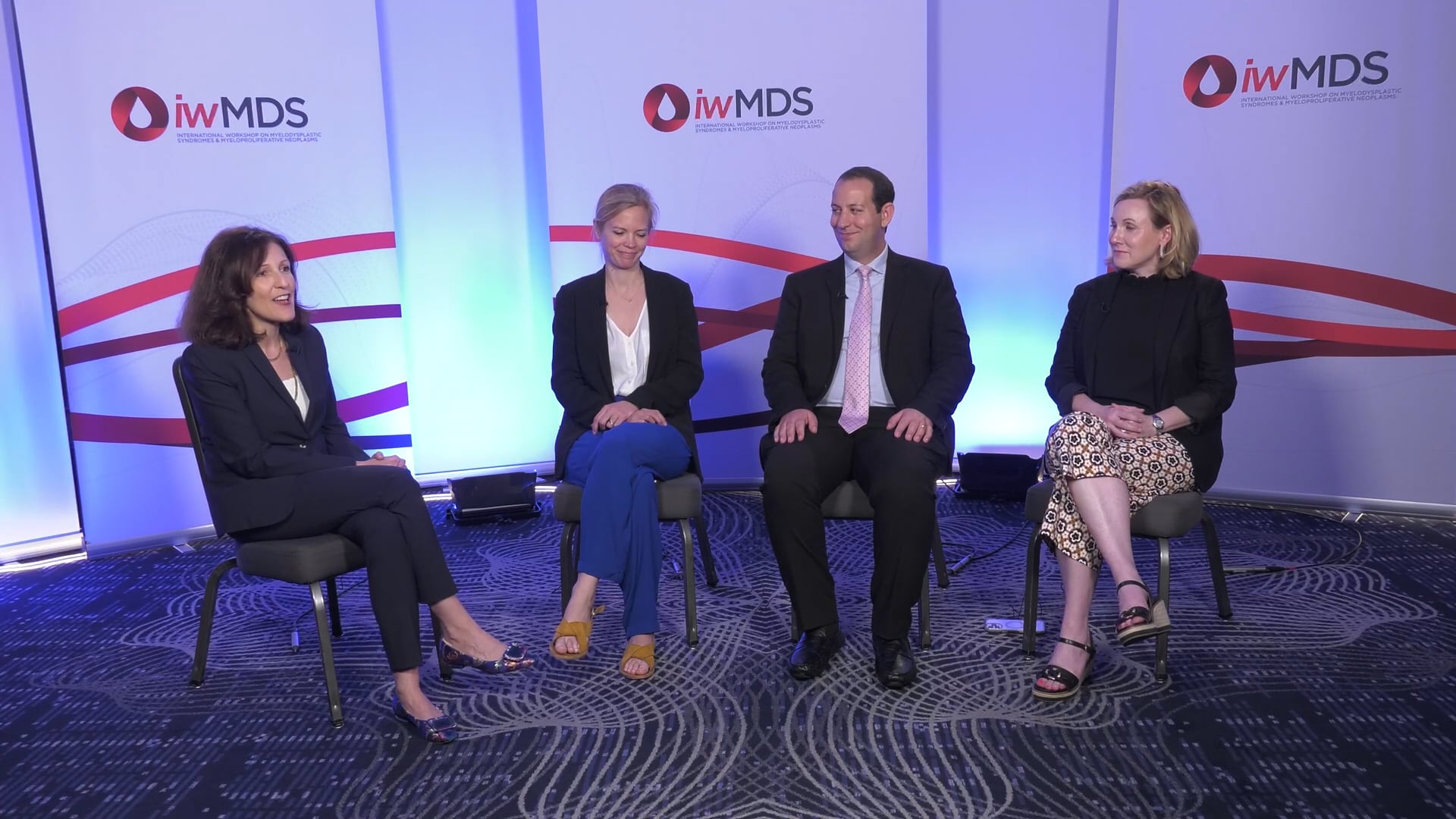
In this roundtable discussion, Olatoyosi Odenike, MD, University of Chicago, Chicago, IL, Alain Mina, MD, Yale School of Medicine, New Haven, CT, Mohamed Kharfan-Dabaja, MD, MBA, Mayo Clinic, Jacksonville, FL, Amy DeZern, MD, MHS, Johns Hopkins University School of Medicine, Baltimore, MD, and Talha Badar, MD, Mayo Clinic, Rochester, MN, discuss the role of allogeneic stem cell transplantation (allo-SCT) in myelodysplastic syndromes (MDS). Dr Mina and Dr Badar debate transplantation in TP53-mutated MDS, while Dr DeZern discusses patient selection, including lower-risk MDS, and graft-versus-host disease prophylaxis with post-transplant cyclophosphamide (PTCy). Dr Kharfan-Dabaja highlights post-transplant maintenance strategies and the challenges of developing CAR T-cell therapies for myeloid malignancies. This roundtable discussion took place at the 4th International Workshop on Myelodysplastic Syndromes & Myeloproliferative Neoplasms (iwMDS/iwMPN) 2026, held in Washington, D.C.
These works are owned by Magdalen Medical Publishing (MMP) and are protected by copyright laws and treaties around the world. All rights are reserved.
Transcript
Olatoyosi Odenike
Good day everyone. My name is Olatoyosi Odenike I’m from the University of Chicago. And we just had this very interesting session at the iwMDS workshop that was focused on allogeneic stem cell transplant in MDS, as well as the role of cellular non-transplant therapies.
in MDS. And I am joined by a group of distinguished colleagues who each had very stimulating interesting talks in the session...
Olatoyosi Odenike
Good day everyone. My name is Olatoyosi Odenike I’m from the University of Chicago. And we just had this very interesting session at the iwMDS workshop that was focused on allogeneic stem cell transplant in MDS, as well as the role of cellular non-transplant therapies.
in MDS. And I am joined by a group of distinguished colleagues who each had very stimulating interesting talks in the session. And I’ll let each of them introduce themselves. Thank you.
Alain Mina
Hi, my name is Alain Mina from the Yale University School of Medicine.
Mohamed Kharfan-Dabaja
My name is Mohamed Kharfan-Dabaja. I’m from the Mayo Clinic in Jacksonville, Florida.
Amy DeZern
I’m Amy DeZern from Johns Hopkins University School of Medicine in Baltimore.
Talha Badar
Hi, I’m Talha Badar, Mayo Clinic, Jacksonville, Florida.
Olatoyosi Odenike
So Dr. Mina and Dr. Badar had a very interesting debate that was focused on the role of allogeneic stem cell transplant in TP53-mutated MDS. I am very curious about, you know, what your positions are on the issue and if there are any
If there’s anyone in particular with TP53-mutated MDS that you would transplant in this day and age, and why?
Alain Mina
Yeah, I think Dr. Badar and myself took very, you know, different sides, a yes side and no side, but I think we both reached the same conclusion, which is a decision to take patients with TP53-mutated disease is very nuanced. a lot of context, clinical context, disease-specific context need to be, you know, taken into consideration. having a TP53 mutation, we both agreed it’s not a definite no.
It just needs a more nuanced and thoughtful approach.
Talha Badar
No, I agree with Dr. Mina. I think it’s a very challenging disease and what we have seen over the last decade or so. We did see some novel therapies coming along the way, but they haven’t been able to show the durable responses that we all looking for. And then the allogeneic stem cell transplant has been like like oldest immune-based therapy, just to have an immune surveillance, a new immune surveillance, how to counteract the cancer cells.
And that strategy still shows some potential. I won’t say the curative strategy for this highly challenging disease, but there’s a potential to improve outcome compared to what we have at this point in time, where we do not have a therapy that can have a long-lasting outcome. What we are dealing with at this point in high-risk MDS in general is a hypomethylating therapy, either in a form of azacitidine or decitabine. And various trials, prospective, retrospective, shown the survival in the range of 1.5 to 2 years.
And especially among TP53-mutated MDS and AML, it’s up to six to nine months or so, and long-term survival less than five percent. When you are dealing with such challenging scenarios, such challenging disease, there is allogeneic stem cell transplant, stem cell transplant can only give a hope, an option to improve long-term outcome. However, having said that, it’s an incorrect decision. As they mentioned earlier, not all TP53-mutated MDS or AML should go for transplant. Similarly, not all TP53-mutated MDS or AML should be no to transplant. It should be in a holistic approach, looking at the disease burden, more granularity in terms of chromosomal profile, the allelic state, the HCT-CI score, looking at the comorbidity index score and the patient’s performance and so forth while making those decisions. And not only those, we also need to develop a strategy, how to a maintenance strategy, how to prevent relapses post-transplant. That is the most higher high risk in terms of post-transplant outcome these patients is not non-relapse mortality, is the risk of relapse. So we need to have strategies also on that front to improve our
Olatoyosi Odenike
Thank you very much. Dr. DeZern, I was quite struck by a term that you say that you use very frequently with your patients. and if I recall correctly, you talked about allogeneic stem cell transplant as a path to a potential cure. I wonder in your practice what your thoughts are about.
A, the TP53-mutated story that we were just talking about, as well as another group of patients that came up in your talk, which are patients who have low-risk MDS, where we have traditionally well well, where the dogma has been that these are patients whose disease is not severe enough to merit a transplant.
So how how do you approach these two groups of patients in your practice and how do you select for potential transplant?
Amy DeZern
I think both good questions, and probably the shortest of answers is that it’s all very individualized to the patient in front of us. But these two examples really represent the extremes, what we might see in a transplant consultation clinic. And similar to my colleagues, I think the TP53 patients really require a very eyes wide open conversation about disease burden going in, patient comorbidities and ability to tolerate a transplant.
And something I also I guess I have all these catchphrases, the path to cure, but we also talk a lot about quality and quantity of life and where the individual transplant candidate, especially in the TP53 disease, where even a transplant probably is not a cure, but does give some durability, as you mentioned, and how a patient and I use each of those different parts. I think the same lessons are quite applicable in the low-risk space, because you’re right. Historically we’ve thought that was a bit of a no-no.
Because they have a long ability to live with their low-risk MDS, perhaps we should not incur any treatment-related mortality, TRM, in the setting of transplant. We are moving transplant earlier in our, shall we say, hierarchy therapeutically or algorithm for patients who aren’t the high blast, really high disease burden patients, but using selective clinical factors and scoring systems to decide who should go to transplant in the historically low-risk group, perhaps a very large number. By that I might mean three or more, number of molecular mutations, heavy transfusion burden, because blood is not an unlimited resource. And then using things like that, again with a very open conversation with the patient, if a transplant could meet their goals. And I think as we all talked about in our various presentations, that age does continue to be something that plays into our decision making.
In both of these flavors of patients.
Olatoyosi Odenike
Thank you. What about the role of trying to mitigate post-transplant-related mortality, say with certain types of graft-versus-host disease prophylaxis? you talked a bit about PTCy in that?
Amy DeZern
I did. It’s hard to come from Baltimore and not talk about post-transplant cyclophosphamide as, shall we say, the workhorse of the graft-versus-host disease prophylaxis. And there were some great questions from the audience that really get at what has long been the concern about PTCy. It’s fantastic graft-versus-host disease prevention prophylaxis. But we also know, as my colleagues spoke about as well that the allo effect of transplant, the immunologic effect of transplant that can be graft-versus-MDS, may be blunted, perhaps appropriately in the setting of no graft-versus-host disease. But is that clinically meaningful in MDS? And I did review some of the data in the BMT CTN study that really brought PTCy to the standard of care.
And about 28% of patients in that study had MDS. They did do as well as those with the other hematologic malignancies. In a specific subset analysis of those over age 70, the survival was very durable and the quality of life was not worse. And so I think there probably will be an ongoing role for the use of PTCy in transplantation for MDS.
Olatoyosi Odenike
Dr. Kharfan-Dabaja. I have a couple of questions for you. one is back to the TP53 story. Well, this is a very challenging subgroup of patients, so pardon me for repeatedly going back to them, but I think at each of our centers it’s quite a struggle and we are all trying to figure out ways in which we can help those patients. We talked about the role or potential role of post-transplant maintenance in that setting. And there was discussion about, you know, how best this should be studied or should it be studied at all. I’m very interested in your thoughts on that.
Mohamed Kharfan-Dabaja
So as all my colleagues have mentioned, it’s a very difficult disease. And I would say that our comparison is generally no transplant versus transplant. And certainly among all the acute myeloid leukemias, this is a group who tend to have less of a good outcome following an allogeneic transplant. I would say that the treatment or the consideration should really be enrollment in clinical trials. And I think that should be our top priority to really investigate new drugs. At our center, we emphasize the need of prescribing some maintenance, if those are part of a trial, if it’s available. If not, certainly coordination between the referring hematologist or treating hematologist and the transplant physician. And many times, go-to therapies would be hypomethylating agents. each one of us may have a particular preference of decitabine versus azacitidine. But certainly, we don’t have anything beyond that to say that something is, at this time, probably more promising than the hypomethylating agent in that particular setting. There is a big unmet need, and I would say that research will be the best way moving forward to try to identify effective post-transplant maintenance strategies, which could perhaps be even pre-transplant, peri-transplant, and post-transplant, I would say.
Olatoyosi Odenike
Yeah, that’s a very good point. and and in follow up to that, one area that’s been very challenging for us in the setting of myeloid malignancies in general, including MDS, is immunotherapy. obviously allogeneic stem cell transplant is you know, the original immunotherapy.
So we know that these diseases are susceptible to immunotherapeutic approaches. We all have long-term survivors of transplants. But one area that has been of huge benefit to patients with lymphoid leukemias has been CAR T-cell therapies and similar approaches.
So non-transplant cellular therapies, which was the focus of your talk. What do you think the future holds in terms of the potential promise for that approach for myeloid malignancies? And what do you think the challenges have been or continue to be? Certainly I know that in my clinic I have patients coming in not infrequently asking me about CAR T-cell therapy for their disease, for their MDS or for their acute myeloid leukemia.
Mohamed Kharfan-Dabaja
So that’s a tough question actually.
Olatoyosi Odenike
You have the easiest talk. Just sarcastic.
Mohamed Kharfan-Dabaja
For those not familiar, CAR-T stands for chimeric antigen receptor T-cell therapy. So it’s a T-cell engineered or it’s an engineering of the T-cell to make it more effective in identifying a target and eliminating it. The challenge I would say with myeloid disorders has been the lack of a target that has similar impact as CD19 has for lymphoid malignancies like large B-cell lymphoma, other types of lymphomas, and B-cell acute lymphoblastic leukemia. So I would say the target is one, but also we know that the disease itself plays a very negative role. AML and MDS, as a matter of fact, they tend to create that immunosuppressive state that makes the immunotherapy less effective. So there are different approaches to consider, would say most of the therapies that have failed to demonstrate efficacy had been therapies that use cells from their own patients. And we know that if we were to take the efficacy of allogeneic transplants, we are using fresh T cells from healthy donors. So perhaps a more promising approach would be using allogeneic cells, although the argument may be countered by the fact that in lymphoid malignancies, there have been also some challenges with allogeneic donor cells. So I would say it’s a very complex situation where you have to not only target the disease, but you have to also change the milieu or that environment where the cells are living and try to increase that immunogenicity in that particular way. I would think that the future will bring those type of interventions and we cannot stop from trying. At least we have to continue to try to bring those type of therapies for this patient. In lymphomas, it has changed totally the prognosis of those diseases, particularly after failing two or more lines of therapy like the case of large B-cell lymphoma or B-cell acute lymphoblastic leukemia and hopefully the future will bring something similar for myeloid disorders, MDS, AML.
Olatoyosi Odenike
I think that that would be a very good note to end. you know, taking care of patients with myeloid malignancies, MDS, AML and similar disorders, I would say it’s not for the faint of heart. You have to keep trying. Our patients obviously are relying on us.
And I am so pleased to be part of this group. Thank you for all you do and thank you for being here today. Thanks.
Mohamed Kharfan-Dabaja
Thank you very much.
Read more...