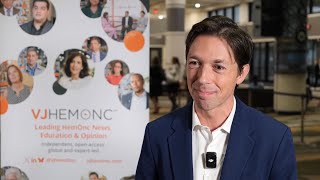
CAR-T Meeting 2025 | A single-center experience of implementing physiotherapist-led prehabilitation for CAR-T therapy
In this video, Orla McCourt, MSc, MCSP, University College London NHS Foundation Trust, London, UK, presents a single-center experience implementing physiotherapist-led prehabilitation for patients receiving CAR T-cell therapy. Dr McCourt describes the implementation of a hybrid program combining face-to-face assessments and remotely delivered exercise rehabilitation, which resulted in clinically meaningful improvements in physical functioning and strength among patients before admission for CAR T-cell therapy. This interview took place at the EHA-EBMT 7th European CAR T-cell Meeting, held in Strasbourg, France.
These works are owned by Magdalen Medical Publishing (MMP) and are protected by copyright laws and treaties around the world. All rights are reserved.
Transcript (AI-generated)
Yeah, so we had some short-term funding to provide some physiotherapy resources. We previously didn’t have any physiotherapy resources within our CAR-T service at our centre. And so this funding allowed us to put a physiotherapist into a clinic and it allowed us to do some really good patient involvement work where we asked patients who’d previously been through CAR-T about their recovery and their preparation for CAR-T and how they felt rehabilitation could help...
Yeah, so we had some short-term funding to provide some physiotherapy resources. We previously didn’t have any physiotherapy resources within our CAR-T service at our centre. And so this funding allowed us to put a physiotherapist into a clinic and it allowed us to do some really good patient involvement work where we asked patients who’d previously been through CAR-T about their recovery and their preparation for CAR-T and how they felt rehabilitation could help. And they sort of shared with us about how they come into CAR-T feeling quite low physically and that how this has both a psychological and a physical effect and really that they think that anything that could support people to prepare physically and mentally but also to help their recovery afterwards would be a really positive thing.
So we implemented a hybrid programme where we assessed patients face-to-face in the CAR-T clinic, at referral for CAR-T and then again pre-admission for CAR-T. And in between that time, we implemented remotely delivered exercise rehabilitation with a physiotherapist, so a walking programme and an unsupervised strength programme. And we supported patients weekly to try and stick to that programme as they came through bridging therapy and in preparation for their admission.
And I suppose the main things that we found, it was a small number of patients and it’s a single centre project but what surprised us really was the level of functional impairment among the patients. So we used six-minute walk tests and timed sit-to-stand tests to measure physical function and lower limb strength and what we found is that the majority of patients had impaired physical functioning at referral for CAR-T, quite low for their age and gender and so this allowed us to justify that actually there was quite a significant need for rehabilitation within this group.
And then when we looked at pre and post outcomes, what we saw was that we saw clinically important differences in terms of improvement of physical functioning and strength among these patients pre-admission for CAR-T. So, you know, it informed us that we’re bringing patients into their CAR-T admission at a greater physical function than they were at referral.
This transcript is AI-generated. While we strive for accuracy, please verify this copy with the video.
Read more...

Disclosures
Education grant: Kite/Gilead; Honorarium: Menarini Stemline.