The Myelodysplastic Syndromes Channel is supported with funding from Geron (Silver).
VJHemOnc is an independent medical education platform. Supporters, including channel supporters, have no influence over the production of content. The levels of sponsorship listed are reflective of the amount of funding given to support the channel.
CTEP perspectives on developing novel therapies for MDS
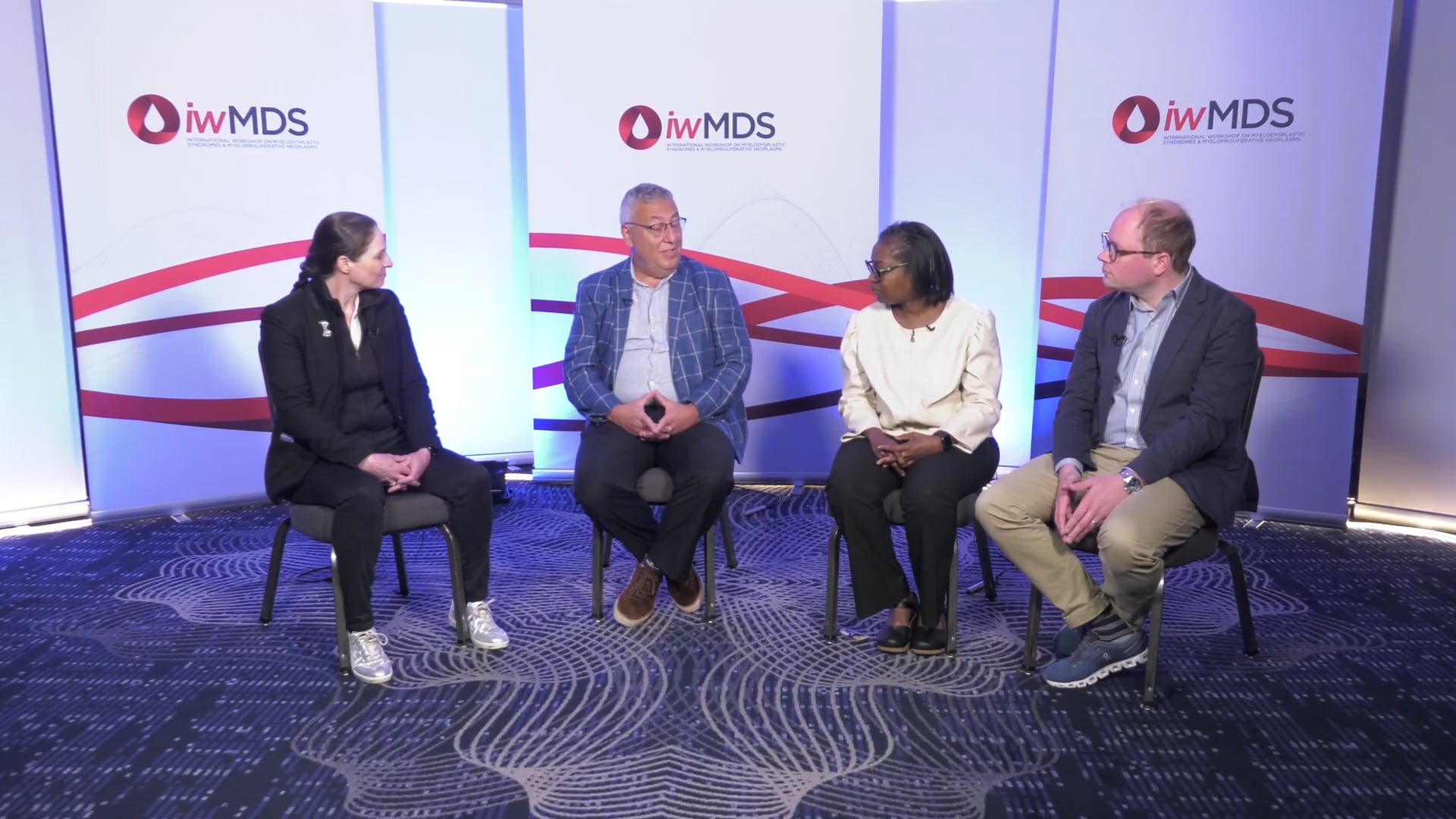
Steven Gore, MD, National Cancer Institute, Bethesda, MD, discusses the Cancer Therapy Evaluation Program (CTEP)’s approach to developing novel therapies for myelodysplastic syndromes (MDS). Dr Gore highlights the importance of biologically driven clinical trial design, discussing the the MyeloMATCH screening study (NCT05564390) and an early-phase study of the splicing inhibitor cirtuvivint, alone and in combination with oral decitabine/cedazuridine (NCT06484062), in MDS and acute myeloid leukemia (AML). This presentation took place at the 4th International Workshop on Myelodysplastic Syndromes & Myeloproliferative Neoplasms (iwMDS/iwMPN) 2026, held in Washington, DC.
These works are owned by Magdalen Medical Publishing (MMP) and are protected by copyright laws and treaties around the world. All rights are reserved.
Transcript
Already used 10 seconds. For those of you who are not United States investigators, and for those of you who are nine who are United States investigators but have always been embarrassed to ask any of your colleagues what is CTEP anyway? Which I was like that originally when I was at Hopkins. CTEP Cancer Therapy Evaluation Program is one of the programs in the Division of Cancer Therapeutics and Diagnosis in the National Cancer Institute...
Already used 10 seconds. For those of you who are not United States investigators, and for those of you who are nine who are United States investigators but have always been embarrassed to ask any of your colleagues what is CTEP anyway? Which I was like that originally when I was at Hopkins. CTEP Cancer Therapy Evaluation Program is one of the programs in the Division of Cancer Therapeutics and Diagnosis in the National Cancer Institute.
we are among the largest sponsors of clinical research around the world. we sponsor essentially all the trials in the North American cooperative groups and a very large portfolio of trials in other networks like our earlier phase experimental therapeutics clinical trial network, the branch, investigational drug branch, for which I’m the branch chief, partners with pharmaceutical companies to bring
Their drugs under cooperative research agreements, with which we then make the drugs available to our investigators and co-develop them. We hold all the do all the regulatory responsibility, their grants pay for the clinical trials. So that’s who CTEP is. And I speak, you know, not for CTEP exactly, but you know, we think alike at CTEP in general. And we deal I deal with all kinds of cancers now.
It’s always nice to be with my homies here. So thanks for the the invitation. But we don’t really think of MDS drug development as different from drug development in breast cancer or ovarian cancer or colon cancer or glioblastoma. we think trials need to be scientifically based, well designed so that they have interpretable endpoints, so you get the maximum data out of them. It’s no surprise. And I’m sorry Alan’s not here, but
I think Alan’s talk yesterday, like do it like Alan did. Alan List, you know, he proposed lenalidomide, at least in part based on data they had developed, I think really in response to the thalidomide signal that really is Osra Raza’s contribution. But anyway, there was a signal with CC50 whatever it was, one three or three eight or whatever it was. And then there was this empiric, surprising observation of the five Q minus.
And he and other investigators, some of them here took that back to to discover all sorts of science and and what do we get out of that besides an effective treatment? Certainly in the five Q group, we we got the whole area of protein integrators through Seroplon, right? That’s a whole field of pharmacology now that was major con contribution. A lot of understanding about transcriptomics, the whole P53 thing in in MDS, etc. So
No, I’m probably done with my slides. so the first time I was involved with MDS was in 1993. 1993 was the third international symposium of MDS. So you know our history isn’t that long. I’m just gonna skip all this because you know it. So why do I know? Why do MDS experts freak out every time that there’s a new classification schema? A, because it’s difficult to apply prior research to current patients, b,
It’s hard to define research compared to historic controls, which we shouldn’t really be doing anyway. Or there’s new requirements to apply therapies to patients who wouldn’t have been assigned to them and prior schemata. Or there’s just basically been no progress in the treatment, so there’s nothing else to be passionate about. So we just make new classifications. Yeah. So back then there was a paper in the JCO.
that said that AML therapy was as effective for MDS patients as it was for other AML patients based on CALGB with now alliance trials. They did central path review of 907. They they found 33 of them who happened to have fewer than 20 blasts. They called them MDS. Most of them were core binding factor leukemia. So anyway. So as I was saying about talking Tohless, we really
And is it really true on Myelomatch for those of you who are involved with Mylomatch, which is our precision medicine effort across North America, for to take newly diagnosed patients with AML and MDS, do very comprehensive profiling within 72 hours, more or less, and then assign them based on their clinical and genetic qualities to a variety of trials and following them through subsequent tiers of therapy.
These are small randomized phase two trials. they’re based on a putative surrogate endpoint, which is mostly change in MRD after a certain point, hoping that that’s going to be an early signal and looking for big changes. So we’re looking for for hazard ratios of two or 0.5, whichever way you want to look at it. For the most part, that keeps the sample size down. We’ve got very relaxed alpha, appropriate for phase two trials because they’re meant to be signal finding. Because if you’re not seeing a signal.
Stop, right? and they’re biologically not category driven. That was my point about the MDS before. You know, treat core binding factor like core binding factor, call it whatever you want. NPM one, same, call it whatever you want. Inversion three, three percent blast, pretty terrible. You know, call it whatever you want. It is that disease in and study it that way. We all know about the challenges, the heterogeneity, blah, blah, blah, lack of models. here’s here’s what we where I think we failed in the last five years. You can
Correct me if I just haven’t been catching keeping up, but you know, how does how does it a metalstat, or however we say it in met telstat, I think I hear Rena say, how how is that working? I mean, it clearly does. I mean, I I last I knew it was a telomerase inhibitor and they proposed it in MDS for nobody knows why, and now we got the signal. Like, where’s the Allen list piece of that? Yeah, because there’s gotta be something else that would lead us to a new drug or or new approaches. I don’t have to show you the data.
Why is Lucipatocep effective in SF3, whichever SF3 ones? Have we figured that out yet? I mean, like here’s another like a super important signal, right? SRSF2, whichever one it is. why do 70% of MDS have splicing factor mutations? I know some of you actually do work on that. I it’s obviously really great biology here that I think is probably untapped or not very tapped.
And this is just a shout out to Max and his group, which is studying a drug called Surtuvivent, which is inhibitor of the click kinases, click and dirk kinases, which impact the splicosome when you require phosphorylation. This phosphorylation require of the splicisosome requires phosphorylation to continue and complete the splicing. And
And when you inhibit clicks and Dirks, that’s held up. So maybe that will be important for splicing factor mutation. I don’t know. But this is the kind of thing that we’re very interested in. There’s there’s some biology, preclinical biology, for example, in this MV411 leukemia, which is pretty easy to cure in mice. It cured it in mice. and when they gave it to patients with with it’s true, right?
And because we don’t have good MDS models. I said that blah, blah, blah. So you have to you have to watch the slides really fast. because I’m under two minutes now. and the the company, which was then called Biosplice, had done a phase one study in solid tumors and showed that there was some correlation between the PK and detection in the blood of certain abnormal splice variants induced by the therapy, presumably. So and there’s Max, are you gonna talk about your study at all? Not
Are you gonna be talking about your study at all in this afternoon? Okay. So I can talk about what’s that? Next meeting. I know. Well, so anyway, this is just kind of what we’re doing. So Max applied in response to a pre-solicitation. We we’d brought the certuficent under CRADA. We sent out a thing, we th that company was almost dead at that point, to be honest. So we could only do one study with them. and myeloid, there’s reason to think it might be active in solid tumors as well, but myeloid was the thing.
So we tried to do the best we, because it was really an iterative process. I mean, Max proposed it and we fixed it or helped it. we worked together. so he takes they, it’s now Evan Chen, who’s doing really a superb job, I have to say, call it to Evan, fantastic investigator at Harvard. Relapse Refractory MLs as well as Relapse Refractory MDS, they were randomized or or sequentially treated in one of two schedules.
Not because of pro Project Optimus, but because the company already knew that there was gonna be some difference in the five out of seven days, which is what they had done most of their work in, but which caused a lot of diarrhea, and two out of seven days, which the PK suggested might be okay. So we did dose finding did a really great job. there’s now a plan to do a food effect study, substudy, and then moving on to
combination in newly diagnosed high-risk MDS with Aztec727. Thank you very much, Harold, for supplying the drug and the CRATA costs for that. you may not remember you did, but we great you are they are great partners. This is the way pharma companies should be. I just want to shout it out. And they’re not even listed up there. I don’t think maybe they are. And and in relapse refractory AML, looking at a combination, I think now with Veneticlex based on some really great
some really great preclinical data. So again, maybe this drug is gonna be a b a a you know, a dud like everything else.
Maybe it will. Well, I’m not sure we’re allowed to talk about that. Okay. Maybe there will be CRs. so all I’m saying is it’s a phase one study, right? So maybe it’s a done, but there’s good biology. It’s a new target. We’re thinking of thought they are thinking of thoughtful ways to combine it and getting the most out of a phase one study that we can get to like point us in the next direction. So this this is kind of how like we like to do it.
So, and I think that’s maybe my last slide. Let’s see. I don’t want to do this one. We did this before. So here we go. How do we go backwards? This one. I’m zero. I can stop. Anyway, so let’s say the do’s and don’ts, and then I’ll stop. so unless there’s a pharmacodynamic or biological reason to combine these drugs with the DNA methyl transferase one inhibitor, you don’t have to just combine it and compare it to azacitidine. Now, maybe clinically there’s a practical reason to do that, but if you don’t have a biological reason to do it, it’s probably not gonna do anything special. And you’re just gonna give more toxicity or reduce the dose of your azanucleosides. So just give up on that. Or develop a model that shows there’s a reason to do it. We have a reason, Max has a reason instead of it. gonna try it. If you do decide to go down this classic, now classic cottage industry of azanucleosides plus or minus, you’re gonna have to do a randomized phase two drug, or you’re gonna repeat the magrolimab’s and the eprenetapopt’s for the rest of your lives, and all the pharmaceutical companies are gonna go broke. And some of you are gonna look pretty well, you’re gonna have kind of a besmirchy name. But you need a good signal before you launch a phase three study. And I blame the pharma company, I’m not just blaming us, but you know, us as part of it.
Don’t let your enthusiasm about your patient’s outcome make you forget the clinical variability and outcomes of MDS patients. And I’m guilty of that with our you never saw data like it with MS-275, SNDX-275, and entinostat with azocytadine 10 days. Never saw CRs like that until we did the randomized phase two in ECOG. And they were equivalent. Do focus on molecular targets, cellular consequences, clinical.
Parameters, blah, blah, blah, blah. I think I’m gonna stop now. And I’ll stop now. So thanks. Yeah, thank you so much, Steve.
AI-generated transcript. Please refer to the video as the authoritative source.
Read more...