The Community Focus Channel is supported with funding from Johnson & Johnson (Gold).
The Non-Malignant Channel is supported with funding from Agios (Gold).
The Thalassemia Channel is supported with funding from Agios (Gold).
VJHemOnc is an independent medical education platform. Supporters, including channel supporters, have no influence over the production of content. The levels of sponsorship listed are reflective of the amount of funding given to support the channel.
EBMT 2026 | Key considerations when selecting patients with thalassemia or SCD for gene therapy
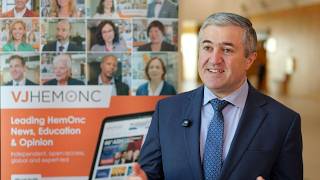
Rabi Hanna, MD, Cleveland Clinic, Cleveland, OH, shares insights into key considerations when selecting patients with thalassemia or sickle cell disease (SCD) for gene therapy. Dr Hanna explains the importance of assessing age and liver function in patients with thalassemia and highlights that working holistically with the hematology and apheresis team is vital in SCD. This interview took place at the 52nd Annual Meeting of the EBMT in Madrid, Spain.
These works are owned by Magdalen Medical Publishing (MMP) and are protected by copyright laws and treaties around the world. All rights are reserved.
Transcript
I’m going to break it into two for thalassemia and for sickle cell. For thalassemia, it’s so important. It’s first, depending on your centers and the region. So in the USA, you can have access to two medications. One, it is beta-cel that’s approved for age four and higher. So age is the first factor. The other medication, exa-cel, it is age 12 and higher...
I’m going to break it into two for thalassemia and for sickle cell. For thalassemia, it’s so important. It’s first, depending on your centers and the region. So in the USA, you can have access to two medications. One, it is beta-cel that’s approved for age four and higher. So age is the first factor. The other medication, exa-cel, it is age 12 and higher. Versus in the rest of the world, in Europe and in Asia, it is only exa-cel that is approved. So that will be the first factor within the thalassemia. Second, it is really the liver function. That is the most important factor that it is predicting both from iron overload impact on the liver and also on the heart. So pay attention to both of them. And there is discrepancy, not always like you sometimes see the liver iron, it is acceptable, but the heart may be actually more overloaded. So you have to really evaluate this too, carefully, because this is somewhat elective. Take your time in optimizing the iron overload status put this patient on two iron chelation, be more intense so you could decrease their risk, and even do more functional assay or testing like FibroScan or if needed liver biopsy to ensure that the liver is okay and not adding any risk.
For sickle cell, what I would say, it’s the psychosocial and the pain assessment. You really need to work collaboratively with the hematologist, who they know this patient a little bit better. That collaboration enables you to provide more holistic care for this patient, both in preparation and counseling them, but also prospectively after that, how they can go back. And second, it is the stem cell collection. You need to work with your apheresis team. This is the critical piece we learned from it. Apheresis, they do hundreds, if not thousands of collections for adult patients with multiple myeloma or lymphoma for CAR-T. The collection is simply just different. So there are some practical notes. I mentioned how they have to go deep in the well to collect because the stem cells tend to be a little bit lower. Number two, you need to get more blood volume around four times. And even the inlet flow, you need to slow it, the anticoagulation. So you have to work with the apheresis team and re-audit, do continuous improvement for your own product when you collect, and see how can you improve on that, and share and learn from other centers who may have collected a little bit more, specifically in sickle cell patients.
This transcript is AI-generated. While we strive for accuracy, please verify this copy with the video.
Read more...