The Multiple Myeloma Channel is supported with funding from BMS (Gold) and Legend Biotech (Bronze).
VJHemOnc is an independent medical education platform. Supporters, including channel supporters, have no influence over the production of content. The levels of sponsorship listed are reflective of the amount of funding given to support the channel.
EHA 2025 | The future of myeloma treatment: MRD-guided decisions and novel mechanisms being explored
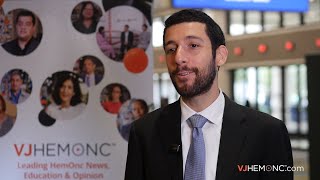
Luca Bertamini, MD, Erasmus MC, Rotterdam, Netherlands, discusses the future of myeloma treatment. He highlights the importance of detecting measurable residual disease (MRD) to guide treatment decisions and shares novel mechanisms of action presented at EHA this year. This interview took place at the 30th Congress of the European Hematology Association (EHA) in Milan, Italy.
These works are owned by Magdalen Medical Publishing (MMP) and are protected by copyright laws and treaties around the world. All rights are reserved.
Transcript
So I think the future of treating myeloma really relies a lot on detecting minimal residual disease and identifying patients that need prolonged therapy and the patients that could benefit from discontinuation or earlier discontinuation of therapy and this is going to be really the future. And an important step would be also to implement MRD in different centers across Europe and being able to use different modalities from flow, NGS and also mass spectrometry...
So I think the future of treating myeloma really relies a lot on detecting minimal residual disease and identifying patients that need prolonged therapy and the patients that could benefit from discontinuation or earlier discontinuation of therapy and this is going to be really the future. And an important step would be also to implement MRD in different centers across Europe and being able to use different modalities from flow, NGS and also mass spectrometry. We are really seeing new interesting data also on that. So I think it’s going to be a really exciting time and a lot of different opportunities which have of course advantages and disadvantages but the more important thing is to really test MRD. Whatever method you use it’s not so important. I think the important thing is to really use this to guide treatment. That’s the future. I think at this year we had really two beautiful presentations about targeting two very hard targets for myeloma, one was deletion 17p and the other was MYC, so which are really important genomic alterations we know but so far we haven’t been able to do that and I really would like to shout out to the authors, Anaïs Schavgoulidze and Domenico Maisano,, that did amazing work, check it out, it’s really promising.
This transcript is AI-generated. While we strive for accuracy, please verify this copy with the video.
Read more...