The Multiple Myeloma Channel is supported with funding from BMS (Gold) and Legend Biotech (Bronze).
VJHemOnc is an independent medical education platform. Supporters, including channel supporters, have no influence over the production of content. The levels of sponsorship listed are reflective of the amount of funding given to support the channel.
COSTEM 2021 | The role of upfront double auto-SCT in high-risk myeloma
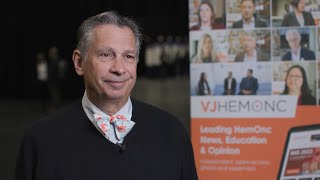
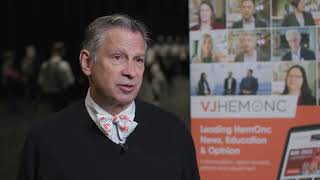
Sergio Giralt, MD, PhD, Memorial Sloan Kettering Cancer Center, New York, NY, talks on the role of double autologous stem cell transplant (auto-SCT) in the treatment of high-risk multiple myeloma. Dr Giralt discusses findings of the Phase III STaMINA trial (NCT01109004), which he reports showed no benefit of tandem versus single transplant in the initial read-out, but reported a progression-free survival benefit with tandem transplant in long-term follow-up analysis. This interview took place at the 2021 Relapse After HSCT² Workshop in New York, NY.
Transcript
It was interesting how there’s a divide now on where tandem or double transplants for myeloma perform. In European guidelines, it’s very strongly suggested that patients with high-risk disease, which means ISS stage 3, high-risk cytogenetics, should be strongly encouraged to go through double transplants because they have been associated with a significant survival benefit, in randomized trials...
It was interesting how there’s a divide now on where tandem or double transplants for myeloma perform. In European guidelines, it’s very strongly suggested that patients with high-risk disease, which means ISS stage 3, high-risk cytogenetics, should be strongly encouraged to go through double transplants because they have been associated with a significant survival benefit, in randomized trials. The American experience with tandem versus single, in the initial readout of the STaMINA trial, showed no benefit for tandem transplant. However, in a long-term follow-up analysis, that was recently presented by Dr Parameswaran Hari, at the ASCO meeting, there showed a benefit for progression-free survival, benefit for patients who underwent the tandem transplant. That was, they were treated with what they were assigned with, as compared to those who were assigned to the other two groups, or who did not get transplanted.
So, I think in the United States, particularly because there’s access to so many salvage treatments. The true question, the true way of defining the role of tandem transplant is that you would randomize patients to a tandem upfront, or a single transplant with the option of a salvage transplant in the event of relapse and see what the impact on survival is. I personally, if I’m doing a tandem transplant, I would do a tandem transplant in young patients, who have high-risk disease, but the second transplant wouldn’t be an autologous, the second transplant would actually be an allogeneic. I am doing tandem transplants in older patients, who present with plasma cell leukemia. And there I would do two autologous transplants, if they’re not candidates for allogeneic transplant.
Read more...

Disclosures
Sergio Giralt, MD, PhD, discloses links to Amgen, Janssen, Celgene, Quintiles, Pfizer, CSL Behring, Sanofi, Adienne, Kite, JAZZ and Actinium.