The Lymphoma Channel is supported with funding from AstraZeneca (Diamond), BMS (Gold), Johnson & Johnson (Gold), Takeda (Silver) and Galapagos (Bronze).
The Multiple Myeloma Channel is supported with funding from BMS (Gold) and Legend Biotech (Bronze).
VJHemOnc is an independent medical education platform. Supporters, including channel supporters, have no influence over the production of content. The levels of sponsorship listed are reflective of the amount of funding given to support the channel.
ASH 2025 | Implementing bispecific antibody therapy for R/R myeloma and lymphoma in an institution in the UK
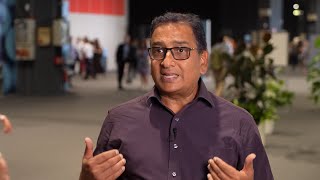
Sunil Gupta, MD, FRCP, FRCPath, MBA, Lewisham and Greenwich NHS Trust, London, UK, discusses the introduction of bispecific antibodies in the treatment of relapsed/refractory (R/R) myeloma and lymphoma at his institution. He highlights that this institution serves a diverse population with a high prevalence of these conditions. This interview took place at the 67th ASH Annual Meeting and Exposition, held in Orlando, FL.
These works are owned by Magdalen Medical Publishing (MMP) and are protected by copyright laws and treaties around the world. All rights are reserved.
Transcript
Hi, I’m Dr. Sunil Gupta. I’m the Consultant Hematologist at Lewisham and Greenwich NHS Trust, which is a large trust covering nearly 800,000 people in a very dynamic young population and surrounded by Afro-Caribbean population where myeloma, sickle cell anemia and also complex lymphomas, T-cell lymphomas, they’re quite prevalent in that area, and the clinical lead for hematology and also the research lead, and we are running a very, very busy clinic...
Hi, I’m Dr. Sunil Gupta. I’m the Consultant Hematologist at Lewisham and Greenwich NHS Trust, which is a large trust covering nearly 800,000 people in a very dynamic young population and surrounded by Afro-Caribbean population where myeloma, sickle cell anemia and also complex lymphomas, T-cell lymphomas, they’re quite prevalent in that area, and the clinical lead for hematology and also the research lead, and we are running a very, very busy clinic. We are the second largest center for sickle cell in the entire country at the moment. What we are doing is bringing bispecifics, which is, of course, at the moment, the talk of the town in hematology around the world, in fact, not only in the town but around the world, and bispecifics are making a massive impact in patients’ lives, especially those patients who have relapsed refractory DLBCL, multiple myeloma, and now also follicular lymphoma. We just had a talk in the morning as a setter symposium, and I was quite startled by the response rate and CR rate in follicular lymphoma also now with the CD19 bispecific, which is fantastic. I was very impressed. So the current scenario in Lewisham Hospital and Queen Elizabeth, which is a South London hospital, me and my colleagues have taken the plunge. And, of course, because of various reasons, unfortunately, we are the last one possibly in the country to start bispecifics. But we are actually coming thick and fast. And all these patients will be massively benefited. And come January in 2026, we’ll be taking on our first patient in myeloma and also DLBCL. As I said, multiple myeloma is very prevalent in our area because of the population we cater to, a young population from the African background. So where myeloma is more prevalent and also more complex. So the lives of these patients are going to be, you know, changed in a big way. Now it is nice to prove the lentumab and teclistamab in multiple myeloma and glofitamab and also the apcotumab in the diffuse large B-cell lymphoma. So we will have a very good outcome, patient outcome in this area, and I’m very hopeful that we will be training. We have already trained our nurses and also trained our ITU staff and also the medical staff, and we will be making very good progress. We have already created pathways, and it is about to start in January next year.
This transcript is AI-generated. While we strive for accuracy, please verify this copy with the video.
Read more...