The Community Focus Channel is supported with funding from Johnson & Johnson (Gold).
VJHemOnc is an independent medical education platform. Supporters, including channel supporters, have no influence over the production of content. The levels of sponsorship listed are reflective of the amount of funding given to support the channel.
EBMT 2026 | Ongoing efforts to improve training and education in transplantation and cellular therapy
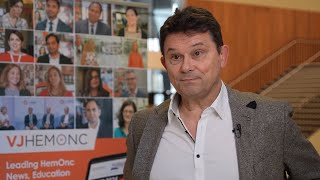
Christian Chabannon, MD, PhD, Paoli-Calmettes Institute, Marseille, France, discusses the importance of training in stem cell transplantation and cellular therapies, noting that professional associations such as the EBMT are filling the training gap for healthcare professionals through various educational tools and initiatives. These include the GoCART Physician Passport and Observership Programme. This interview took place at the 52nd Annual Meeting of the EBMT in Madrid, Spain.
These works are owned by Magdalen Medical Publishing (MMP) and are protected by copyright laws and treaties around the world. All rights are reserved.
Transcript
Stem cell transplantation and cellular therapy are unique activities with very specific requirements from different categories of healthcare professionals. None of these skills are really taught during the initial training of physicians, of nurses, of pharmacists and so on. And so at the moment, professional associations like EBMT and others are filling this gap by providing different educational tools to acquire the skills and maintain the skills over time...
Stem cell transplantation and cellular therapy are unique activities with very specific requirements from different categories of healthcare professionals. None of these skills are really taught during the initial training of physicians, of nurses, of pharmacists and so on. And so at the moment, professional associations like EBMT and others are filling this gap by providing different educational tools to acquire the skills and maintain the skills over time.
Well, there are different educational tools that have been developed. This includes handbooks, such as the well-known EBMT handbook. More recently, the European CAR-T handbook that is actually a joint effort from EBMT and the European Hematology Association. Based on the content of the handbook, we are building a passport, which is a sort of self-assessment tool. The first version is designated for physicians, but we will be working on other versions designated for nurses with the nurses group of the EBMT, for pharmacists, for apheresis specialists, and so on. On top of that, we are launching a program, hands-on training for junior physicians that we call the observership, where young physicians from non-CAR-T cells treating centers will be allowed to travel to an experienced treating center and acquire there the basic skills for clinical care of these patients.
This transcript is AI-generated. While we strive for accuracy, please verify this copy with the video.
Read more...


Disclosures
Honoraria or consultation fees: BMS, Kite/Gilead, Jazz, Miltenyi Biotec, Novartis.