The Multiple Myeloma Channel is supported with funding from BMS (Gold) and Legend Biotech (Bronze).
VJHemOnc is an independent medical education platform. Supporters, including channel supporters, have no influence over the production of content. The levels of sponsorship listed are reflective of the amount of funding given to support the channel.
ASH 2024 | Deciphering the association between ocular AEs and the clinical activity of belamaf in myeloma
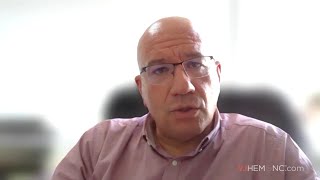
Evangelos Terpos, MD, PhD, University of Athens School of Medicine, Athens, Greece, notes that a sub-analysis of the ongoing Phase I/II BelaRd study (NCT04808037) has found an association between ocular adverse events (AEs) and the clinical activity of belantamab mafodotin (belamaf). The study is assessing this agent in combination with lenalidomide and dexamethasone in transplant-ineligible patients with multiple myeloma (MM). This finding warrants further investigation, particularly in larger Phase III studies. This interview took place at the 66th ASH Annual Meeting and Exposition, held in San Diego, CA.
These works are owned by Magdalen Medical Publishing (MMP) and are protected by copyright laws and treaties around the world. All rights are reserved.
Transcript (AI-generated)
This is a sub-analysis of Phase I/II study that I’m running in my institute with belantamab in combination with lenalidomide and dexamethasone in patients who are not eligible for transplant and are intermediate fit or frail. So the median age of these patients was approximately 74 years of age, and the doses of belantamab that were given were 1.4, 1.9, and 2...
This is a sub-analysis of Phase I/II study that I’m running in my institute with belantamab in combination with lenalidomide and dexamethasone in patients who are not eligible for transplant and are intermediate fit or frail. So the median age of these patients was approximately 74 years of age, and the doses of belantamab that were given were 1.4, 1.9, and 2.5 in order to know what is the best dose to go for the second part of the study. And we checked that the 1.9 mg per kilogram given every 8 weeks is the best way to go on with the combination of lenalidomide and dexamethasone. What we’ve seen in this study is that patients who developed a higher grading of ocular toxicity had a higher response to treatment. Of course, this may seem logical for some colleagues, but I think that it’s something that we have to take into consideration and also to see if this can be, let’s say, confirmed in larger studies like in Phase III studies.
This transcript is AI-generated. While we strive for accuracy, please verify this copy with the video.
Read more...



Disclosures
Amgen: Honoraria, Other: Travel expenses, Research Funding; AstraZeneca: Honoraria, Other: Travel expenses; BMS: Honoraria; EUSA Pharma: Honoraria, Other: Travel expenses; Janssen: Honoraria, Research Funding; GSK: Honoraria, Research Funding; Menarini/Stemline: Honoraria; Pfizer: Honoraria; Sanofi: Honoraria, Other: Travel expenses, Research Funding; Takeda: Honoraria, Other: Travel expenses, Research Funding; Novartis: Honoraria; Antengene: Honoraria, Research Funding; Swixx: Honoraria.