The Lymphoma Channel is supported with funding from AstraZeneca (Diamond), Johnson & Johnson (Gold), Takeda (Silver) and Galapagos (Bronze).
VJHemOnc is an independent medical education platform. Supporters, including channel supporters, have no influence over the production of content. The levels of sponsorship listed are reflective of the amount of funding given to support the channel.
SOHO 2026 | Epcoritamab plus R² in R/R follicular lymphoma: rationale, CRS, and outpatient delivery
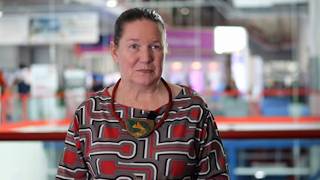
Bradley Hunter, MD, Intermountain Healthcare, Salt Lake City, UT, discusses the Phase III EPCORE FL-1 trial (NCT05409066), which evaluated epcoritamab plus rituximab and lenalidomide (R²) versus R² alone in patients with relapsed/refractory (R/R) follicular lymphoma (FL). Dr Hunter explains the rationale for combining epcoritamab with R² to potentially improve efficacy. He highlights that a three-step step-up dosing regimen was associated with a low incidence of cytokine release syndrome (CRS), supporting the potential for administration in outpatient and community settings. This interview took place at the 14th Annual Meeting of the Society of Hematologic Oncology (SOHO 2026) in Houston, TX.
These works are owned by Magdalen Medical Publishing (MMP) and are protected by copyright laws and treaties worldwide. All rights are reserved.
Transcript
The EPCORE FL-1 trial was a Phase III trial testing standard of care in the second line and beyond, which was an R-squared backbone to epcoritamab plus R-squared. Because of the safety profile of epcoritamab, it was felt that it could be combinable with R-squared to potentially get greater efficacy and perhaps longer PFS and better time to next treatment. I do think that the future will hold knowing, you know, future studies help us to know are there instances in which we can use a bispecific by itself or is it really best in combination...
The EPCORE FL-1 trial was a Phase III trial testing standard of care in the second line and beyond, which was an R-squared backbone to epcoritamab plus R-squared. Because of the safety profile of epcoritamab, it was felt that it could be combinable with R-squared to potentially get greater efficacy and perhaps longer PFS and better time to next treatment. I do think that the future will hold knowing, you know, future studies help us to know are there instances in which we can use a bispecific by itself or is it really best in combination. During the course of the trial, the step-up dosing was shifted from a two-step-up dosing regimen to a three-step-up dosing regimen. With that three-step-up dose regimen, the incidence of grade two CRS was only 5%, and there was no grade three or four CRS reported in the trial. I think because of that, it would tell most community oncologists that there is a very low likelihood that a patient would need to be admitted, not a zero percent chance, but in the five percent range. And so with a robust infrastructure built to be able to take care of a patient, if they do develop grade two CRS in that rare instance, I think community oncologists could feel comfortable administering this in the outpatient setting and even in the community setting.
This transcript is AI-generated. While we strive for accuracy, please verify this copy with the video.
Read more...