The Multiple Myeloma Channel is supported with funding from BMS (Gold) and Legend Biotech (Bronze).
VJHemOnc is an independent medical education platform. Supporters, including channel supporters, have no influence over the production of content. The levels of sponsorship listed are reflective of the amount of funding given to support the channel.
ASH 2024 | Pre-apheresis prediction of toxicity & response to BCMA-directed CAR-T in patients with R/R myeloma
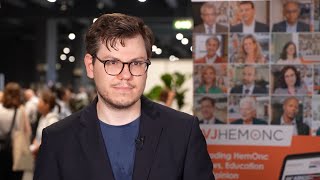
Kai Rejeski, MD, Memorial Sloan Kettering Cancer Center, New York City, NY, comments on the importance of early prediction of toxicity and response to BCMA-directed CAR-T in patients with relapsed/refractory (R/R) multiple myeloma. Dr Rejeski highlights the limitations of existing risk models, which are often assessed too late, and presents a novel score, the CAR-HEMATOTOX score, which predicts key toxicities and survival outcomes earlier in the treatment process. This interview took place at the 66th ASH Annual Meeting and Exposition, held in San Diego, CA.
These works are owned by Magdalen Medical Publishing (MMP) and are protected by copyright laws and treaties around the world. All rights are reserved.
Transcript (AI generated)
This is an abstract that we’re really excited about where we looked at a large cohort of relapsed/refractory multiple myeloma patients. And one of the big issues that we have so far when it comes to clinical prognostication is that we oftentimes or the existing models are almost too late. So we have risk models that prognosticate for toxicity like the CAR-HEMATOTOX score or survival outcomes like MyCARe, but they’re assessed at lymphodepletion...
This is an abstract that we’re really excited about where we looked at a large cohort of relapsed/refractory multiple myeloma patients. And one of the big issues that we have so far when it comes to clinical prognostication is that we oftentimes or the existing models are almost too late. So we have risk models that prognosticate for toxicity like the CAR-HEMATOTOX score or survival outcomes like MyCARe, but they’re assessed at lymphodepletion. So this is not necessarily a very clinically actionable time point, unfortunately, because we’ve sort of already made the decision to proceed with CAR T-cell if you’ve put in effort financially, logistically, also psychologically for the patient. And so what we really try to do with this cohort of patients is see if we can identify early predictors of toxicity and response. So in a large international multi-center trial of 809 BCMA CAR-T recipients, we really tried to address this. And we looked at pre-apheresis predictors of toxicity response. And interestingly, we find that the CAR-Hematotox score predicts, at this earlier time point, key toxicity outcomes, including prolonged neutropenia, prolonged use of supportive therapies for cytopenias, an increased rate of infectious complications, non-relapse mortality, and hospitalization. We also find that the score is associated with survival outcomes, even on multivariate analysis. And strikingly, when we combine the Hematotox score with other high-risk or myeloma-specific features, such as extramedullary disease or history of extramedullary disease or also elevated LDH and also prior BCMA exposure, we were really able to identify an ultra-high-risk set of patients that have really dismal PFS of about 20%. This is a small group of patients, only about 9% of patients, but we were able to identify these patients early on. More generally, we really took a view of the pre-CAR T-cell journey and we can see that risk factors are actually modifiable during this bridging phase. So probably the message is really we need more effective bridging therapies that give patients from sort of a high-risk state to a low-risk state. And I think that that’s something that’s really exciting moving forward.
This transcript is AI-generated. While we strive for accuracy, please verify this copy with the video.
Read more...


Disclosures
Pierre-Fabre: Other: Travel support; novartis: Honoraria; kite/gilead: Consultancy, Honoraria, Other: Travel support, Research Funding; BMS/celgene: Consultancy, Honoraria.