The Lymphoma Channel is supported with funding from AstraZeneca (Diamond), Johnson & Johnson (Gold), Takeda (Silver) and Galapagos (Bronze).
VJHemOnc is an independent medical education platform. Supporters, including channel supporters, have no influence over the production of content. The levels of sponsorship listed are reflective of the amount of funding given to support the channel.
EHA 2026 | Vispa-cel, an allogeneic CAR-T, in patients with R/R B-cell NHL: results from ANTLER trial
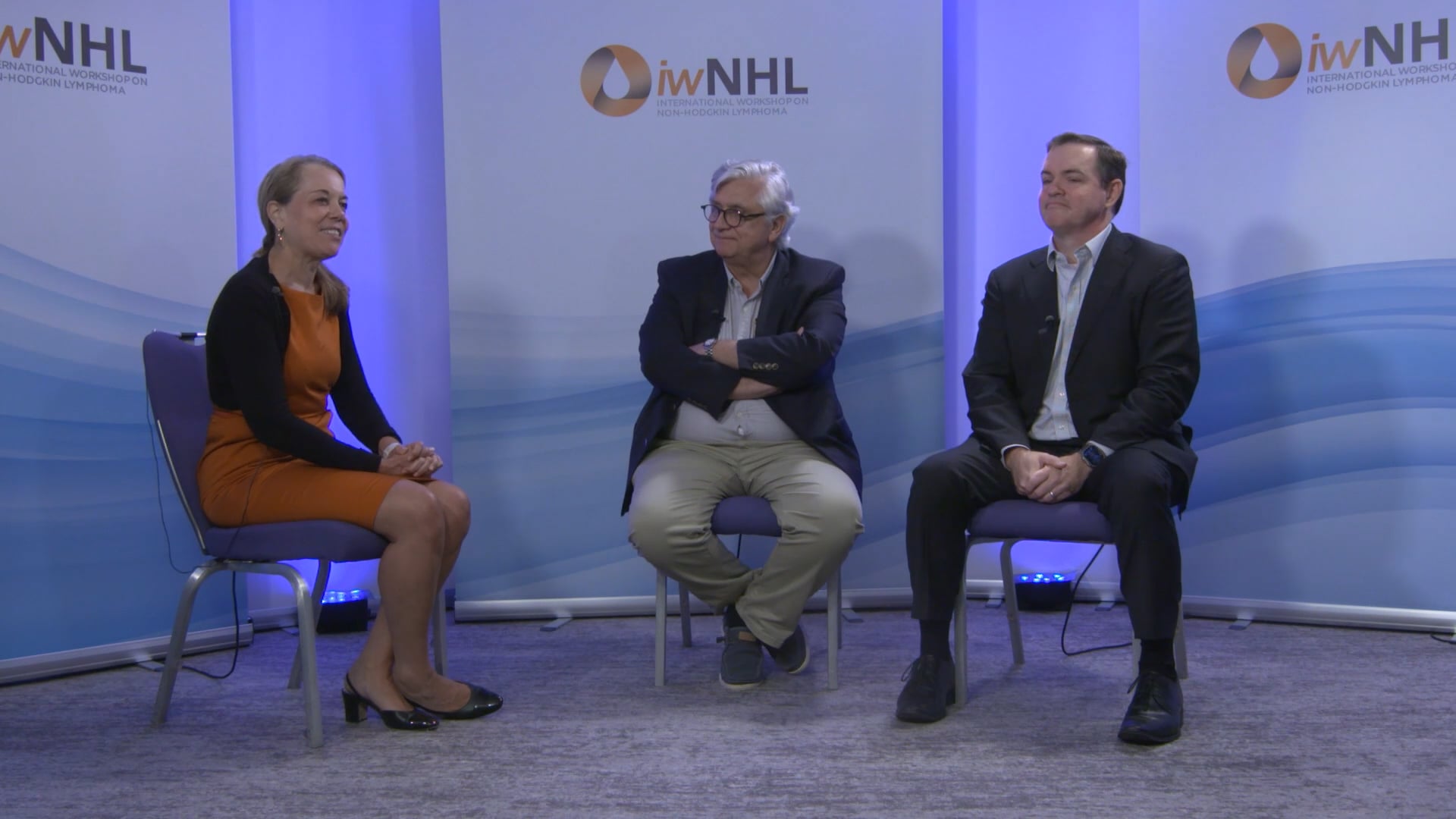
Stephen Schuster, MD, University of Pennsylvania, Philadelphia, PA, discusses the results of the Phase I ANTLER clinical trial (NCT04637763) investigating vispacabtagene regedleucel (vispa-cel), an allogeneic anti-CD19 CAR T-cell therapy with a PD-1 knockout, in patients with relapsed/refractory (R/R) B-cell non-Hodgkin lymphoma (NHL). Prof. Schuster believes that this construct holds great potential due to the minimal toxicity and promising efficacy observed in this trial, and he anticipates that the planned randomized trial will demonstrate the superiority of vispa-cel over standard of care. This interview took place at the 31st Congress of the European Hematology Association (EHA) in Stockholm, Sweden.
These works are owned by Magdalen Medical Publishing (MMP) and are protected by copyright laws and treaties around the world. All rights are reserved.
Transcript
Yeah, I was very excited to present yesterday the outcome with long-term follow-up of the phase one trial of vispa-cel, which is an allogeneic CAR T-cell product off the shelf. So it’s pre-manufactured for patients. And actually, it’s quite a different approach. The cells have been engineered to no longer express their PD-1 receptor. So they’re more fit, less likely to get exhausted...
Yeah, I was very excited to present yesterday the outcome with long-term follow-up of the phase one trial of vispa-cel, which is an allogeneic CAR T-cell product off the shelf. So it’s pre-manufactured for patients. And actually, it’s quite a different approach. The cells have been engineered to no longer express their PD-1 receptor. So they’re more fit, less likely to get exhausted. The CAR transgene is inserted into the T-cell receptor genes, so they don’t express the TCR. There’s been no graft-versus-host disease reported. And basically, very excellent results are obtained when you use donors that are under the age of 30 or that are at least two antigens matched. And those were the data that we focused on yesterday. And they’re the product characteristics and patient characteristics that we’re going to use for the pivotal trial, which is a randomized trial against standard of care.
The median progression-free survival was 17.1 months for all the patients treated on the phase 1 Vispa-cel. And I think the planned pivotal trial will be a randomized trial, which I think, again, looking at the immunochemotherapies that are standard of care, at least in the U.S., I think 17 months will beat what we normally get. So I can’t wait. Maybe two years from now we’ll be presenting those results.
I think this could potentially replace autologous CAR T-cell for a variety of reasons. Number one, it doesn’t require apheresis or harvesting. Number two, you’re using healthy lymphocytes, not lymphocytes that have seen a lot of chemotherapy or they’re from elderly people. And number three, the toxicity was minimal. I mean, like there was zero grade three or higher ICANS in the pivotal group and also very low, I think one case of CRS that was grade three or higher. So I see this as being something we’ll be able to offer CAR T-cells throughout the country in the community. Centers won’t have to have apheresis. They’ll be able to manage many patients as outpatients because the toxicities are so acceptable. So I think it’s a game changer.
This transcript is AI-generated. While we strive for accuracy, please verify this copy with the video.
Read more...