The Multiple Myeloma Channel is supported with funding from BMS (Gold) and Legend Biotech (Bronze).
VJHemOnc is an independent medical education platform. Supporters, including channel supporters, have no influence over the production of content. The levels of sponsorship listed are reflective of the amount of funding given to support the channel.
Belantamab mafodotin combined with pomalidomide and dexamethasone in RRMM: HRQoL in DREAMM-8
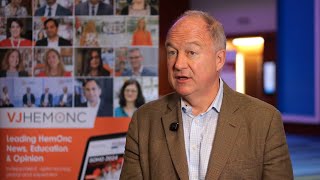
Paul Richardson, MD, Dana-Farber Cancer Institute, Boston, MA, discusses the health-related quality of life (HRQoL) results of the Phase III DREAMM-8 study (NCT04484623) evaluating belantamab mafodotin in combination with pomalidomide and dexamethasone in patients with relapsed/refractory multiple myeloma (RRMM). Dr Richardson highlights that the HRQoL of patients was substantially preserved and/or improved in the experimental arm. This interview took place at the 67th ASH Annual Meeting and Exposition, held in Orlando, FL.
These works are owned by Magdalen Medical Publishing (MMP) and are protected by copyright laws and treaties around the world. All rights are reserved.
Transcript
We presented data on DREAMM-8. It was a privilege to present on behalf of the study team, looking at measures of quality of life in patients in the DREAMM-8 study. Just to remind people, this was a prospective comparison of pomalidomide, bortezomib, and dexamethasone as an active control. That’s based on the Optimism study, which was a study that clearly showed the clinical benefit of this and set it up as a standard of care globally in relapsed refractory myeloma...
We presented data on DREAMM-8. It was a privilege to present on behalf of the study team, looking at measures of quality of life in patients in the DREAMM-8 study. Just to remind people, this was a prospective comparison of pomalidomide, bortezomib, and dexamethasone as an active control. That’s based on the Optimism study, which was a study that clearly showed the clinical benefit of this and set it up as a standard of care globally in relapsed refractory myeloma. The experimental arm was Belantamab combined with pomalidomide and dexamethasone and was informed by the really pivotal work of Dr Suzanne Trudell and colleagues in Toronto, Canada, where she had shown that this particular platform was exquisitely active and well-tolerated. DREAMM-8 confirmed her findings. There was a highly significant clinical benefit as measured by progression-free survival in favor of belantamab, pomalidomide, and dexamethasone compared to the active control. And what was very interesting is there’s also a survival trend in favor of the belantamab POMDex. So this kind of resonates, to me, with the remarkably positive data from DREAMM-7, which show not only approximately a three-year progression-free survival gain, but also an overall survival gain for the DREAMM-7 study. So whilst DREAMM-8 doesn’t quite match that survival gain yet, we anticipate that will happen in a year or so where we’ll see real survival benefit that can be proven. We hope for that. The progression-free survival was nonetheless very striking and again was about over 36 months. So with that in mind, the question was, how did this impact on the quality of life of patients? And what we saw was that the quality of life of patients was substantially preserved and or improved in the Belantamab POMDex arm. But what was unique about our analysis, and this was based upon our meetings with FDA this last summer in the context of the Oncology Drug Advisory Committee, was to show that whilst we all recognize the ocular toxicity with Belantamab, it is actually a very manageable side effect, which is entirely non-lethal, which is very important to point out. Whilst obviously the eye is an area of concern, this has actually proven a very manageable and reversible side effect that is really in the vast majority of patients a matter of blurring of vision transiently for a few days. And with dose reduction and schedule change and appropriate management of the eye, which involves simply the use of natural tears, this side effect becomes much less of an issue. Whilst obviously for patients, you know, perceptually, oh my goodness, there’s ocular toxicity, that’s a worry. But in reality, actually what the KVA grading system has done is provide us with a very, very reliable mechanism to prevent significant ocular toxicity. And speaking for our own center, where we’ve treated over 170 patients with belantamab, we have not seen any irreversible eye toxicity, and we’ve seen no serious corneal complications such as corneal perforation. We’ve never seen it. So the initial concerns about ocular toxicity with belantamab, I think, have been largely assuaged by what I think has been a very, very comprehensive and determined effort to minimize this toxicity as a barrier. Because beyond that, belantamab is a remarkably well-tolerated and very active drug. So in this study, what we sought to do was to show that quality of life in the setting of ocular toxicity was actually not impacted in any way. And we were able to show that convincingly. And we showed for three major measures of quality of life that actually, in every case, the belantamab pomalidomide dexamethasone arm was above the control. And whilst obviously the differences weren’t pronounced, it showed no difference or no decrement and above all a consistent signal of being both preserved and enhanced. Not least of which because as the triplet combination worked for patients, their functioning and quality of life improved as a reflection of their disease control. So this is an important abstract to share because it provided a quality of life measure as reported by patients to reflect the fact that the ocular toxicity did not impact on their quality of life. So an important abstract to share.
This transcript is AI-generated. While we strive for accuracy, please verify this copy with the video.
Read more...