The Multiple Myeloma Channel is supported with funding from AbbVie (Platinum), Sanofi (Gold), Legend Biotech (Bronze), and through an educational grant from Alexion Pharma GmbH.
VJHemOnc is an independent medical education platform. Supporters, including channel supporters, have no influence over the production of content. The levels of sponsorship listed are reflective of the amount of funding given to support the channel.
COMy 2026 | REALiTEC cohort 2: teclistamab shows favorable real-world outcomes in R/R myeloma
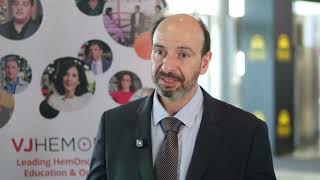
Rakesh Popat, MBBS, MRCP, FRCPath, PhD, University College London Hospitals, London, UK, presents data from cohort 2 of the REALiTEC study (NCT06285318) evaluating the real-world use of teclistamab in patients with relapsed/refractory (R/R) multiple myeloma (MM). He reports favorable progression-free survival (PFS) and safety outcomes compared with the REALiTEC cohort 1, attributable to increased use of immunoglobulin replacement therapy, and concludes that the data support the use of teclistamab in routine clinical practice. This interview took place at the 12th World Congress on Controversies in Multiple Myeloma (COMy) in Paris, France.
These works are owned by Magdalen Medical Publishing (MMP) and are protected by copyright laws and treaties around the world. All rights are reserved.
Transcript
The REALiTEC-2 study is a real-world data set for patients with relapsed/refractory myeloma who are treated across 11 different countries in Europe and indeed in Israel. We’ve previously published through the cohort one, so that’s REALiTEC-1, which showed the very early uptake of teclistamab. And that was predominantly using patients who are being treated in named patient programs. So the difference with REALiTEC-2 is that this is a later cohort and is more reflective of the sort of patients that we’re treating in real life...
The REALiTEC-2 study is a real-world data set for patients with relapsed/refractory myeloma who are treated across 11 different countries in Europe and indeed in Israel. We’ve previously published through the cohort one, so that’s REALiTEC-1, which showed the very early uptake of teclistamab. And that was predominantly using patients who are being treated in named patient programs. So the difference with REALiTEC-2 is that this is a later cohort and is more reflective of the sort of patients that we’re treating in real life. And actually that’s seen when you look at the demographics. So there’s over 200 patients in this real-world data set, and the oldest patient that was treated was 100 years of age. So that’s a real difference compared to the early use when we were restricting it to young, fit patients. We’re now seeing it in older patients as well, which is great. Patients had a median of four prior lines of therapy. And also, interestingly, 15% had prior BCMA exposure. And when you drill into what that was about, 10% of that 15% is antibody-drug conjugates. Again, talking about the use of belantamab mafodotin now in real-world practice. In terms of the efficacy, it’s very similar. So 66% of patients responded, which is exactly what we saw in earlier data sets. But what’s encouraging is that the progression-free survival now seems to be a little bit longer. So in MajesTEC-1 and REALiTEC-1, the median PFS was about 11 months. Now in REALiTEC-2, we’re seeing it to be about 15 months. And that probably reflects that we’re treating patients a little bit better and hence getting better responses as well. The focus of this really was about the toxicity profile that we see in this current cohort. And of course, what we are most concerned about is infections. So we do, again, see lots of infections, about 70% to 80% all grade infections. But the difference in REALiTEC-2 is that the grade 3 infections and above drops right down to 25%. Just to put into context, in MajesTEC-1, it was just over 50%. It was 55% in the pivotal study. So we’re seeing almost half the number of severe infections. In terms of the timing, most of these infections occur quite early on, within the first three months, and then infections gradually get better as time goes on. Now, the reason why the infection rate is lower is because the use of immunoglobulin replacement therapy has gone up. So across the cohort, it’s about 75%. And if we look at the patients who are more established on treatment, and that’s patients who are on more than two cycles, it goes up to about 85%. So immunoglobulin replacement therapy clearly is reducing the amount of severe infections that we’re seeing. Unfortunately, there were some deaths that were picked up in this real-world data set. And most of those deaths were in patients who had severe infections and were not on intravenous immunoglobulin replacement therapy. So that really does tell you that it’s so important. And it doesn’t have to be IVIG. It can be subcutaneous immunoglobulin replacements, and some patients had that as well. Just to talk briefly about CRS. Again, CRS was common. It was predominantly grade one and grade two. And importantly, it all happened within the first step-up phase. We didn’t see much in the way of CRS occurring once patients were established. And it was mainly treated with tocilizumab. And we had a small number of patients who were being treated in the outpatient setting. So overall, I think this gives more evidence in the real-world that teclistamab can be easily given. It’s given reassuring data about infection rates going down and underlining the need for infection prophylaxis and immunoglobulin replacement therapy as early as possible because the infections happened within the first three months.
This transcript is AI-generated. While we strive for accuracy, please verify this copy with the video.
Read more...