The Community Focus Channel is supported with funding from Johnson & Johnson (Gold).
The Lymphoma Channel is supported with funding from AstraZeneca (Diamond), Johnson & Johnson (Gold), Takeda (Silver) and Galapagos (Bronze).
VJHemOnc is an independent medical education platform. Supporters, including channel supporters, have no influence over the production of content. The levels of sponsorship listed are reflective of the amount of funding given to support the channel.
EBMT 2026 | Patient perspectives in the era of patient experience data: balancing clinician & patient priorities
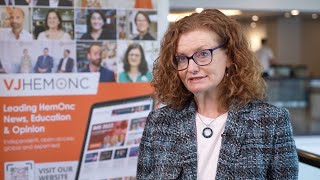
In this video, Lorna Warwick, BA, Lymphoma Coalition, Toronto, Canada, provides insight into patient experience data, highlighting frequent discrepancies between clinical trial reports and patient surveys. Ms Warwick notes that patients with relapsed/refractory (R/R) diffuse large B-cell lymphoma (DLBCL) treated with CAR T-cell therapy often prioritize quality of life over clinical factors, highlighting the need to balance what is important to patients with the clinician’s priorities. This interview took place at the 52nd Annual Meeting of the EBMT in Madrid, Spain.
These works are owned by Magdalen Medical Publishing (MMP) and are protected by copyright laws and treaties around the world. All rights are reserved.
Transcript
So when we were talking about patient experience, really we were focusing in on the discrepancy sometimes between what’s reported in a clinical trial and then what we find out when we survey or interview patients on their own experiences with a particular treatment. In this instance, we did some examples from CAR-T, specifically looking at diffuse large B-cell lymphoma...
So when we were talking about patient experience, really we were focusing in on the discrepancy sometimes between what’s reported in a clinical trial and then what we find out when we survey or interview patients on their own experiences with a particular treatment. In this instance, we did some examples from CAR-T, specifically looking at diffuse large B-cell lymphoma. We have patients, for instance, their priorities of care, what they want to receive changes as the treatment progresses. So this is not a case of you find out what the acceptable PROs are once and then just move on, the patient dynamic changes as they go through the care continuum. So for patients that are relapsed/refractory once, equally important to them is a cure from a new therapy as well as their quality of life. But for those who have relapsed or are refractory more than once, their priority completely shifts to quality of life. And so what’s important with that is we also ask them if they think that their doctor fully understands the impact of their lymphoma on their quality of life, and half the patients say no.
So then if we’re looking at traditional validated tools for incorporating PROs into registries or other data, it’s interesting because is there a filter happening by a clinician who perhaps doesn’t fully understand the impact of the lymphoma diagnosis for the patient. So as an example, when we interview patients and get them to self-report, you know, seven out of 10 patients report issues with fatigue, which of course is important, but I think it’s often minimized. Yet when we ask about the severity of the impact on their quality of life, you know, for those participants, about 43% then say it has a severe or very severe impact on their quality of life. We have similar numbers, a little bit fewer if you’re looking at absolute numbers who indicate that being immunocompromised has the same impact. But we see all kinds of sessions and focus in talks at conferences like this on the immunocompromised piece and nobody talks about fatigue. So it’s like, how do we balance these out and talk about what’s really important to patients as well as what’s important to a clinical perspective? Sometimes they overlap. Patients are also concerned about being immunocompromised, but let’s not forget the things that patients themselves prioritize that they need help with and support managing so that they can have a better quality of life overall.
This transcript is AI-generated. While we strive for accuracy, please verify this copy with the video.
Read more...