The Lymphoma Channel is supported with funding from AstraZeneca (Diamond), Johnson & Johnson (Gold), Takeda (Silver) and Galapagos (Bronze).
VJHemOnc is an independent medical education platform. Supporters, including channel supporters, have no influence over the production of content. The levels of sponsorship listed are reflective of the amount of funding given to support the channel.
ASH 2025 | MorningSun: subcutaneous mosunetuzumab in patients with previously untreated HTB follicular lymphoma
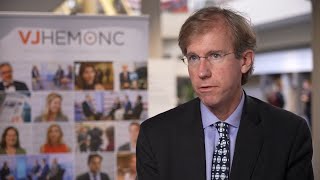
John Burke, MD, Rocky Mountain Cancer Centers, Aurora, CO, discusses results from the Phase II MorningSun study (NCT05207670) evaluating subcutaneous mosunetuzumab in previously untreated, high-tumor burden (HTB) follicular lymphoma. Dr Burke reports high response rates, manageable toxicity, and early evidence of deep molecular responses by circulating tumor DNA (ctDNA) analysis. This interview took place at the 67th ASH Annual Meeting and Exposition, held in Orlando, FL.
These works are owned by Magdalen Medical Publishing (MMP) and are protected by copyright laws and treaties around the world. All rights are reserved.
Transcript
The rationale was to study the bispecific antibody mosunetuzumab in patients with a variety of lymphomas in which mosunetuzumab had not previously been studied. Mosunetuzumab is a bispecific antibody targeting CD20 on B lymphocytes and CD3 on T lymphocytes. Mosunetuzumab has previously been approved by the FDA for treatment of relapsed cervical lymphoma in patients who’ve received at least two prior therapies, and the approved route of administration is intravenous...
The rationale was to study the bispecific antibody mosunetuzumab in patients with a variety of lymphomas in which mosunetuzumab had not previously been studied. Mosunetuzumab is a bispecific antibody targeting CD20 on B lymphocytes and CD3 on T lymphocytes. Mosunetuzumab has previously been approved by the FDA for treatment of relapsed cervical lymphoma in patients who’ve received at least two prior therapies, and the approved route of administration is intravenous. What we studied in Morning Sun was a subcutaneous formulation of mosunetuzumab, and we studied that in several different cohorts in Morning Sun, which is a basket study, including patients with follicular lymphoma, both high tumor burden and low tumor burden, elderly patients with DLBCL treatment naive that were unfit to receive standard chemo, relapsed mantle cell lymphoma, and others. And so what I reported on at ASH was the cohort of patients with high tumor burden follicular lymphoma. And so that’s kind of the background for what we’re studying here. The design of the trial was a phase two study where eligible patients had high tumor burden FL by GELF criteria, and they had not received previous therapy for the disease. All patients received the drug. The schedule was to give a step-up dose of 5 milligrams on cycle 1, day 1, followed by 45 milligrams on days eight and 15 of cycle one. Thereafter, it was given on day one of cycles two through 17 at a dose of 45 milligrams. So the goal was to treat patients for a year. Then there was an optional maintenance phase that patients could choose to sign up for if they were in a partial or complete remission at the end of the year. And that schedule was to give one dose every eight weeks for a year. So additional six doses for a year. And then the primary endpoint of the study was the rate of progression-free survival at two years. So that was a design in terms of what we found. We enrolled 103 patients, which was the target. And we have at this point 22 months of median follow-up. So we don’t estimate yet the 24-month PFS, but we estimate the 18-month PFS to be 85%, 18-month overall survival to be 92%. In terms of responses, we see an overall response rate of 88% and complete response rate of 65%. And responses occurred in really all subgroups, including those with higher risk FL. So those were the primary efficacy results that we reported on. And in terms of safety, the most common toxicities were injection site reactions, which were generally mild, but happened in two-thirds of patients. Cytokine release syndrome occurred in one-third of patients, and it was always grades one or two. I’ll point out there was no mandatory hospitalization for monitoring of cytokine release syndrome in these patients. They were just treated as an outpatient. And if they needed to be hospitalized, they could be, but most did not require that. Infections were not uncommon. 79% of patients experienced at least one infection during their time on the study. Most of them were mild and treated and resolved. There were three grade five infections leading to death. And a couple of those were from COVID. One of those was a pseudomonas pneumonia. The other thing we reported at the meeting was an exploratory endpoint of circulating tumor DNA measurements in patients. And we measured ctDNA in patients who achieved a complete metabolic response. We measured it so far at two time points, cycle four day one and cycle eight day one. This is a preliminary analysis of ctDNA because we have more patients since the data cutoff who have achieved a CMR that will be tested, and we will be getting longer follow-up on some of these ctDNA measurements. But what we reported here was a rate of undetectable ctDNA at cycle four day one of 84% of 38 patients that we have analyzed. So 32 of the 38 patients were MRD undetectable. And at cycle eight day one, 85% were MRD undetectable. Just a couple of conversions from positive to negative or negative to positive in between those two intervals. And we’ve only had two progressors of those patients, so too early to determine whether the MRD results were predictive of, you know, progression events. So that was the ctDNA summary, and I think, you know, overall our conclusions were that this bispecific antibody, when given subcutaneously to patients with high tumor burden FL, is clinically effective, has high response rates, has high rates of complete metabolic response, and, you know, a good progression-free survival and overall survival, although with only 22 months of median follow-up, still relatively short duration of follow-up in this disease. You know, the toxicities were, for the most part, acceptable. And although occasionally we did see, you know, serious events, this product can the complete responders had undetectable ctDNA at cycle four day one. We did not test those who were less than a complete metabolic response. So that’s what we found and presented at ASH.
This transcript is AI-generated. While we strive for accuracy, please verify this copy with the video.
Read more...