The Multiple Myeloma Channel is supported with funding from AbbVie (Platinum), Sanofi (Gold), Legend Biotech (Bronze), and through an educational grant from Alexion Pharma GmbH.
VJHemOnc is an independent medical education platform. Supporters, including channel supporters, have no influence over the production of content. The levels of sponsorship listed are reflective of the amount of funding given to support the channel.
ASH 2025 | Updated results from RedirecTT-1: talquetamab plus teclistamab in R/R multiple myeloma with EMD
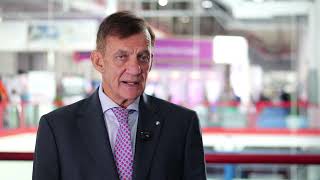
Shahzad Raza, MD, Cleveland Clinic, Cleveland, OH, shares updated Phase II results from the RedirecTT-1 study (NCT04586426), investigating talquetamab plus teclistamab in patients with relapsed/refractory (R/R) multiple myeloma (MM) and extramedullary disease (EMD). Dr Raza highlights that the study showed unprecedented responses, offering hope for patients with EMD who currently represent an unmet clinical need. This interview took place at the 67th ASH Annual Meeting and Exposition, held in Orlando, FL.
These works are owned by Magdalen Medical Publishing (MMP) and are protected by copyright laws and treaties around the world. All rights are reserved.
Transcript
This is an exciting study. You know, patients who have extramedullary disease, they have a very bad outcome. Current standard of care means that they have survival that is only less than six months. Many of these patients, either they get single-agent bispecific therapies, their responses are very suboptimal. So there is an unmet need for extramedullary disease, and how best we can treat it. And this is the first study that I’ve been seeing that the patients who have extramedullary disease or asecretory myeloma with extramedullary disease, which are typically excluded from the study, we have seen some unprecedented responses by combining the two bispecifics together, teclistamab and talquetamab...
This is an exciting study. You know, patients who have extramedullary disease, they have a very bad outcome. Current standard of care means that they have survival that is only less than six months. Many of these patients, either they get single-agent bispecific therapies, their responses are very suboptimal. So there is an unmet need for extramedullary disease, and how best we can treat it. And this is the first study that I’ve been seeing that the patients who have extramedullary disease or asecretory myeloma with extramedullary disease, which are typically excluded from the study, we have seen some unprecedented responses by combining the two bispecifics together, teclistamab and talquetamab. So this is an extension study. So we have like 90 patients enrolled in this study. And we have used the two bispecifics together every other week. And those patients who achieve the VGPR, which happens after the four cycles, these patients will go into once-a-month treatment. And then what we have seen is that the responses are lasting quite significantly. More than 50% of the people are still experiencing durability of the response lasting more than a year and overall survival has not hit the median. What we did differently in this study is we defined the extramedullary disease into different categories like organ EMDs, which means the patients who have extramedullary disease involving the liver, involving the kidney, or non-organ EMDs like patients who have lymph node involvements. So we separate those two categories and also did some volumetric measurements like those who have a 25 centimeter square volume or 50 centimeter square volume. So we try to divide these EMDs into different categories and assess the response. So our responses are quite significant across all organ and non-organ EMDs. So I think as a clinician, it’s a wonderful thing for our patients to have that because EMD patients are the ones that have an unmet need. And I’m so glad to see the results come out in a positive way that our patients will benefit from this study.
This transcript is AI-generated. While we strive for accuracy, please verify this copy with the video.
Read more...