The Acute Myeloid Leukemia Channel is supported with funding from BMS (Silver), and through an educational grant from Jazz Pharmaceuticals.
VJHemOnc is an independent medical education platform. Supporters, including channel supporters, have no influence over the production of content. The levels of sponsorship listed are reflective of the amount of funding given to support the channel.
EHA 2025 | Targeting SLAMF6 upregulation, a newly identified immune escape mechanism, in AML
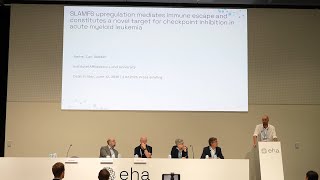
In this video, Carl Sandén, PhD, Lund University, Lund, Sweden, discusses a study that identified SLAMF6 upregulation as a novel immune escape mechanism in acute myeloid leukemia (AML) and provides insight into the development of an antibody targeting the SLAMF6 interaction between T-cells and AML cells. Disrupting this interaction enables the effective killing of leukemia cells by T-cells, as demonstrated by Dr Sandén and his team in both in vitro and in vivo models, and may represent a promising approach to overcoming the current limitations of immunotherapy in AML. This interview took place at the 30th Congress of the European Hematology Association (EHA) in Milan, Italy.
These works are owned by Magdalen Medical Publishing (MMP) and are protected by copyright laws and treaties around the world. All rights are reserved.
Transcript
I’m presenting a study where we identified a novel immune escape mechanism in acute myeloid leukemia. So what we found was that in around 60% of AML cases, the AML cells will start to upregulate this cell surface protein called SLAMF6, which is normally only expressed on lymphocytic cells. And what we showed by CRISPR-Cas9 and blocking antibodies was that this protein serves to protect the AML cells against the anti-leukemia T-cell response...
I’m presenting a study where we identified a novel immune escape mechanism in acute myeloid leukemia. So what we found was that in around 60% of AML cases, the AML cells will start to upregulate this cell surface protein called SLAMF6, which is normally only expressed on lymphocytic cells. And what we showed by CRISPR-Cas9 and blocking antibodies was that this protein serves to protect the AML cells against the anti-leukemia T-cell response. So it’s a mechanism analogous to what you see with PD-1, PD-L1.
And what we did then was that we developed an antibody in collaboration with SciLifeLab that targets specifically the SLAMF6 dimerization sites that mediate the SLAMF6 interaction between T-cells and AML cells. So when we treat co-cultures of T-cells and leukemia cells with this antibody, we see that it breaks the interaction and it enables the T-cells to kill the leukemia cells very effectively, and we have shown this in in vitro cultures with primary T-cells and AML cells, also shown it in vivo in humanized mice transplanted with human T-cells and human leukemia cells to model the immune interactions in vivo, and we see that it’s highly effective in both those models. And this antibody is then being further developed by a spin-off company from the university called Lead Biologics, which aims to take it further along towards human trials.
Immunotherapy, and by that I mean just limited to PD-1, PD-L1 inhibitors, haven’t been really effective in AML so far, and the reason for this might be that there are additional immunoscape mechanisms at work that compensate when you shut down PD-1, PD-L1. We’re hoping that this could open up a new way to target and boost the T-cell and leukemia response and make it possible to actually achieve success with these types of therapies also in AML.
This transcript is AI-generated. While we strive for accuracy, please verify this copy with the video.
Read more...



Disclosures
Lead Biologics: co-founder, CSO, equity.