The Chronic Lymphocytic Leukemia Channel is supported with funding from AstraZeneca (Diamond), AbbVie (Platinum), BeOne Medicines (Silver) and Lilly (Silver).
The Community Focus Channel is supported with funding from Johnson & Johnson (Gold).
The Lymphoma Channel is supported with funding from AstraZeneca (Diamond), BMS (Gold), Johnson & Johnson (Gold), Takeda (Silver) and Galapagos (Bronze).
VJHemOnc is an independent medical education platform. Supporters, including channel supporters, have no influence over the production of content. The levels of sponsorship listed are reflective of the amount of funding given to support the channel.
ASH 2025 | Translating academic-center data to community settings to improve the adoption of bispecifics
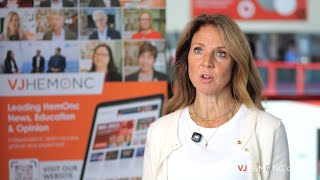
In this video, Tara Graff, DO, Mission Cancer and Blood, Des Moines, IA, discusses the need to bridge the gap between academic-center data and community settings to improve clinical practice. She highlights the importance of educating community oncologists on newer therapies, such as bispecific antibodies, and providing them with the necessary tools and support to operationalize these treatments, to ensure patients have access to effective therapies in earlier lines of treatment. This interview took place at the 67th ASH Annual Meeting and Exposition, held in Orlando, FL.
These works are owned by Magdalen Medical Publishing (MMP) and are protected by copyright laws and treaties around the world. All rights are reserved.
Transcript
These patients are in the community, right? Whether it’s CLL patients, lymphoma, follicular patients, DLBCL patients, these frontline, these treatment-naive patients are in the community. I mean, they’re there for relapsed setting too, but they come to a community center when they’re first diagnosed. And so we need to do a better job of helping educate the community oncologists and helping them operationalize these newer therapies, right? Because bispecific antibodies, you know, do I think that every community oncology group across the country should be doing bispecifics? That’s not what I’m saying...
These patients are in the community, right? Whether it’s CLL patients, lymphoma, follicular patients, DLBCL patients, these frontline, these treatment-naive patients are in the community. I mean, they’re there for relapsed setting too, but they come to a community center when they’re first diagnosed. And so we need to do a better job of helping educate the community oncologists and helping them operationalize these newer therapies, right? Because bispecific antibodies, you know, do I think that every community oncology group across the country should be doing bispecifics? That’s not what I’m saying. There’s a learning curve, right? But I think we need to do better, not just the academic centers, but sites like mine, you know, academics that are in community that can help share some of the tools and the tricks of the trade that have worked at their centers to help empower, educate, and like I said, operationalize and give them the nuts and bolts on how to do this. Because we want our patients, whether treatment-naive follicular, DLBCL, we want, as these bispecifics are, I’m speaking bispecifics, are moved, you know, earlier lines of therapy, right, from third line to now second line to, who knows what next ASH will bring in terms of talking about first line based on what trial is going on. We are going to be doing our patients a disservice if we’re not giving them the option of these therapies in earlier lines of therapy, but their treating physician has to be aware of them. And it could be that they have the smartest doctor in the world, but if their center can’t do these therapies, then they’re going to be stuck with either giving them something that maybe isn’t as efficacious or they’re going to refer them out. So we need… there’s a lot of different barriers and things that we’re going to have to work on to improve access and things like that. But that’s what we’re here for.
This transcript is AI-generated. While we strive for accuracy, please verify this copy with the video.
Read more...